Patrick Donald: A memoir

Our thanks to Garden volunteer Mike Wooller for this piece about the fascinating collection of the late Patrick Donald.

***
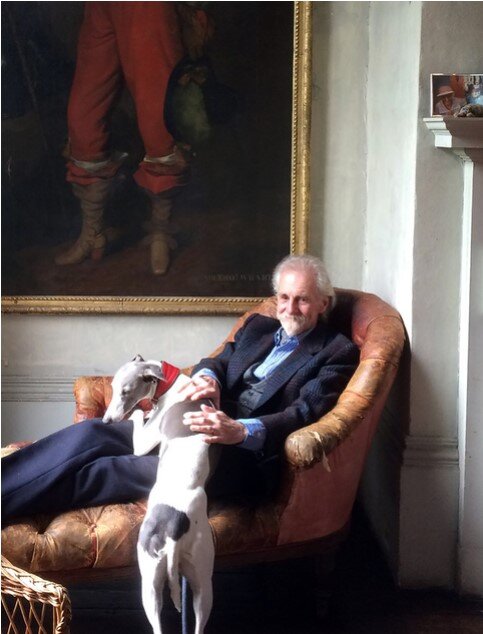
Patrick Donald at Southside House, Wimbledon Image: Richard Surman
Patrick Donald at Southside House, Wimbledon
Image: Richard Surman

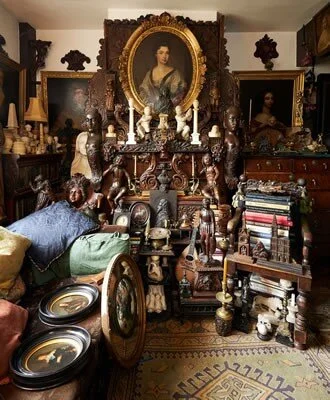
Part of Patrick Donald’s incredible collection

Part of Patrick Donald’s incredible collection

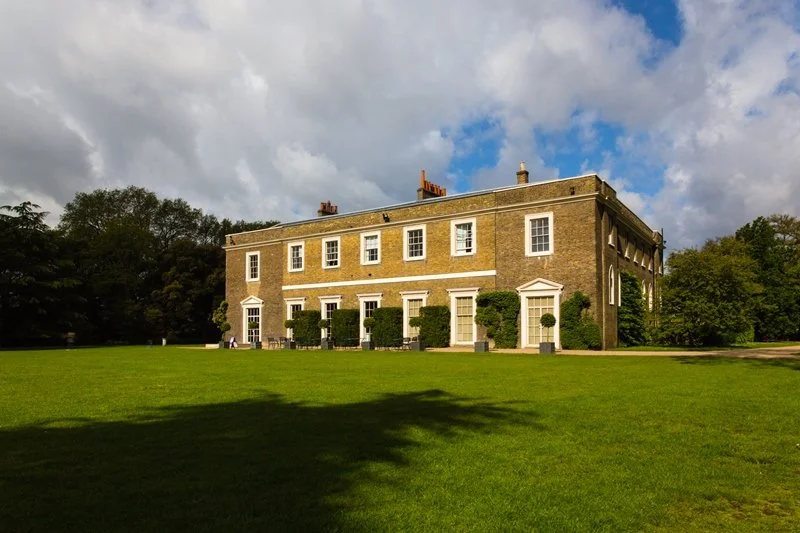
Patrick Donald was a resident of Putney, from the early 1990s (until his passing in September 2018), and his home in the Dover House Conservation Area, housed his collection of early furniture, pictures, works of art, Japanese works of art and Japanese arms and armour.

He had previously lived in Toronto, Canada, where he worked for the Canadian Broadcasting Company as a set designer, and he used these skills to create unique room settings in his Putney home to display the contents of his collection.

On returning to London, he bought a small terrace house, one of many built on a SW London estate originally intended to house returning World War I soldiers. This tiny, two up, two down house was destined to become the home of what was arguably one of the most unusual and eccentric collections in London. Pat had two rules about his possessions; the first was that only a very few trusted friends would ever be allowed in and the second was to cultivate a dilapidated air to the outside of the house, on the hunch that no-one looking at the house from the outside would ever be able to guess what the house contained. By this time Pat had acquired a significant collection of Japanese samurai armour, clothing and weaponry, far out-weighing his more general collection of antiquities and memorabilia. And as if the oriental collection was not enough, another passionate interest was about to be ignited.

Seeking to involve himself in life outside the house, Pat volunteered as a guide at Fulham Palace, where he became intrigued by the lives of the Bishops of London during the Jacobean period. Charles 1 became his great hero and Van Dyck his favourite artist. From that point his collecting took two distinct directions, the Jacobean and Oriental. At the palace he would dress in Jacobean costume, cultivated a ‘Van Dyckian' beard to complete the impression of a Jacobean gentleman. Pat became a familiar figure on the London antique scene - a diminutive, wiry fellow who walked over 100 miles a week, wrestling gigantic pieces of carved wood or stone work onto buses.

Back at home, the downstairs of the house started to fill up with portraits of Charles 1 and his contemporaries, carved busts, ornate wood panelling, candle sconces and period furniture - a deluge of acquisitions that threatened to crowd Pat out of his own home. His solution drew on his earlier years in television: he skillfully worked every single item into the most improbable but convincing stage set imaginable. Not everything was 17th century of course, but the way Pat organised the collection gave a supremely theatrical sense of being exactly of the period.

Similarly his growing collection of armour, weapons and shrines were accommodated upstairs in a small sitting room, in which one would sit, overlooked mixture of menacing helmets, fully assembled suits of armour, racks of weapons and in contrast, a range of serene Zen Buddhas, set in shrines around the wall.

When asked why he had never married - and Pat had an unerring eye for the ladies - he replied that he had his own family already - his collections. Looking at the contents he would say, 'These are my children. Why should I want any others?'.

The Patrick Donald Collection will be auctioned by The Pedestal at 11.00, Tuesday 19 November 2019.

Mike Wooller, Garden volunteer
Object of the month: painting of Thomas à Becket, and ‘Beckford’s Folly’

Every month we feature two blogs written by volunteers, one describes an object in the Palace and one a plant from the Garden. It is a great way to learn more about the Palace. If you would like to contribute there is no set format so please do send in your ideas.

This November we are grateful to tour guide and archive research volunteer Jane Bowden-Dan for researching St Thomas à Becket, and ‘Beckford’s Folly’.

***

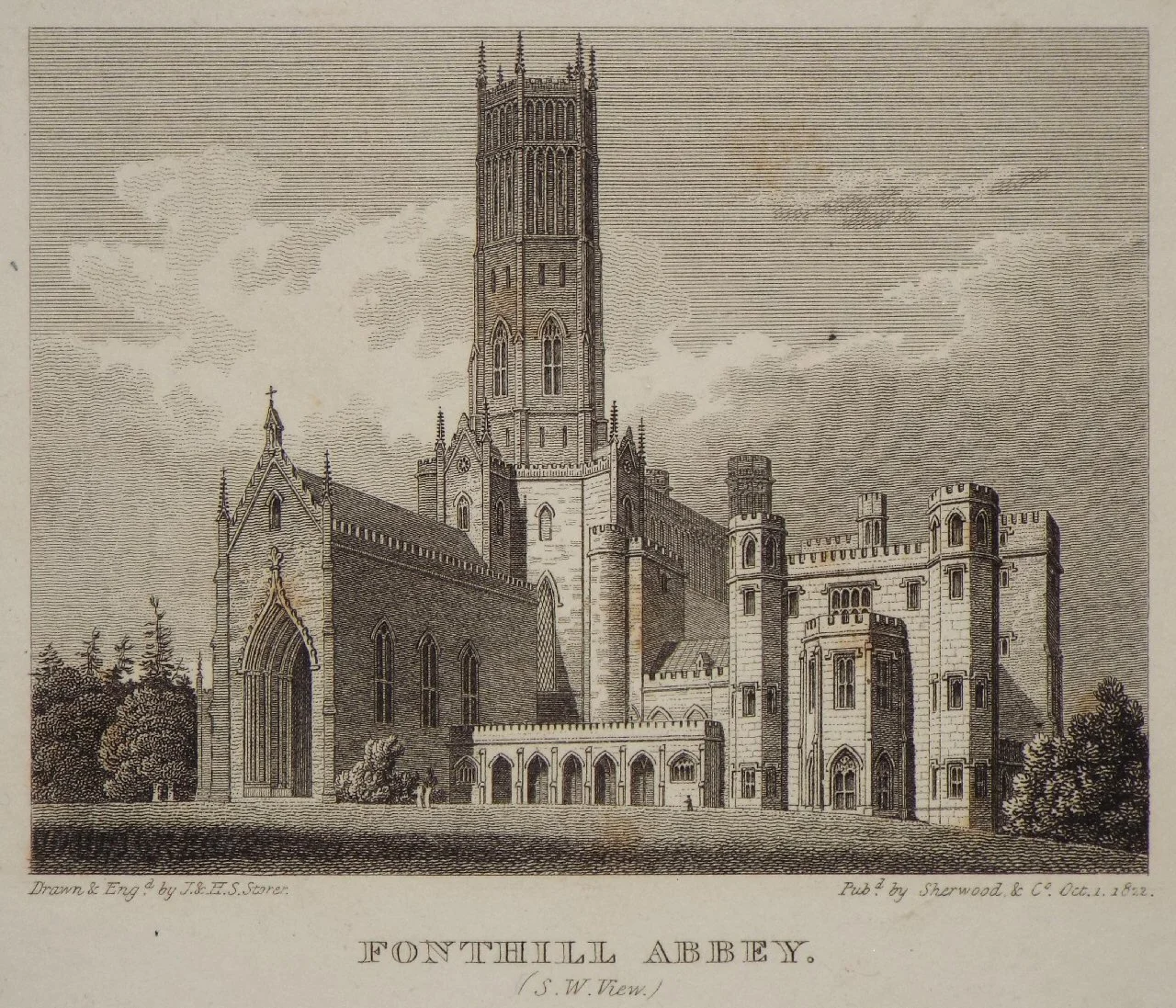
Fonthill Abbey SW.jpg

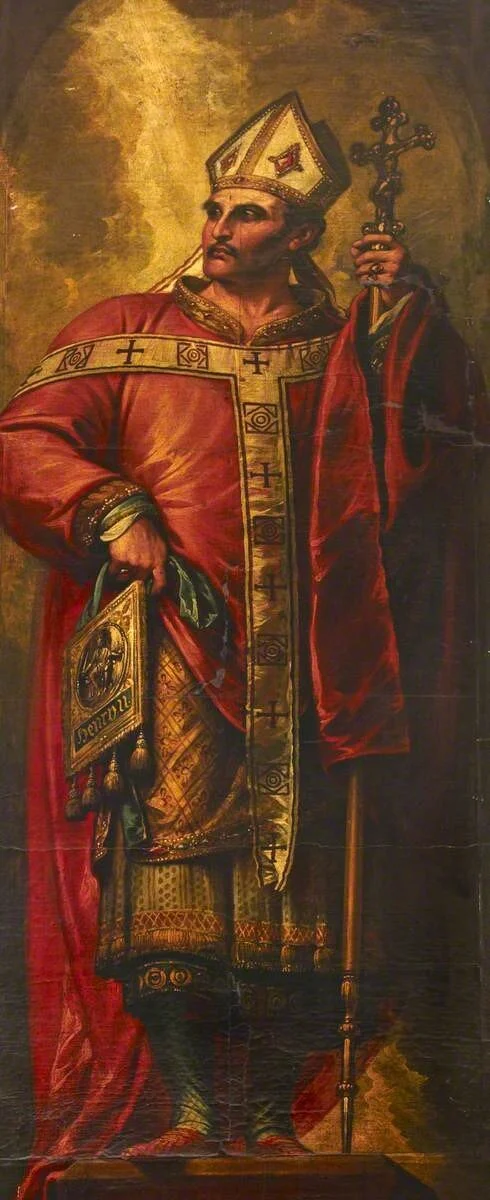
As a History Tour Guide, I have been intrigued by the two ‘cartoons’ or designs painted in oil on paper laid on canvas - in about 1798 - by the American-born artist Benjamin West (1738-1820) who became the President of the Royal Academy.  These designs were for stained-glass windows at Fonthill Abbey, Wiltshire, home of connoisseur and art collector William Beckford (1760-1844).  They have recently been moved to the west wall of the Great Hall at Fulham Palace.

The first design is of St Margaret of Scotland.  A fellow Archive Research Volunteer is studying this.

Art UK Image from Fulham Palace Art Collection LW_FPAC_CC8

Art UK Image from Fulham Palace Art Collection LW_FPAC_CC8

The second design is of St Thomas à Becket (c. 1118-1170), pictured on the left.

The text added to the Museum Tablets inside the historic rooms at the Palace, by our collections and research officer, Lisa Voden-Decker, explains that, as Archbishop of Canterbury, Becket quarrelled with King Henry II.  The King resisted papal reforms that would have weakened his control of the Church.  Murdered in Canterbury Cathedral by four knights of the Court, Becket was soon after canonized.

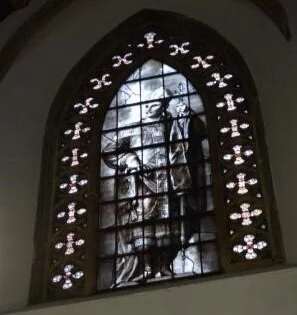
The stained-glass window of Becket, based on West’s design, was made and installed at Fonthill.  It had been commissioned by Beckford, who was a knowledgeable art collector.  However, he was also a novelist – known famously for his Gothic work, Vathek (1786) – and a profligate.  His property Fonthill Abbey was also called ‘Beckford’s Folly’.  Beckford lived there until 1822 when he lost two of his Jamaican sugar plantations in a legal action, and was forced to sell.

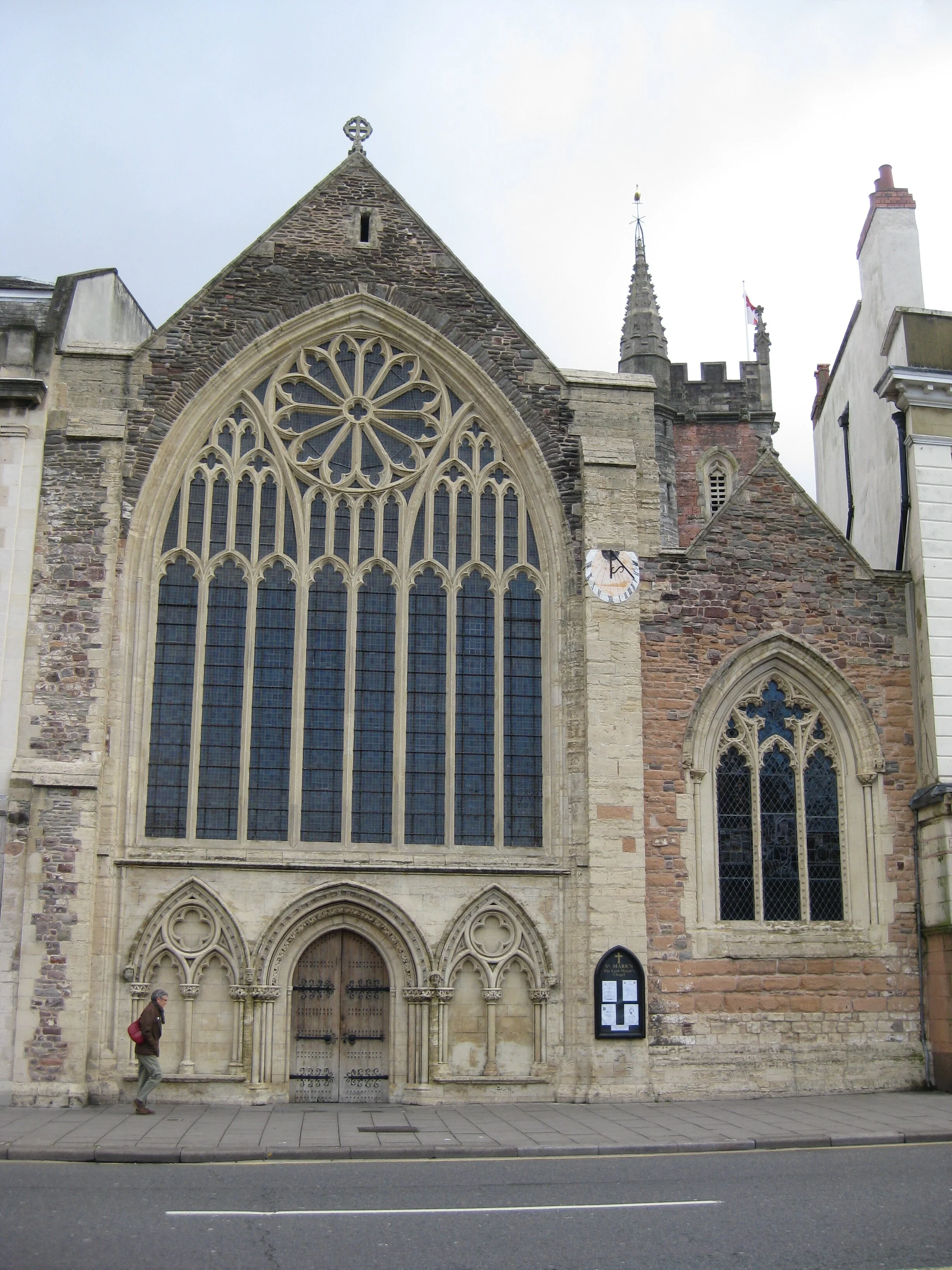
I was already aware that most of Fonthill Abbey collapsed under the weight of its poorly-constructed tower during the night of 21 December 1825.  Until recently, I had been misleading visitors to Fulham Palace by suggesting that West's completed stained-glass window of Becket was lost when much of Fonthill was destroyed!  In fact, the window has survived.  The arms dealer, John Farquhar, who bought Fonthill and its contents in the forced sale, immediately auctioned the art and furnishings in the so-called ‘Fonthill Sale of 1823’.  Apparently, the window was acquired by the Bristol Corporation and is now in the Lord Mayor’s Chapel of St. Mark on Bristol’s College Green.  Pevsner’s Buildings of England describes the stained glass there as of good quality, and tells me that the Becket window is the east one in the south aisle.

Exterior of the Lord Mayor’s Chapel, Bristol

Exterior of the Lord Mayor’s Chapel, Bristol

St Thomas a Becket Stained Glass in the Lord Mayor’s Chapel, Bristol

St Thomas a Becket Stained Glass in the Lord Mayor’s Chapel, Bristol

In mid September, I attended the British Society for the History of Medicine [BSHM] bi-annual Congress in Bristol, and tried to see inside the Lord Mayor's Chapel.  I had learnt that it is the only remaining building of the 13th century Hospital of St Mark, and became the official place of worship for the Mayor and Bristol Corporation in 1721.  But, sadly, it is "currently closed for public visits" and the building seems to be in need of some TLC.  However, I think this is a picture to the right - from Trip Adviser - of the window I sought, in vain.

Two days later, I was surprised to meet the Lord Major herself, Councillor Jos Clark, and her consort, Hugo Clark, who were guests of the BSHM at our Congress Dinner in Bristol's Sansovino Hall, Corn Street (wearing heavy gold regalia!).

Jane Bowden-Dan,

Front of house, archive research and history tour guide volunteer

Thank you to Jane for this blog. Please send your ideas for object or specimen of the month blogs to rachel.bagnall-bray@fulhampalace.org. If you would like some help, please let me know.

Specimen of the month: cucamelon

Every month we feature two blogs written by volunteers, one describes an object in the Palace and one a plant from the Garden. It is a great way to learn more about the Palace. If you would like to contribute there is no set format so please do send in your ideas.

This month we’re indebted to Jamie Atwell for his take on cucamelons!

***

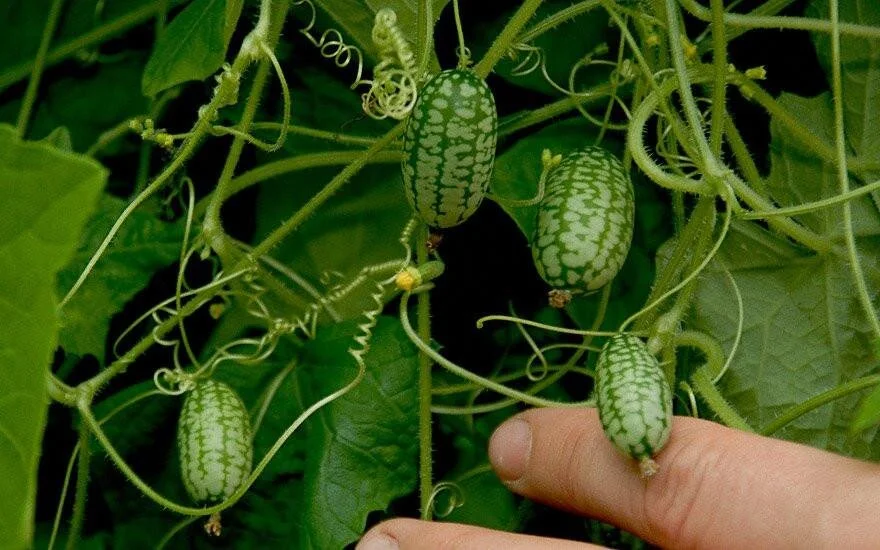
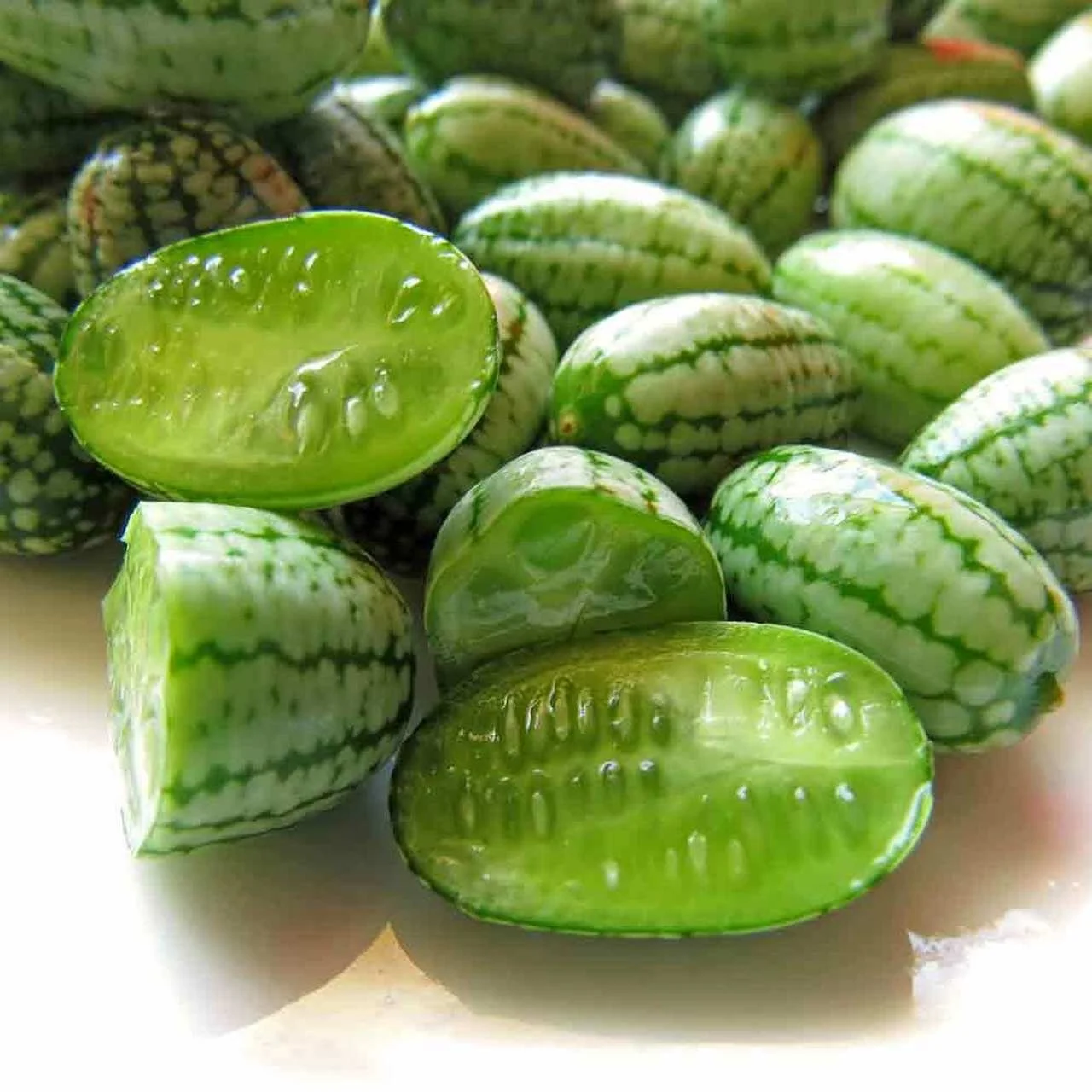
Making a regular appearance in the Vinery over last few years has been the cucamelon (Melothria scabra). It’s a type of vine which produces fruit about the size of a grape. Shaped like a melon and tasting of cucumber (with a hint of lime), no wonder it’s acquired the common name of cucamelon. Another common name, and actually my favourite, is mouse melon (better not tell Edmund). Originating from Mexico and Central America it is believed to have been domesticated there long before the arrival of Europeans.

Cucamelons are one of the many plants grown in the vinery at Fulham Palace

Cucamelons are one of the many plants grown in the vinery at Fulham Palace

They can become rather mushy when cooked (though you could add them to a stir-fry at the last minute) and are best used in salads or in a salsa. They also make a good pickle.

Drought resistant and generally pest-resistant, they are relatively easy to grow and are becoming increasingly popular in the UK. I’ve seen references to them as being one of the new ‘superfoods’.

Cucamelons sliced to open showing the cucumber-like interior and melon-like exterior

Cucamelons sliced to open showing the cucumber-like interior and melon-like exterior

Aside from its use in catering, it also works well (I can attest) in a more bibulous context. Try slicing them in half lengthways and add to a jug of Pimms or, my preference, a gin and tonic.

This year’s crop is now virtually over. However, I’m sure they will be featuring again next year (should Head Gardener so decide) and be available for sale on the Barrow – from about August onwards.

Definitely one to add to your table (or your glass !)

Jamie Atwell , garden volunteer and Head Gardener’s admin assistant

Thank you to Jamie for this blog. Please send your ideas for object or specimen of the month blogs to rachel.bagnall-bray@fulhampalace.org. If you would like some help, please let me know.

Talking Heads, Talking Portraits

Hi fellow Fulham Palace volunteers! I’m Lewis May, a third year Drama, Applied Theatre and Education student at the Royal Central School of Speech and Drama and I’m currently on placement all this term with the fantastic learning department at the palace. I haven’t met many of you yet, but I am certainly looking forward to getting to know everyone during my time on placement. 

On Monday 14 October I took part in the Talking Heads tour of the palace, following collections and research officer Lisa Voden-Decker through the historic rooms to learn more about the previous residents of Fulham Palace through their portraits. Lisa’s tour was a free, public tour, bookable through the website or through the front of house team. The tour began in the Great Hall, and then through to Bishop Sherlock’s dining room, the Porteus library and even the cafe! 

Bishop Tait’s portrait at Fulham Palace

Bishop Tait’s portrait at Fulham Palace

The tour served a triple-fold purpose as an introduction to: the history of Fulham Palace, portraiture and the lives of former Palace inhabitants whose stories are rarely heard. Obviously there are too many portraits on display for Lisa to have given us an in-depth analysis of each, but the ones she did revealed much complexity and even tragedy. The greatest example for me was the portrait of Bishop Tait (1811-1882), who was made Bishop of London in 1856, the same year he lost five of his children to scarlet fever. Tait’s portrait hangs in Bishop Sherlock’s dining room and Lisa drew the attention of the tour-goers to the intricacy of the art. Firstly, the way the light hits Tait in a particularly striking way that makes his image seem more intensely dramatic than many others in the Palace collection, and secondly, the psychological details painted minutely into the eyes of the sitter that perhaps indicate the tragedy in his personal life. 

As well as the history implicit in the art, Lisa used the image of Bishop Tait to illustrate (I had to make an art pun somewhere…) the flaws of the current collection. The case in point being that despite the eminence of Catherine Tait and her importance to Fulham Palace as the organiser of the first of the annual garden parties, there are currently no paintings of her or painting including her in the collection. The same is true of many other women involved in the palace’s history, such as the suffragist Louise Creighton.  

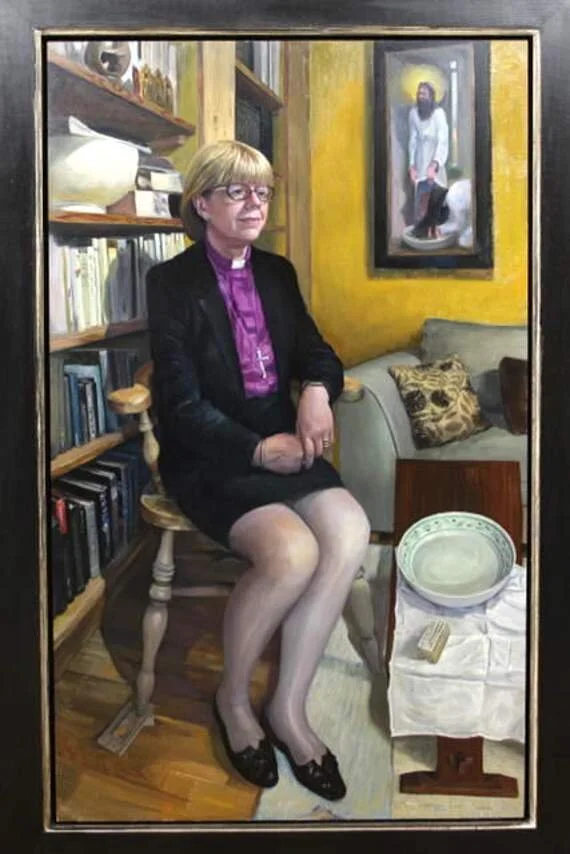
Dame Sarah Mullally’s portrait in the Palace cafe

Dame Sarah Mullally’s portrait in the Palace cafe

A cheerier but no less engaging work of art, which really captured the interest of the tour group, was the portrait of Dame Sarah Mullally who is the current Bishop of London and first female to hold the post. Mullally’s likeness hangs above the sofa in the cafe (by the fridge) and is highly symbolic. She had insisted, for example, on the inclusion of a reference to Christ washing feet to symbolise her belief that the position of bishop is one of service. The portrait sparked lively conversation about what other elements might refer to within the context of Mullally’s life and faith as well as the details given to us by Lisa.  

All in all, the fascinating tour deeply engaged me; educated me; and inspired me to learn much more about Fulham Palace and art. Turns out it’s not all the same as it ever was (a tour titled Talking Heads can’t go without a David Byrne reference. Sorry.). 

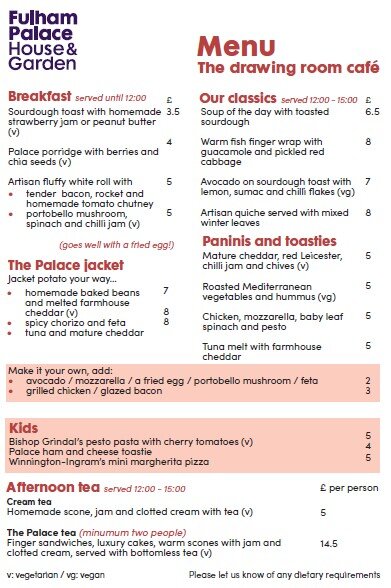
New cafe menu launched

Please pop into the drawing room cafe at the Palace and make use of your 10% discount to sample the new menu which has been launched this week:

New drawing room cafe menu.jpg

You just need your badge to be eligible for the 10% discount, and this can be used at any time, whether it's a volunteering day or not.

You also get 10% discount in the shop so please come armed with your Christmas shopping list on your next volunteering day.

Best wishes, Rachel

Our day at Painshill Park

Our thanks to Paul Russell, Saturday garden volunteer, for this wonderful blog about the volunteers’ coach trip to Painshill Park on Saturday 12 October 2019. Read on for a taster of our day together…

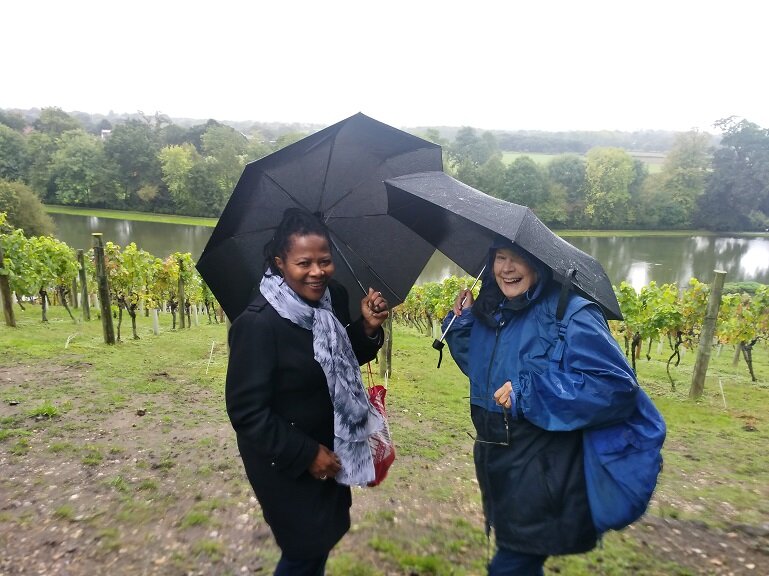
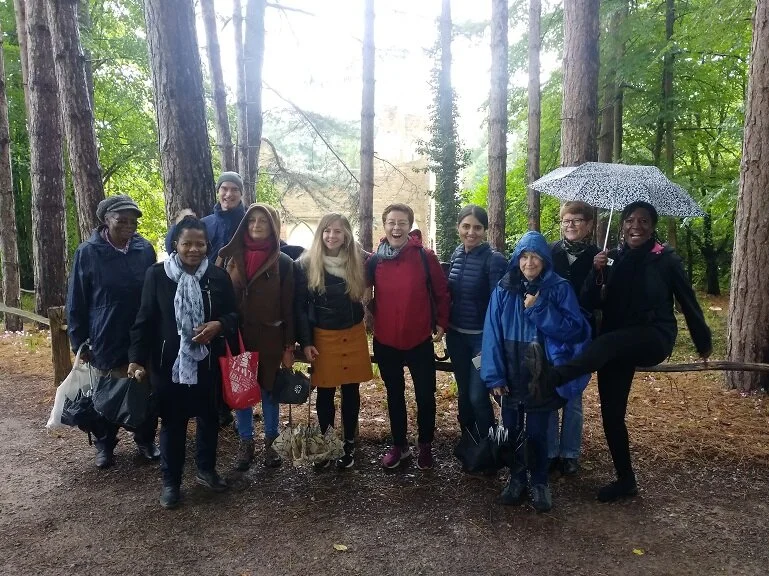
Well it was wet. There’s no denying it, the rain was dripping from trees, umbrellas and noses, but somehow, all the faces still had smiles on them.

Two Yvonnes together in the vineyard

Two Yvonnes together in the vineyard

Honourable Charles Hamilton, 1704 - 1786, original owner of Painshill Park

Honourable Charles Hamilton, 1704 - 1786, original owner of Painshill Park

The journey to Painshill was very quick and we were ushered in through security gates, like celebrities in disguise, in no time at all. After a refreshing cup of coffee and a quick introduction by the staff we set off on our adventure around the 160 acre garden.

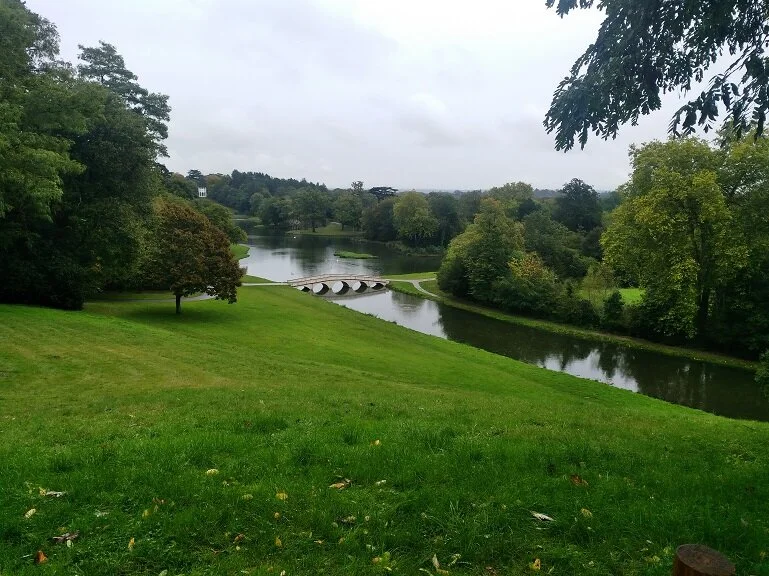
The garden was started by a certain Honourable Charles Hamilton who, while not being rich (relatively speaking), had a great interest in plants. A contemporary of Capability Brown, he was described as the amateur version of Capability, so lots of people went to the Hon Mr Hamilton for ideas (I suppose he was cheaper!). Consequently, the gardens themselves have recognisable hints of Capability Brown, including magnificent Cedrus libani (cedar of Lebanon - those magnificent evergreen pines that stretch up into the sky and look like giant green clouds with flat tops) hidden vistas and vanishing points as well as a huge 14 acre lake.

Iconic Painshill view from the Turkish Tent taking in the Arch Bridge and Gothic Temple in the distance

Iconic Painshill view from the Turkish Tent taking in the Arch Bridge and Gothic Temple in the distance

Our tour group in front of the ‘ruined Abbey’

Our tour group in front of the ‘ruined Abbey’

Originally the garden would not have had many flowering plants (there weren’t actually all that many available in England when the garden was created - 1738 to 1773) but Mr Hamilton was creative with the types of trees and shrubs that he planted in the garden, including quite a few from the New World - North America. They provide seasonal interest in different colours, used in clever ways.

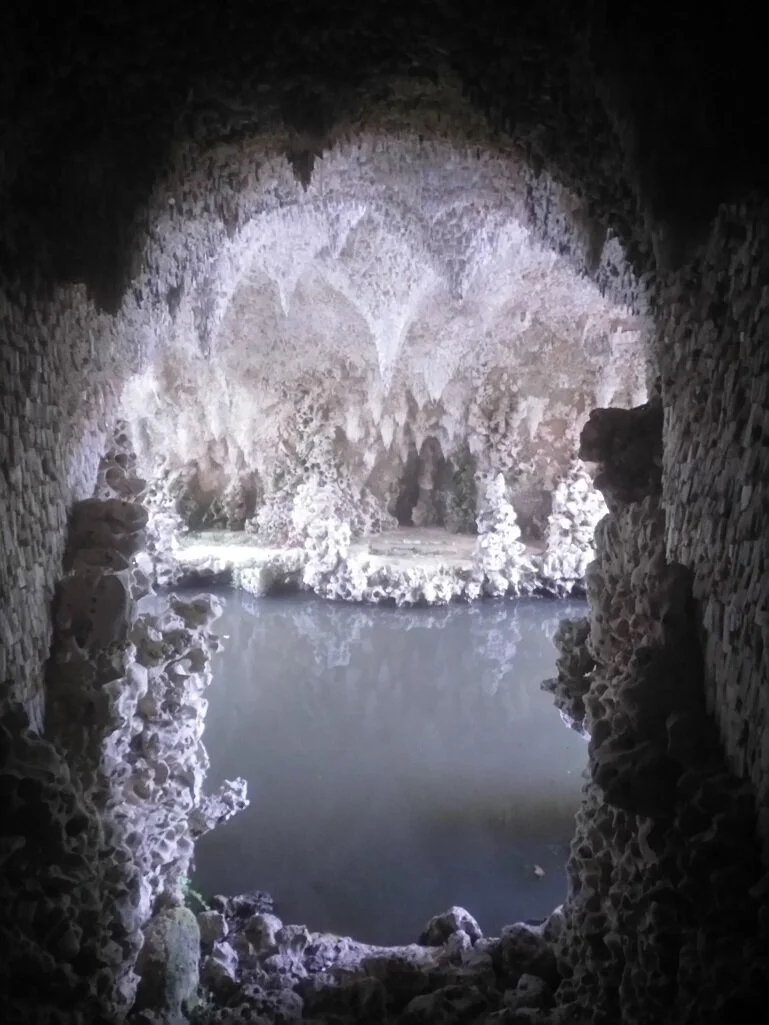
Peering out of the Crystal Grotto

Peering out of the Crystal Grotto

There is a vineyard (although none of the original plants survived, it has been reinstated in much the same place) producing several tonnes of grapes each year that are used to make sparkling roses and whites. Key points of interest are the artistic views over the North Downs, the two bridges and Turkish tent, but the main attraction is the fantastical, cave-like crystal grotto. Most of it was destroyed over the years and then rebuilt, eventually in 2012, with every piece of crystal being set by hand - extraordinary stalactites and stalagmites. I liked the ruined Abbey (neither an Abbey nor a ruin as it turns out!).

After our walk around the main area of the garden, with the interesting observations of our Painshill volunteer guides, Chris and Moyra, we then strolled through the segmented walled garden, which even despite the heavy rain inflicted on it, remained quite enchanting and with some beautiful vegetables still growing (the multi-coloured chard looking particularly lovely in the muted light).

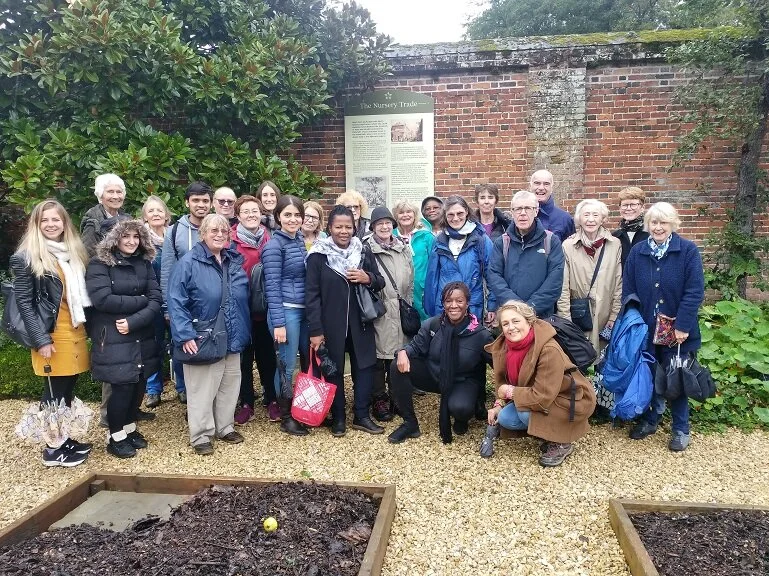
Painshill Park Explorers: Fulham Palace Volunteers, 12 October 2019

Painshill Park Explorers: Fulham Palace Volunteers, 12 October 2019

We returned to Fulham Palace inspired by a wonderful garden and having renewed our friendships with other Fulham Palace volunteers who we don’t always get to mix with so often.

 Paul Russell, Saturday garden volunteer, 15.10.19

Specimen of the month: A cut above

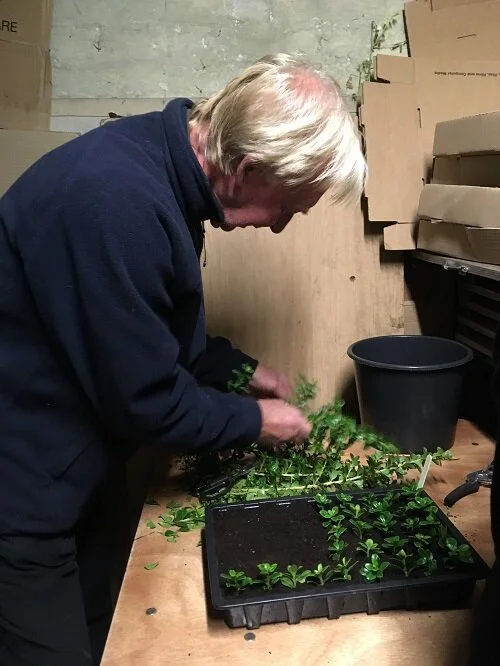
George with the new cuttings

George with the new cuttings

Every month we feature two blogs written by volunteers, one describes an object in the Palace and one a plant from the Garden. It is a great way to learn more about the Palace. If you would like to contribute there is no set format so please do send in your ideas.

This October we hear from George Chamier, garden volunteer, who participated in the first of a new series of monthly training sessions for garden volunteers. Head gardener, Lucy Hart, led this month’s session on ‘Taking Cuttings’ and the following sessions will each be held on different days of the week to ensure all garden volunteers can participate.

***

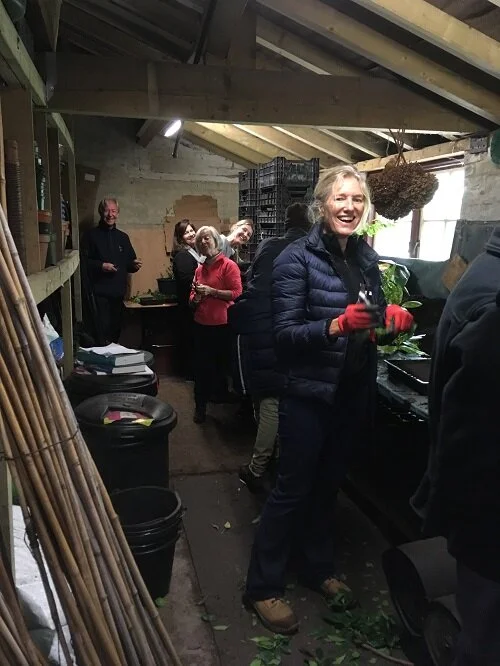
On Thursday, 10 October, a sunny, cool day, perfect for the job, ten garden volunteers gathered for a training session on taking cuttings.

We started in the potting shed, where Lucy Hart, our head gardener and guru, took us through some of the theory, interspersed with anecdotes from her own training and early work experience, including being told off when she did things wrong – ‘Hart! Those cuttings are not in a straight line in the tray. Start again! And don’t just pull them out and put them back in again – refill the tray first. And never pick a cutting up from the floor and use it.’ All useful advice for us, too.

 Lucy explained that now, late summer and autumn, is the time to take semi-ripe cuttings – in other words, the current season’s growth, but not soft material (winter is for hardwood cuttings, spring for soft). She then showed us, as an example, a tray of Penstemon sp. cuttings taken on 29 September, some of which had already rooted, and used some sage to show us the technique and take us through the crucial rules for cuttings:

·         Keep material for cuttings in a moistened bag, because as soon as it is cut, it is in effect starting to die

·         Cuttings should be 5–15cm long depending on the species and condition of material.

·         Cut straight across just below a leaf node, using secateurs or a sharp knife

·         Do not use any dead or diseased material

·         Discard anything that falls on the floor

·         Remove extra leaves from the stem, and if the cutting has large leaves, trim them

·         Use a fine grade compost

·         Push cutting into compost (in straight lines in the tray!)

Garden volunteers learning about taking cuttings

Garden volunteers learning about taking cuttings

We were then reminded about how to fill trays with compost (overfill, scrape off, tamp down) and about proper potting shed procedure: write (must be in pencil) plant and species name on one side of the label, name of gardener and date on the other, enter the details in the propagation book, place the trays on the heated mat in the greenhouse and water daily. Lucy explained that the compost we were using was a proprietary brand, but that we will soon be making our own, with loam from the piles of turves near the compost bays, and some of our excellent leaf mould.

Lucy then led us out into the grounds to collect material. We cut strawberry tree Arbutus unedo from the tree just outside the Tudor gateway and myrtle Myrtus communis from the front of the Palace, then moved to the shrub border adjacent to the nursery and cut Abelia grandiflora, Aucuba japonica ‘Variegata’, Escallonia sp, Fuchsia magellanica and Griselinia littoralis. We brought it all back to the potting shed, and now it was time to put our lessons into practice. With a bit of extra advice from Lucy and her patient answers to our questions, we each managed to fill a tray with cuttings and set them in the greenhouse.

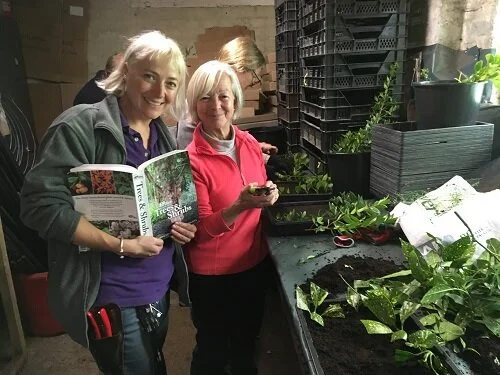
Head gardener Lucy with garden volunteer Isabel

Head gardener Lucy with garden volunteer Isabel

Now it’s just a question of watering and waiting, and if all goes well, there will be lots of plants to grow on for sale on the barrow, or to fill spaces in our borders.

George Chamier, Garden volunteer

Thank you to George for this blog. Please send your ideas for object or specimen of the month blogs to rachel.bagnall-bray@fulhampalace.org. If you would like some help, please let me know.

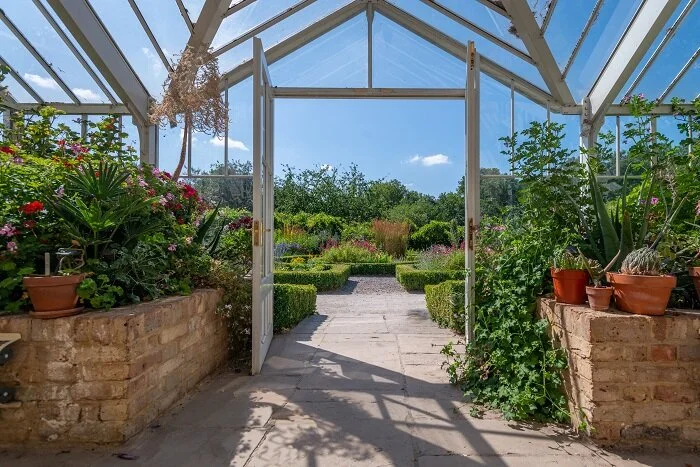
Fulham Palace vinery, where the training took place!

Fulham Palace vinery, where the training took place!