
Our thanks to Garden volunteer Mike Wooller for this piece about the fascinating collection of the late Patrick Donald.
***
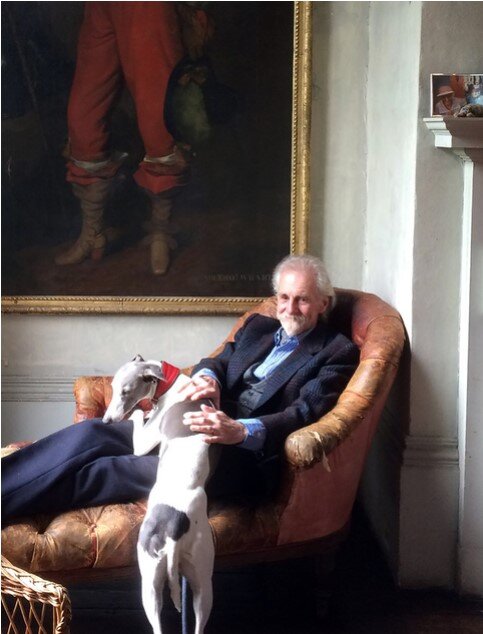
Patrick Donald at Southside House, Wimbledon
Image: Richard Surman
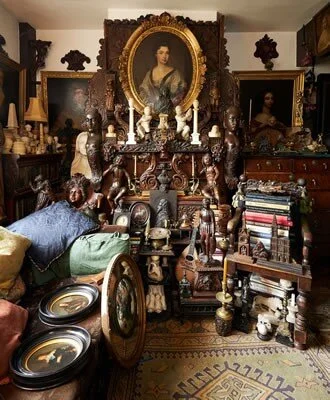
Part of Patrick Donald’s incredible collection
Patrick Donald was a resident of Putney, from the early 1990s (until his passing in September 2018), and his home in the Dover House Conservation Area, housed his collection of early furniture, pictures, works of art, Japanese works of art and Japanese arms and armour.
He had previously lived in Toronto, Canada, where he worked for the Canadian Broadcasting Company as a set designer, and he used these skills to create unique room settings in his Putney home to display the contents of his collection.
On returning to London, he bought a small terrace house, one of many built on a SW London estate originally intended to house returning World War I soldiers. This tiny, two up, two down house was destined to become the home of what was arguably one of the most unusual and eccentric collections in London. Pat had two rules about his possessions; the first was that only a very few trusted friends would ever be allowed in and the second was to cultivate a dilapidated air to the outside of the house, on the hunch that no-one looking at the house from the outside would ever be able to guess what the house contained. By this time Pat had acquired a significant collection of Japanese samurai armour, clothing and weaponry, far out-weighing his more general collection of antiquities and memorabilia. And as if the oriental collection was not enough, another passionate interest was about to be ignited.
Seeking to involve himself in life outside the house, Pat volunteered as a guide at Fulham Palace, where he became intrigued by the lives of the Bishops of London during the Jacobean period. Charles 1 became his great hero and Van Dyck his favourite artist. From that point his collecting took two distinct directions, the Jacobean and Oriental. At the palace he would dress in Jacobean costume, cultivated a ‘Van Dyckian' beard to complete the impression of a Jacobean gentleman. Pat became a familiar figure on the London antique scene - a diminutive, wiry fellow who walked over 100 miles a week, wrestling gigantic pieces of carved wood or stone work onto buses.
Back at home, the downstairs of the house started to fill up with portraits of Charles 1 and his contemporaries, carved busts, ornate wood panelling, candle sconces and period furniture - a deluge of acquisitions that threatened to crowd Pat out of his own home. His solution drew on his earlier years in television: he skillfully worked every single item into the most improbable but convincing stage set imaginable. Not everything was 17th century of course, but the way Pat organised the collection gave a supremely theatrical sense of being exactly of the period.
Similarly his growing collection of armour, weapons and shrines were accommodated upstairs in a small sitting room, in which one would sit, overlooked mixture of menacing helmets, fully assembled suits of armour, racks of weapons and in contrast, a range of serene Zen Buddhas, set in shrines around the wall.
When asked why he had never married - and Pat had an unerring eye for the ladies - he replied that he had his own family already - his collections. Looking at the contents he would say, 'These are my children. Why should I want any others?'.
The Patrick Donald Collection will be auctioned by The Pedestal at 11.00, Tuesday 19 November 2019.
Mike Wooller, Garden volunteer