
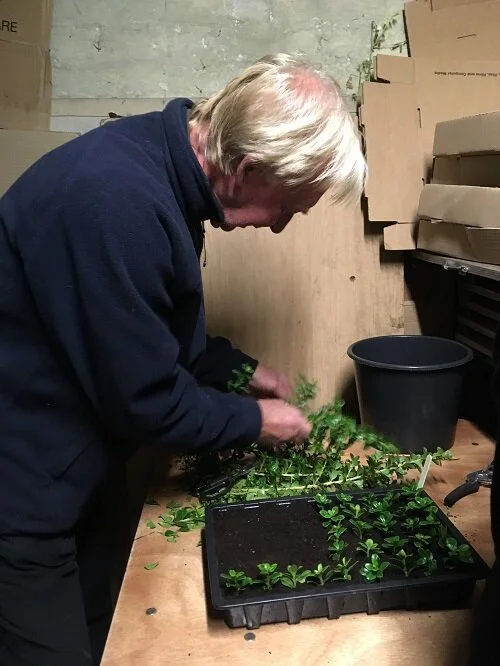
George with the new cuttings
Every month we feature two blogs written by volunteers, one describes an object in the Palace and one a plant from the Garden. It is a great way to learn more about the Palace. If you would like to contribute there is no set format so please do send in your ideas.
This October we hear from George Chamier, garden volunteer, who participated in the first of a new series of monthly training sessions for garden volunteers. Head gardener, Lucy Hart, led this month’s session on ‘Taking Cuttings’ and the following sessions will each be held on different days of the week to ensure all garden volunteers can participate.
***
On Thursday, 10 October, a sunny, cool day, perfect for the job, ten garden volunteers gathered for a training session on taking cuttings.
We started in the potting shed, where Lucy Hart, our head gardener and guru, took us through some of the theory, interspersed with anecdotes from her own training and early work experience, including being told off when she did things wrong – ‘Hart! Those cuttings are not in a straight line in the tray. Start again! And don’t just pull them out and put them back in again – refill the tray first. And never pick a cutting up from the floor and use it.’ All useful advice for us, too.
Lucy explained that now, late summer and autumn, is the time to take semi-ripe cuttings – in other words, the current season’s growth, but not soft material (winter is for hardwood cuttings, spring for soft). She then showed us, as an example, a tray of Penstemon sp. cuttings taken on 29 September, some of which had already rooted, and used some sage to show us the technique and take us through the crucial rules for cuttings:
· Keep material for cuttings in a moistened bag, because as soon as it is cut, it is in effect starting to die
· Cuttings should be 5–15cm long depending on the species and condition of material.
· Cut straight across just below a leaf node, using secateurs or a sharp knife
· Do not use any dead or diseased material
· Discard anything that falls on the floor
· Remove extra leaves from the stem, and if the cutting has large leaves, trim them
· Use a fine grade compost
· Push cutting into compost (in straight lines in the tray!)
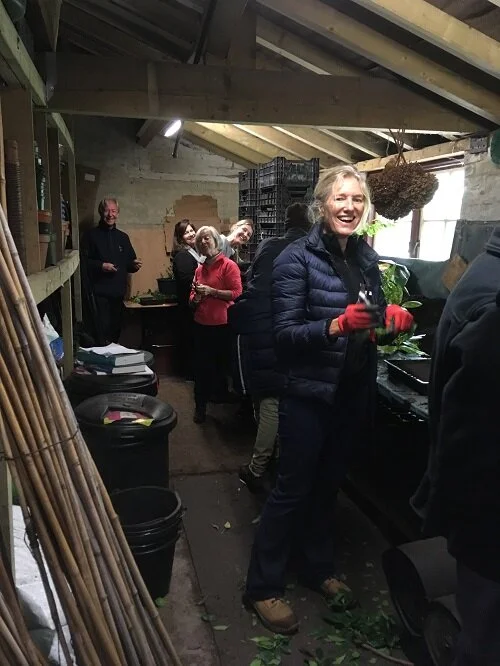
Garden volunteers learning about taking cuttings
We were then reminded about how to fill trays with compost (overfill, scrape off, tamp down) and about proper potting shed procedure: write (must be in pencil) plant and species name on one side of the label, name of gardener and date on the other, enter the details in the propagation book, place the trays on the heated mat in the greenhouse and water daily. Lucy explained that the compost we were using was a proprietary brand, but that we will soon be making our own, with loam from the piles of turves near the compost bays, and some of our excellent leaf mould.
Lucy then led us out into the grounds to collect material. We cut strawberry tree Arbutus unedo from the tree just outside the Tudor gateway and myrtle Myrtus communis from the front of the Palace, then moved to the shrub border adjacent to the nursery and cut Abelia grandiflora, Aucuba japonica ‘Variegata’, Escallonia sp, Fuchsia magellanica and Griselinia littoralis. We brought it all back to the potting shed, and now it was time to put our lessons into practice. With a bit of extra advice from Lucy and her patient answers to our questions, we each managed to fill a tray with cuttings and set them in the greenhouse.
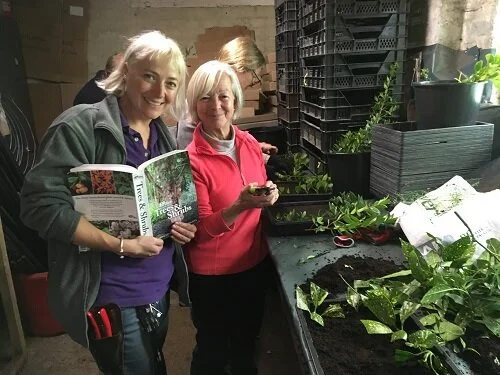
Head gardener Lucy with garden volunteer Isabel
Now it’s just a question of watering and waiting, and if all goes well, there will be lots of plants to grow on for sale on the barrow, or to fill spaces in our borders.
George Chamier, Garden volunteer
Thank you to George for this blog. Please send your ideas for object or specimen of the month blogs to rachel.bagnall-bray@fulhampalace.org. If you would like some help, please let me know.
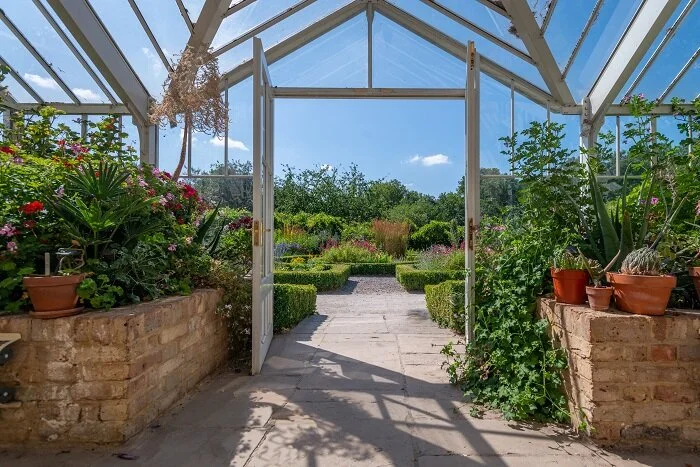
Fulham Palace vinery, where the training took place!