The Steyning Screen

Volunteer Susan Richards discovered how a decorative Tudor oak panel in West Sussex is connected to Fulham Palace and the Bishops.

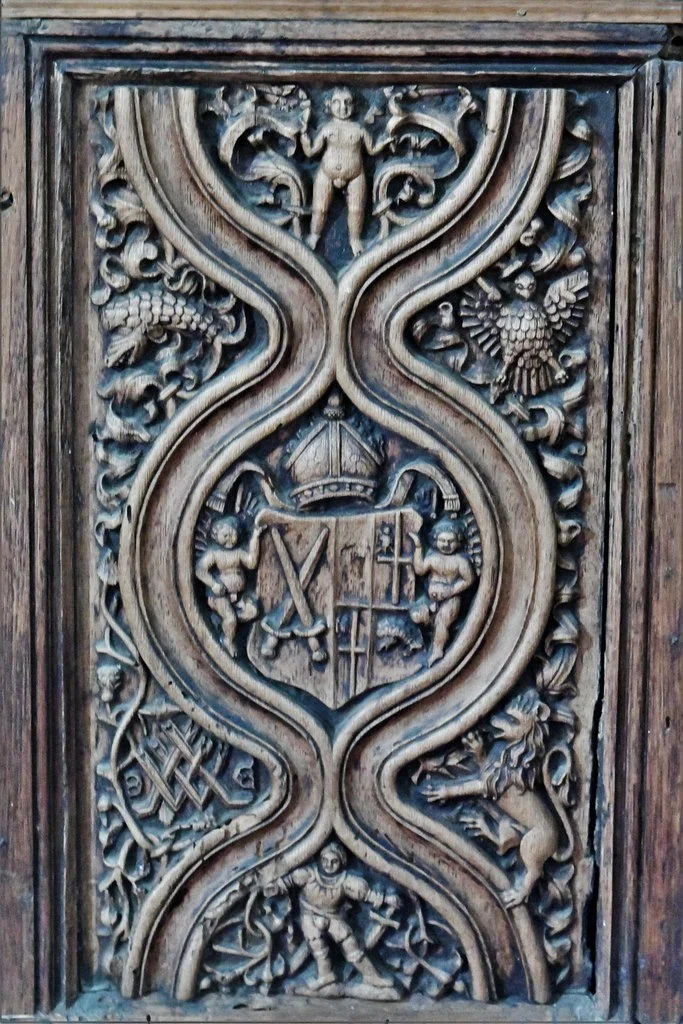
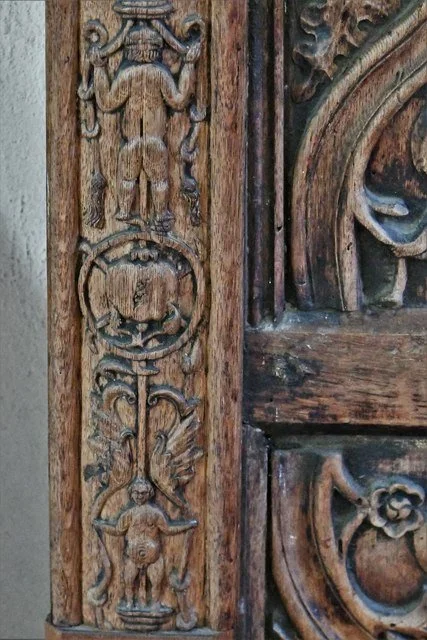
The Steyning Screen is an amazing oak screen made up of decorated panels which I saw very recently in Steyning Parish Church in West Sussex.

It may have been commissioned by or for Bishop Richard FitzJames for display at Fulham Palace to celebrate the marriage of Henry VIII and Catherine of Aragon in 1509. Given that it was not finished until 1522, the same year Bishop FitzJames died, it also could have been created as a memorial to him.  

After 1522, when Henry was beginning proceedings to divorce Catherine, the screen would have become somewhat of an embarrassment and may have been moved out of sight. It came to Steyning seemingly via the granddaughter of Bishop Juxon’s brother who married the Rector of Steyning Parish Church.

The panels forming the screen display Henry’s Tudor Rose and Catherine’s Pomegranate symbol. There are also grapes and roses intertwined on a trellis symbolising the marriage. The arms of the Bishop of London are also displayed together with Bishop FitzJames’s own family arms, including wavy crosses, dolphins, and spread eagles.

The panels have suffered quite a bit during their journey from London to Sussex having been cut to fit different spaces and some parts have been discarded altogether. In 1983 the screen found its final home as the reredos behind the high altar in the Parish Church.   

I couldn’t find any more information other than a link on the church website to the research carried out by Steyning Museum.

See: https://steyningparishchurch.org/tudor-panels/.

This includes interesting mentions of Bishop FitzJames’s support of Catherine, Bishop Juxon hiding from Cromwell’s men disguised as a bricklayer, and the Rector at Steyning being a Jacobite secret agent! I do hope that it’s all true!

The arms of Richard FitzJames, Bishop of London (1506-1522).

The Steyning screen was carved in 1522.

‘The moral uplifting of the citizens’ : Bishop Winnington-Ingram and the Public Morality Council (part one)

 Anne Connaughton, front of house volunteer, has completed some very impressive research for this fascinating and fruity historical post on Bishop Winnington-Ingram and the Public Morality Council.

The London Council for the Promotion of Public Morality (PMC) was founded in 1899 to campaign against ‘the torrent of vice which floods our streets.’ The Bishop of London, by virtue of his office, became President of the organisation. Like other office holders, Bishop Winnington-Ingram’s (WI) presidency coincided with his tenure as Bishop of London. The Council and the Executive of the PMC consisted of representatives of the church and political establishments, and others from among the great and the good. Although early records are lost, the London Metropolitan Archive holds a range of sources, including Annual Reports of the PMC; Patrol Workers’ Reports; and a later sermon preached by WI.

During the Borough elections in 1901, the PMC lobbied candidates running for office ‘to press on the Police authorities the need for acting resolutely and energetically for the prevention of open soliciting to vice on the streets, from both men and women and using the powers they possess for the prosecution of those who live on immoral earnings of women.’

The PMC grapples ‘with the horrors of procuration, the offensive indecency of the streets and the existence of houses of ill-fame.....to redeem London from the reproach of being an open market for body and soul’ as it seeks to influence public opinion by ‘disseminating trustworthy information.’ A petition was circulated, claiming that ‘the moral condition of certain streets within the City of Westminster.....is seriously injurious to public morality.......with many of our young men, fresh from school or college, and many of our innocent girls....find themselves assaulted by temptations and solicitations to vice, insulted by those who live an openly vicious life.’ This ‘open exhibition of vice renders many of our streets late in the day unsuitable for free use by respectable persons of all ages.’ Its Watch Committee recommended immediate action ‘to clear the streets of prostitutes, and for the prevention of solicitation...more vigorous exercise of the powers already possessed by the Police.’

It was expected that borough councils would ‘uphold and work towards the moral uplifting of the citizens, and guard against the rising generation from being ensnared by vicious people in the public streets.’ PMC activists claimed that ‘a large majority of street women and those who keep disorderly houses are foreigners’, and were affronted by how such places masqueraded as ‘quasi medical establishments.’ Not surprisingly, they welcomed the establishment of the Royal Commission of Alien Immigration and the subsequent Aliens Act 1905. At around this time, the PMC highlighted the licensing trade, including whether legislation should be sought to prevent young women working as bar maids.

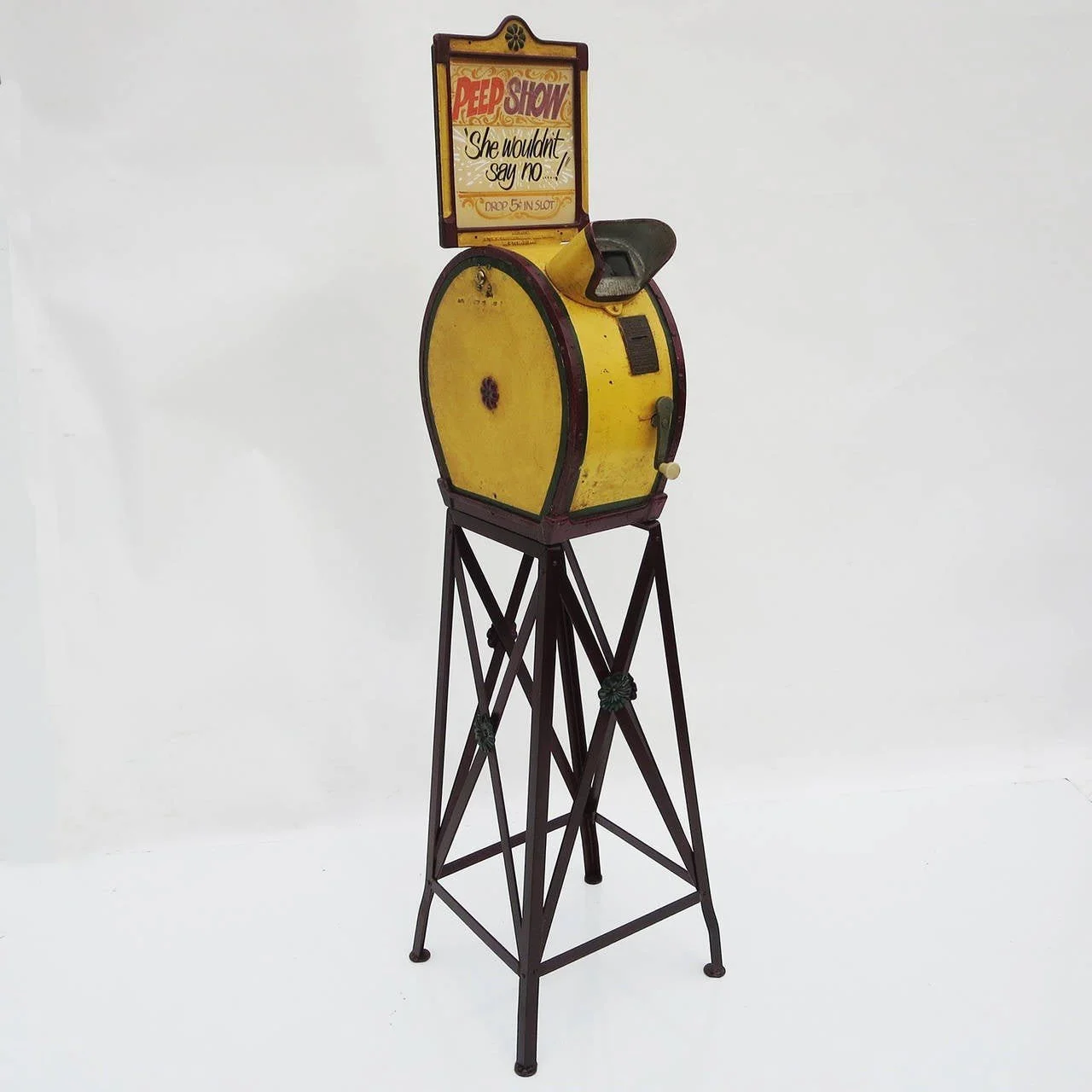
Members campaigned against ‘the sale of noxious literature’, in the hope that the London County Council would pass a by-law ‘to improve the procedure for the suppression of evil.’ Given that “the evils of noxious literature have grown to such an extent ‘the Headmasters’ Conference lobbies Borough and County authorities in ‘suppressing the publication of such poisonous literature.’ The PMC’s earlier preoccupation with unsuitable literature focused on a cheap illustrated Mutoscope, an early form of cine photography, and a popular medium for erotic entertainment, which became associated with a controversial divorce case in late-Victorian London.  In 1902, the PMC alleges that ‘descriptions of abominable scenes in these machines’ were sent to MPs. Moreover, ‘shameful traps were being laid to destroy the purity of the rising generation.’ The PMC complained that publications of ‘a most disgraceful character’ were available for sale in thousands of newsagents. The prevalence of ‘lewd, illustrated postcards.......in hundreds of shop windows’ constituted ‘a direct incentive to vice.’ Once again, The Headmasters’ Conference intervened by appealing to Council and Borough authorities to help ‘stem the torrent of pernicious literature’ and use the law to punish publishers and traders ‘who flourished upon this vile traffic.’

The PMC wanted censorship in public entertainment to be ‘as far as possible free from any political influence or control.’ In a sermon delivered towards the end of his tenure, Bishop Winnington-Ingram saw the cinema as ‘a real asset to the life of the nation...it can be a very dangerous thing indeed.’ Working in conjunction with censors would ensure that plays and films seen by young people ‘are good ones and ones that will not do them any harm.’ The public, he argued, ‘don’t really want the sex plays.’ The theatre should be ‘a clean, improving, amusing place to go.’ Nudity on the stage was ‘dishonouring to the girl and extremely bad for the decadent young men who find pleasure in it.’ Open spaces were intended for recreation and ‘not to be open air brothels.’ Winnington-Ingram proudly championed the PMC’s role in closing down hundreds of brothels during his tenure, and in making open spaces as safe as they were. He saw London as the heart of the Empire, ‘a happy place, (with) a clean theatre, cinemas that will amuse them, open spaces where they can go without temptation, books - periodicals.....which will be good for their minds.’ The sermon gave him another opportunity to counsel against the unhealthy influence of ‘filthy books...filthy periodicals.’

Under Winnington-Ingram’s aegis, other areas of public life, such as the influence of drink shops; inequalities of the gambling laws as between rich and poor; the inequality of the law relating to solicitation as between men and women, and the falling birth rate would fall under the scrutiny of the PMC’S patrol work.


The referenced material in Part 1 comes from the following sources:

The London Council for The Promotion of Public Morality  : Report(s) and Statement(s) of Accounts for 12 Months Ending 28 February, 1901; 28 February, 1902; 28 February, 1903; 28 February, 1904 and 10 Months Ending 31 December, 1905 (London Metropolitan Archive)

A Report on Cinema Films Presented by the Special Films Sub-Committee to the Public Morality Council at a Meeting on 29th October, 1938 (London Metropolitan Archive)

Statement of Work and Programme of the Council as approved at its meeting on 31 January, 1938 (London Metropolitan Archive)

The Mutoscope- an early motion picture device allowing one person to view at a time.

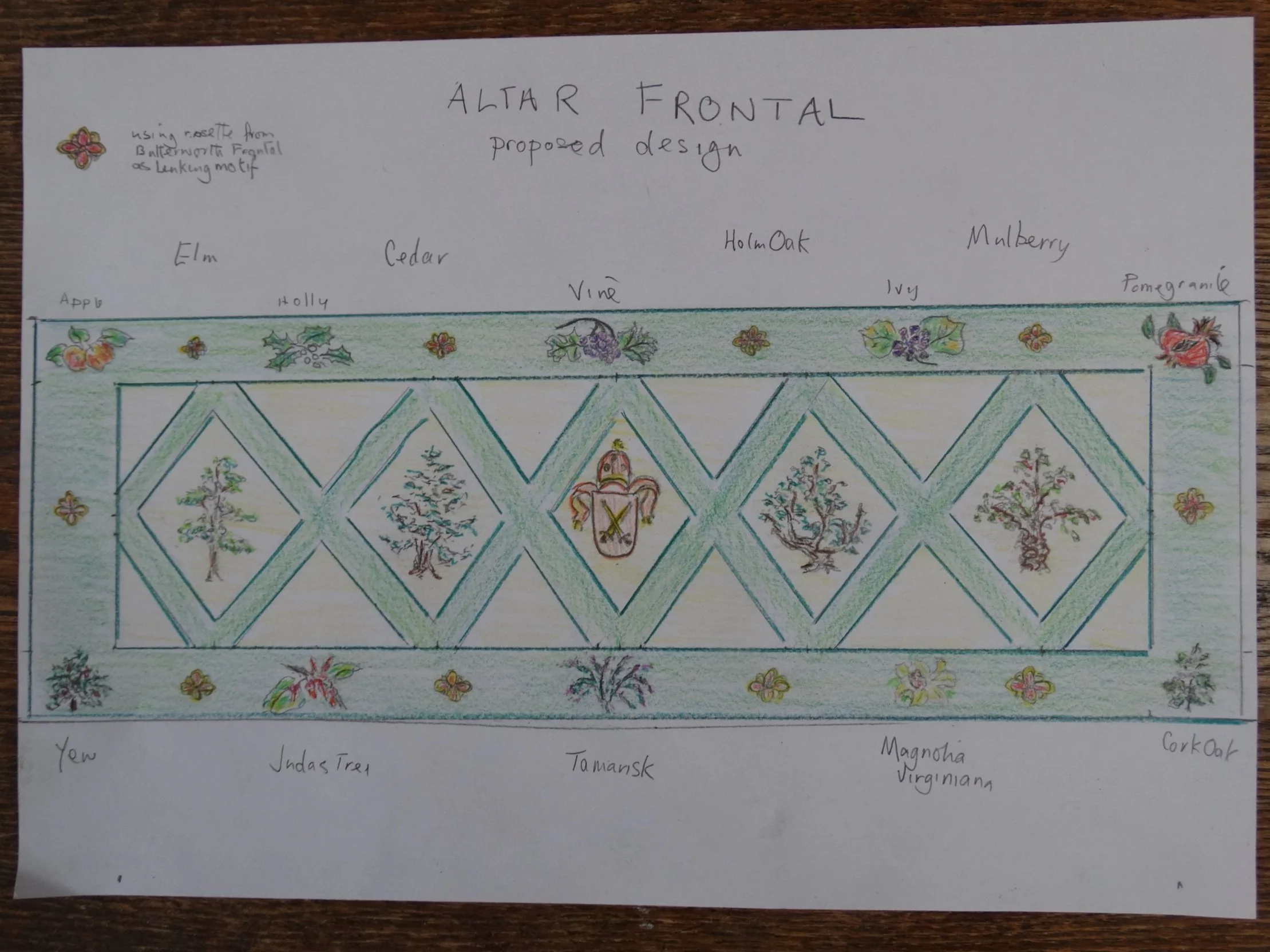
Altar frontal: a work in progress

We’re grateful for this latest blog submission from Esther Dean, long time Fulham Palace volunteer and valued member of the sewing bee! In this blog post, Esther discusses the sewing bees work on creating a new alter frontal for our chapel.

Many moons ago - in what seems like a different age - before our lives were turned upside down by the pandemic lockdowns, the sewing bee and Palace embroiderers were looking for a new venture. They had embroidered postcards, kneelers and bishops badges. What could they now do, to give something to enhance the Palace and that could be a project for the whole community and also for their own enjoyment. The idea emerged that we should make and embroider a new altar frontal for the chapel.


Then COVID struck, we were all isolated in lockdown and could no longer meet up together at the Palace. The idea of the frontal had been mulling around inconclusively now for sometime. With time on my hands, marooned in my own home, I started to think about ideas for the design of the frontal and how and what embroideries we could incorporate. What should the overall design be? What should be the subject of the embroideries be? Could we make use of the bishops badge which had been lying unseen in a cupboard for years. 


Using an old sheet laid out on the floor, I played around with ideas for the design, and in to my head crept the vision of the diaper pattern of the bricks in the Tudor Courtyard. It seemed a good basis to start from. The bishops badges were quickly discarded as they did not seem appropriate for this project, they still await their moment in the sun. Many ideas for the embroidered motifs were running around in my head, possibly using the postcards that we had embroidered using parts of the palace architecture and gardens. Time in lockdown dragged on.


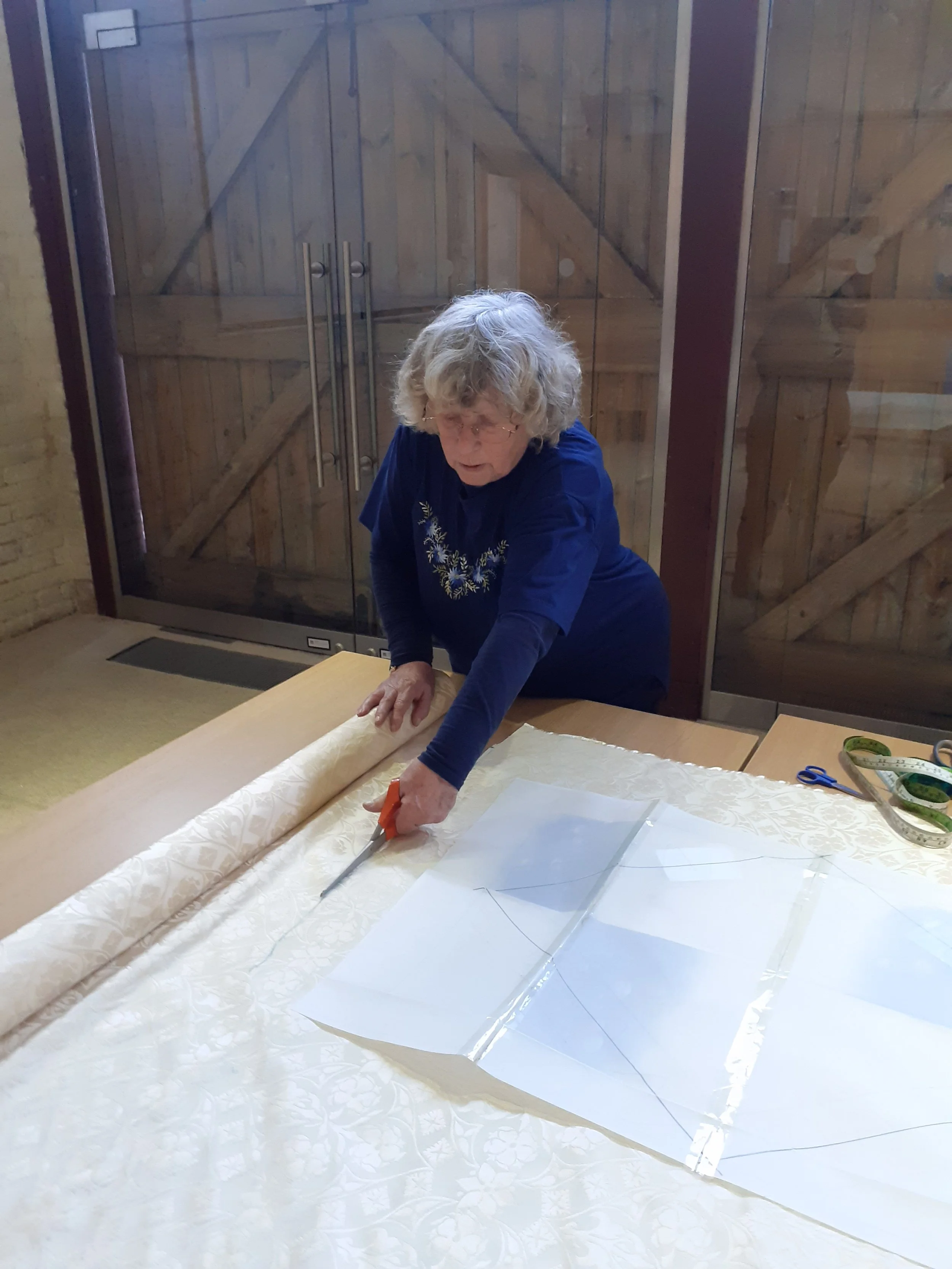
Then came the moment of the first lifting of the lockdown and some of us could meet up to share our ideas. We made several trips to the chapel to measure, then remeasure and then double check the size of the frontal. We had a wonderful day, full of laughter, in the carriage room using lining wallpaper to make a full size template of the frontal, complete with its diaper pattern. From this we could work out where we should put the embroideries.


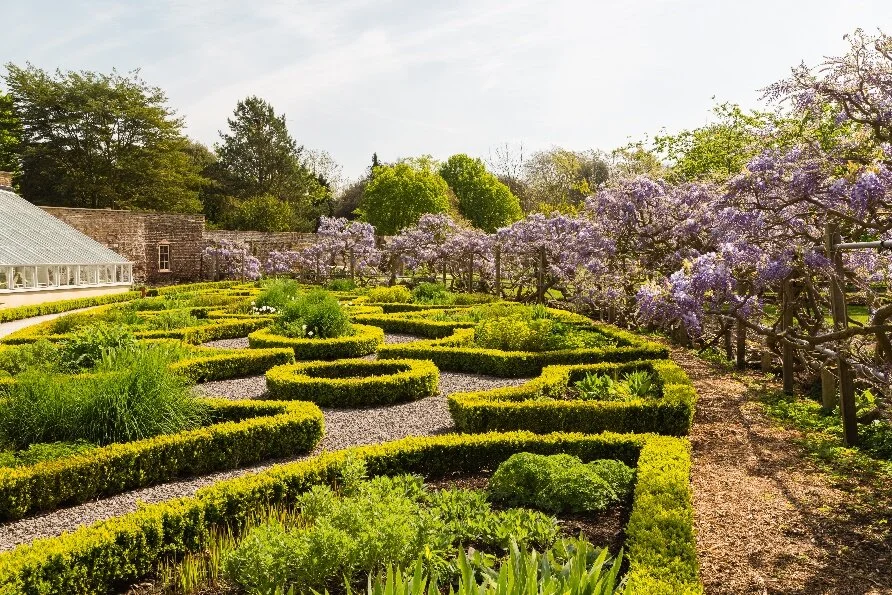
Next we needed to find a coherent theme for the embroidered motifs. They should reflect the sacred nature of the project, so every motif should have either a biblical or religious reference. But what should the integral theme be? Heads were put together and an organic theme emerged. The gardens of the Palace are so full of beautiful plants, it was difficult to make choices. Once again we isolated with a series of lockdowns. It gave time to consider all the wonderful plants in the gardens, and look up any biblical or religious references and then make our choice. Many happy hours were then spent drawing and colouring the chosen images.


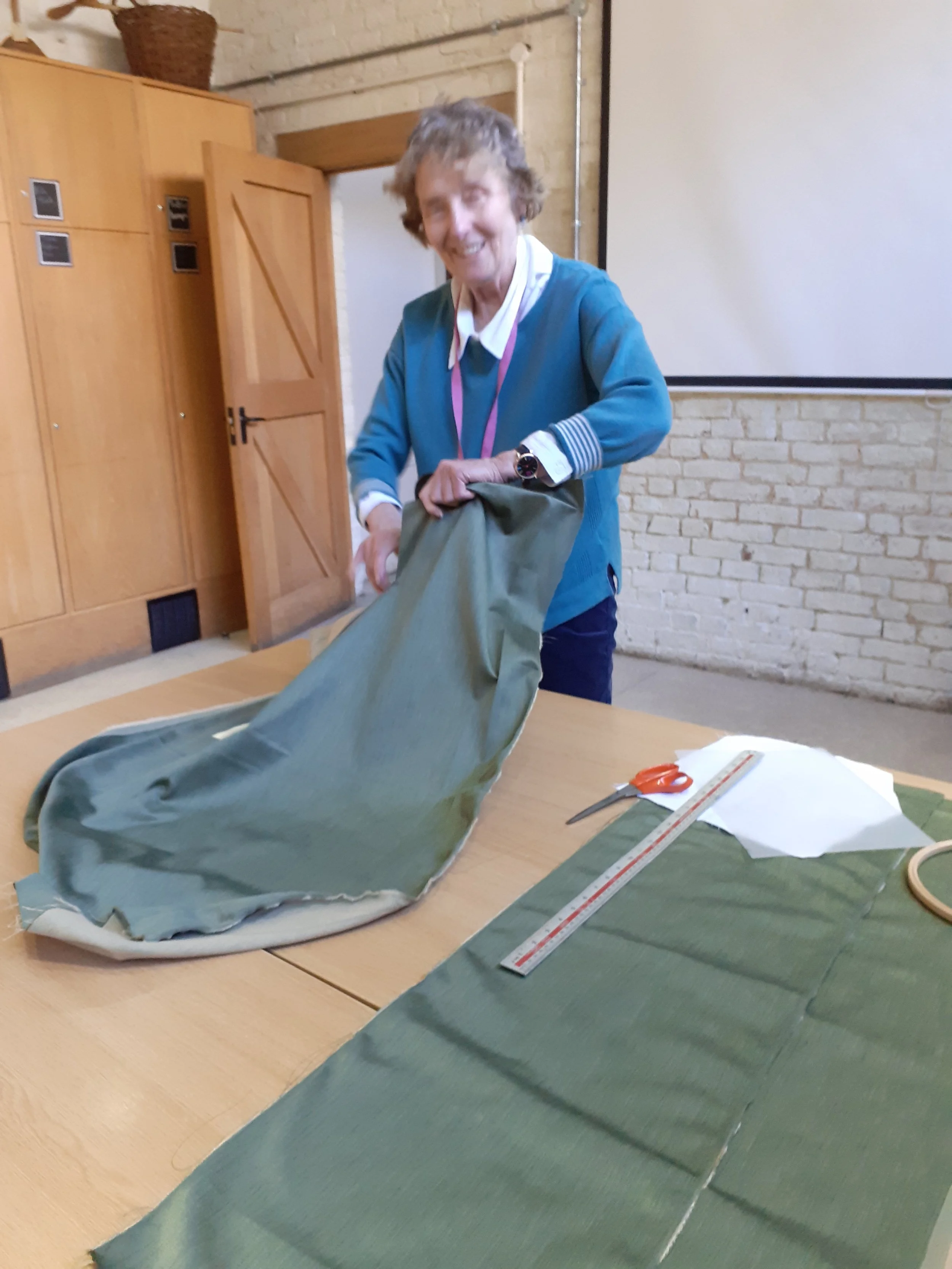
We still had not found the fabrics with which to make the frontal, so we had a trip to Watts, the ecclesiastical supplier near Westminster abbey, which is full of wonderful things. We also visited John Lewis furnishing fabrics for further inspiration. Finally after a great deal of cogitation we settled on two fabrics as suitable both for the embroideries and the hanging of the frontal.


We then collected together all the ideas, fabrics, drawings for the approval of our masters, before we could at long last go ahead with the actual making, embroidering and construction of the frontal. Vicky did valiant work converting her measurements to the chosen fabrics so that they could be cut up and distributed to our embroiderers and eventually used for the very complicated construction of the frontal.


At long last we have met up in person, motifs have been chosen, silks sorted out and this blog is to be continued to report on progress.


Hello from Lucetta, garden volunteer

20201205_145332.jpeg

Hello from Lucetta, garden volunteer

This blog post was written by Lucetta Dodi, former garden volunteer. Lucetta was hoping to return to palace last year, but the pandemic got in the way; we hope we can see you again soon Lucetta!

Dear all,

I am Lucetta, maybe someone remembers me, since I was a volunteer in the garden in summer 2019. Great summer that one. Before the pandemic changed it all.

Needless to say, I had a wonderful time with Lucy, Hattie, Chris and all the volunteers I met. My choice of spending my holidays at Fulham Palace must have been seen unusual, definitely unexpected and even weird. An Italian middle-aged woman who fills in an application form as a volunteer in August in London?


I know, it can sound quite extra-ordinary. For this reason when I had my interview with Lucy I was a bit anxious. A phone call in English, or better to say an interview in English with someone who did not know me and who was in charge of deciding whether I was suitable for the job or not. What is more, the line was bad. Now I am smiling at that afternoon, when I was waiting for Lucy’s call and I was so worried.


I had the same feeling my first day at the garden with Rachel and Lucy. In my profession I work with words and I am well aware of how powerful they can be. Mastering a language is not easy, it goes beyond the vocabulary and the syntax, it is about the subtleties of a gesture, of an intonation, of a wrong collocation.


My main concern was my English. I am a hard-working person and I am used to working in team, I have no problem in meeting new people but will I be able to express myself so as to show who I really am? This is what I was keeping on thinking, but after the first day I started to feel more and more at ease because everyone was kind and welcoming. Talking to customers at the wheelbarrow, sharing some food during lunchtime or a tea in the morning with the volunteers and the gardeners, taking care of those beautiful flowers were moments of joy and my worries vanished. I was part of the group, I fitted in. I had made the right choice.


I have always loved London. And with Fulham Palace, well, it was love at first sight. It is off the beaten track but not too far from the hustle and bustle of the city, which I like since I live in a small town. It is so peaceful and so quintessentially British with its combination of history, cultural heritage, vibrant colours that, when I visited the Palace the first time with my family, I said to myself: this is the place where I would like to spend more time. How I came to know Fulham Palace is a little secret that I mean to keep, although I think I have already spilled the beans with some volunteers.


So I put pen to paper and unexpectedly I was successful. My summer in the garden was an experience to cherish: for the people I met, for the beauty I saw, for the job I did, for the language I spoke. My areas of expertise were the potatoes and the marigolds. Digging up potatoes and deadheading the whilted marigolds, to be specific. In addition, I was quite good at edging the borders as well as at spotting the bugs in the hedge, while not bad when it came to piling up some stones or weeding the space under the trees.


Not exactly my things in my ordinary life. I am a teacher of Italian and Latin in a secondary school in Parma, but for this reason my job at the garden was much more challenging and rewarding. Challenging mostly because of the language, rewarding for what I learned and for the opportunity of talking to people I was working with.


No matter how different our history is, or our traditions are, people, good people, can connect, they can share their points of view and talk together. This is what I have been learning over the years. And there is nothing better than working and eating together in order to connect. My summer at Fulham Palace proved it.


I was ready to come back in summer 2020, but the pandemic has brought all the plans to a halt. It has been and it is still a rough ride for everyone. Sadness and grieving have been feelings we have experienced very often lately. It will not last forever. O wind, if winter comes, can spring be far behind?


I will come back to Fulham. I look forward to it. In my memory the colours of the garden with the purple of its dahlias along the old wall have been a comforting thought during these tough months. P.B. Shelley cannot get it wrong.


Un abbraccio a tutti voi

Lucetta


Volunteering in the Library

Many thanks to Alexander Ogilvie-Graham for writing this informative blog post about volunteering in the library!

I have been volunteering at the Palace since 2016 as a tour guide, and since I began here it has been my dream to become a librarian.

I completed my first tour in the library last week thanks to Sharda.

When I started my shift at the library I gave a quiet nod to the Bishop that I admire the most- Bishop Porteous born May 1731 to 1809 I think of him as the library Patron.

In 1788 Bishop Porteous supported Sir William Dolben against the slave trade. The Bishop also supported William Wilberforce and many of the books in the Porteous library are written in support of the anti-slavery bill and against the slave trade. I admire this Bishop and his support of the abolitionist movement against the slave trade, considering many of his peers did not speak out.

I have always liked the Fulham palace library and hope to be the best version of myself when I am Librarian. It was brilliant ticking of my first shift and I look forward to many more Sundays well spent being a custodian for the library.

Now, for a little insight into the library collection. In the year of 1666 when there was the great fire of London, many of the books were moved to the Library of Saint Pauls for safeguarding against the fire. Here, Bishop Sherlock kept them safe amongst the rafters of the Cathedral.

I hope to bring you all many more facts and exciting stories from the library as I expand my knowledge of this great collection. To quote the library motto “Fortitude will get you far in life”

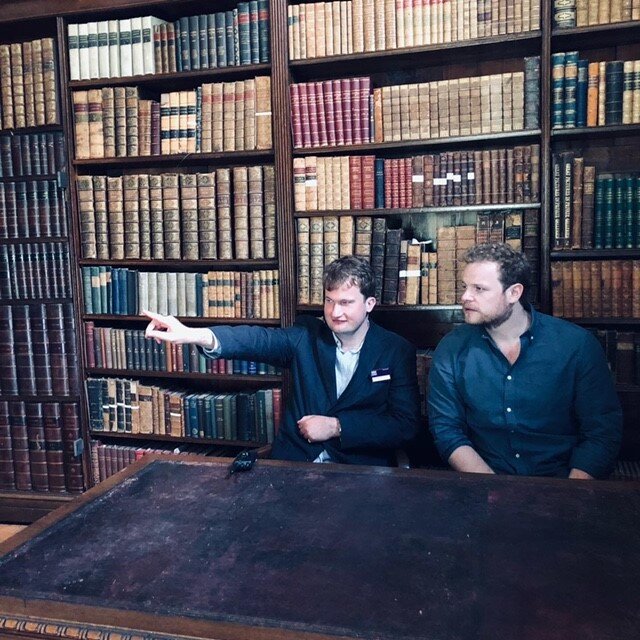
Showing my first visitor (who happened to be my brother) around the library.

Showing my first visitor (who happened to be my brother) around the library.

LET'S TALK BRICKS

CONSERVATION IN ACTION. THE CIA

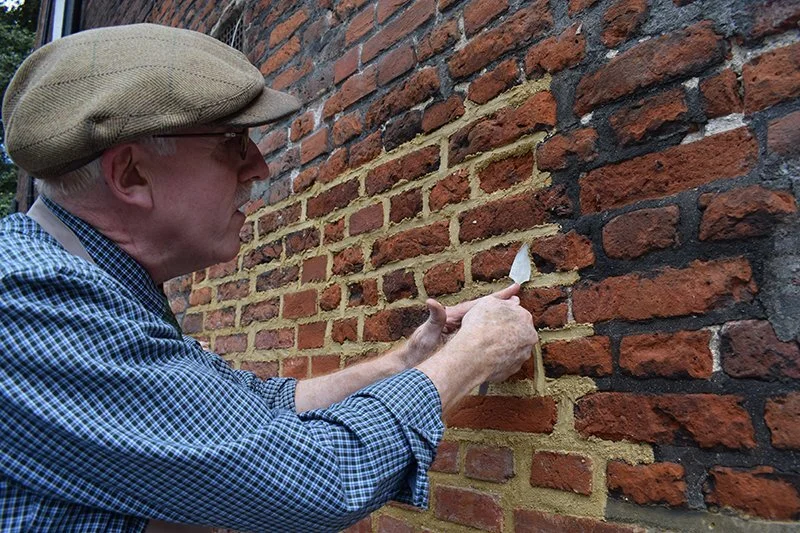
An apprentice using the hot lime method

An apprentice using the hot lime method

Thanks to Lee for writing this detailed and engaging blog!

Back at the start of the 2018/2019 Major works Project at Fulham Palace, a new Volunteer role was established called Conservation in Action (CIA for short). Those interested in joining this new team were told our role would be to conduct tours, donning Hard Hats, good footwear and, amazingly, no masks!

We were about to embark on leading tour groups inside the previously rarely seen areas of the Palace. This would be an exciting time for us and the public, following the progress from start to finish, watching as transformations took place, bringing unseen spaces back to life. We uncovered hidden gems, like the wall paintings in the upstairs room, no. 109, to Tudor floor boards and much more. It was a real voyage of discovery, culminating in the now finished museum rooms where you can see many of the treasures found.

But a large part of the works were to be the Tudor Bricks.

GERARD LYNCH, MA PhD, master brickmason, historic brickwork consultant and author. Gerard trained through the apprenticeship system and at Bedford College, where he later became Head of Trowel Trades. He is internationally recognised for his extensi…

GERARD LYNCH, MA PhD, master brickmason, historic brickwork consultant and author. Gerard trained through the apprenticeship system and at Bedford College, where he later became Head of Trowel Trades. He is internationally recognised for his extensive specialist knowledge and skills in the conservation, repair and re-pointing of traditional and historic brickwork.

Tudor brickwork exudes confidence, being used for both utility and show.

Firstly, it had to be decided how best to proceed with the restoration of the Bricks. So, the Palace called upon:

Gerard carried out several tests on the Palace Brickwork.

a bricks fp.jpg
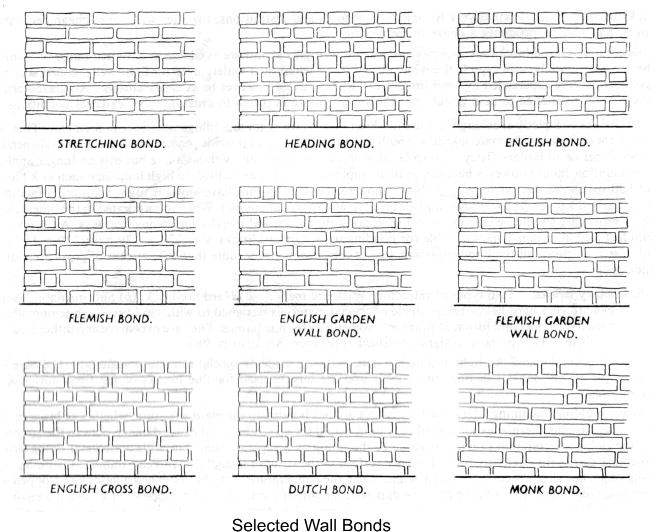
Types of Bonding

Types of Bonding

Bonding (The type of Pattern) was mainly based on variations of English bond. English cross-bond was particularly popular as it allowed bricklayers to create regular, quarter-bond offsets in every course that facilitated patterns, or diapers, utilising the flared headers to create a polychromatic effect.

Tudor brickwork is characterised by thick joints of lime-rich mortar that served as a flexible gasket. This was necessary for laying the typically irregular bricks to the line, level and overall gauge required to fit the dimensions of the architectural elements of a façade. The faces of the joints were finished, or jointed, using the trowel as work progressed to create either a flush face or, more usually, a struck or a double-struck

It was decided to use the Double-Struck and Hot Lime Mortar method for the Palace bricks.

And soon after, work began.

A caged-off area near the Bishops tree was erected to house the Hot Lime Mortar. Visitors were invited to watch and learn as the Brick experts prepared the Hot Lime safely inside their Cage. A hot-mixed lime mortar is based on three components: quicklime, water and an aggregate such as sand. In a conventional mix, aggregate is mixed with lime which has previously been slaked. 'Slaked' basically means using a shovel to mix. In this case, quicklime is mixed with the aggregate and then slaked with water. The process generates heat, hence the term Hot Lime. It may be used immediately as a hot mix or later when cool.

a brick shroud.jpg

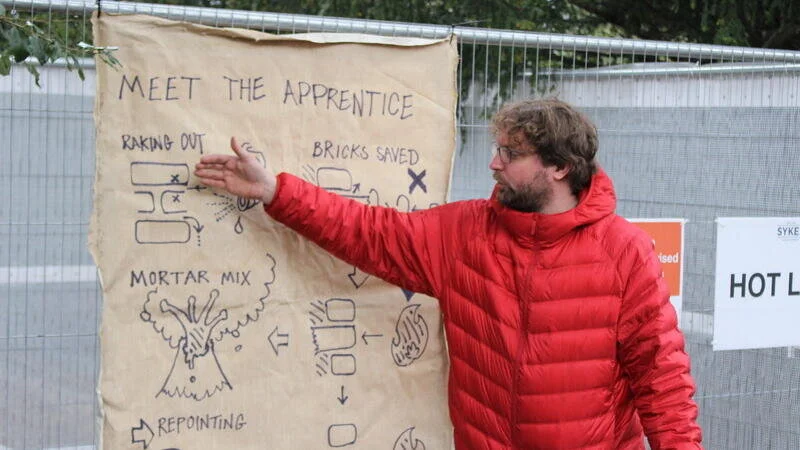
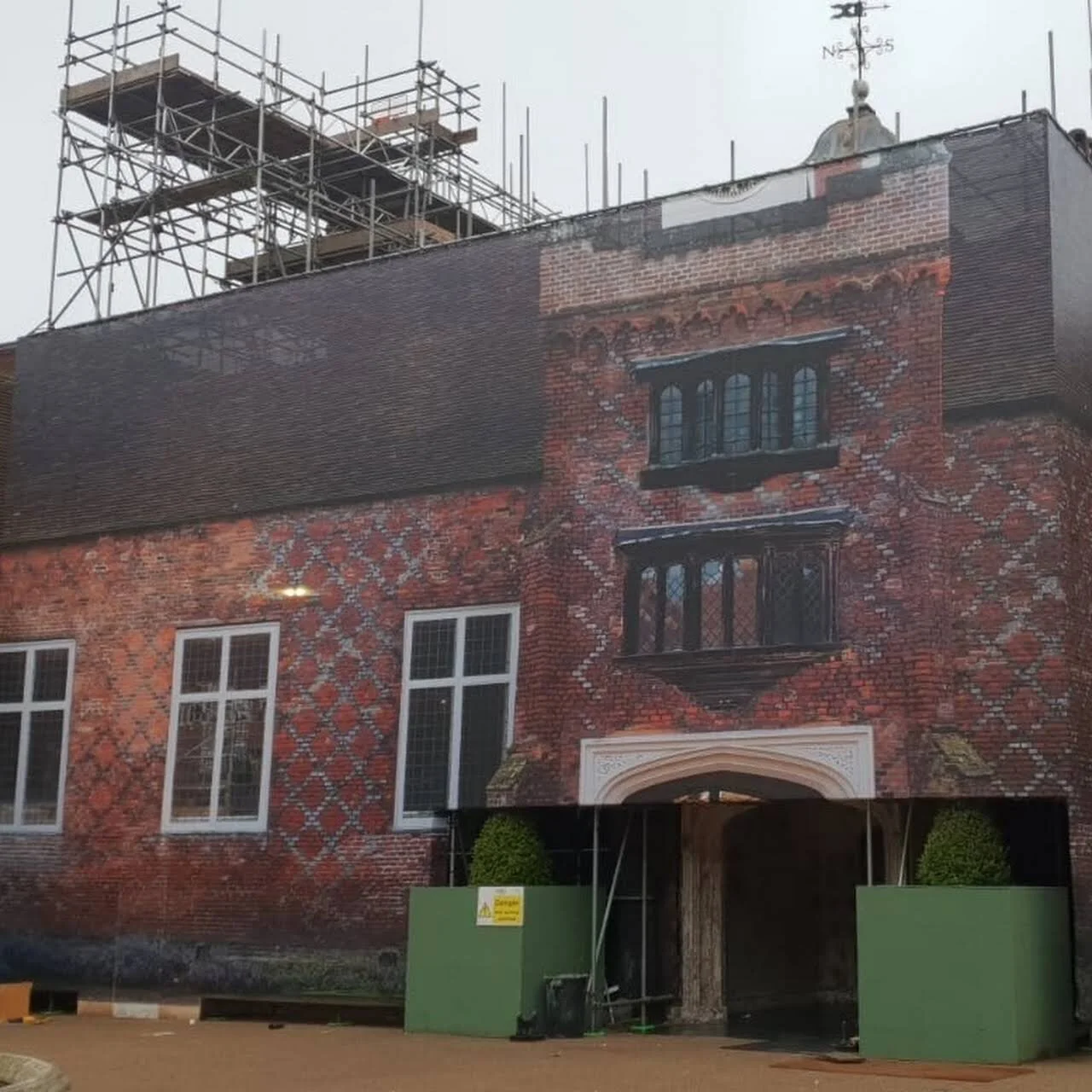
Brick laying experts painstakingly removed each brick from the Wall. Many experts in this highly specialist job are young women. They worked day after day behind the scaffolding that had been placed to the front of the Palace. They were hidden from sight behind a large printed picture of the Palace. They worked and endured The Beast from the East.

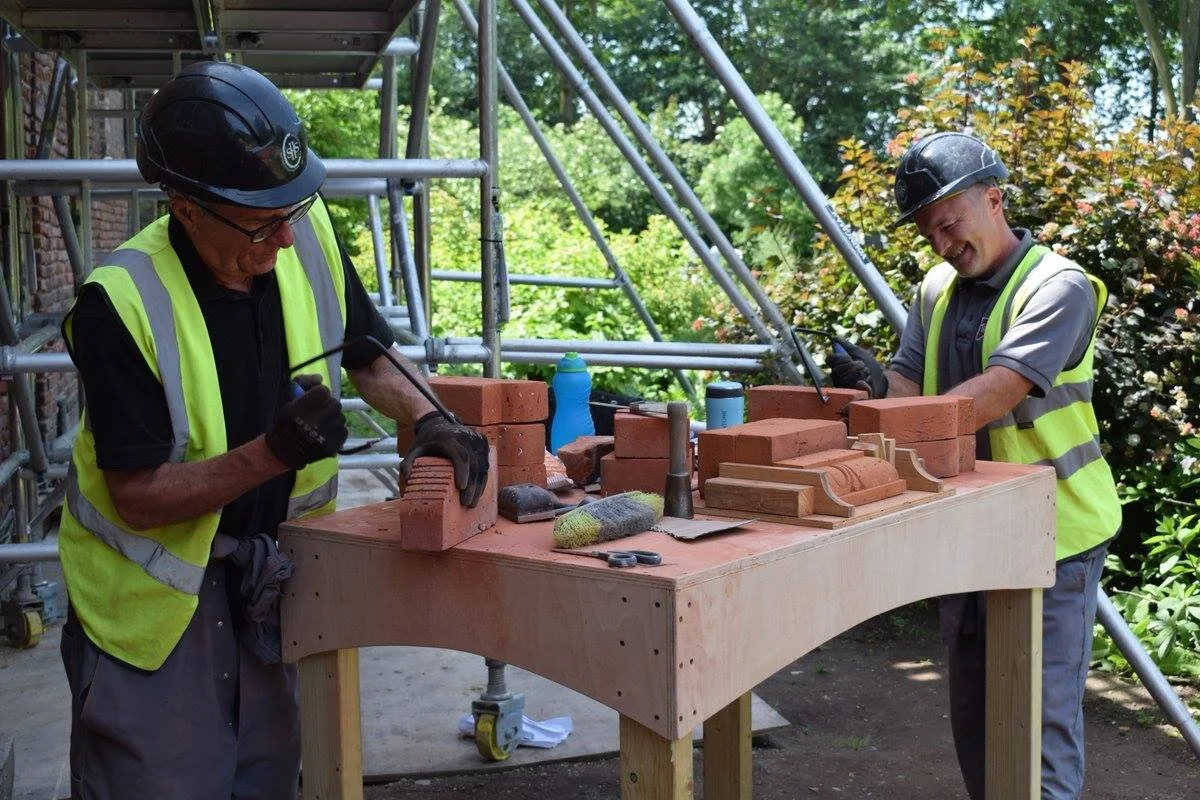
Bricks that could be reused were examined. Some were cleaned and ready to be replaced. New bricks were commissioned from Henry George Matthews, who has been producing traditional handmade bricks since 1923. H. G. Matthews established the brickworks that bears his name in Buckinghamshire. The bricks at the Palace are handmade in the Tudor style. Using traditional tools and techniques, the process has changed very little over the years. Amazingly, H.G. Matthews handmakers can make around 1000 bricks per day!

Colours are determined by the location of the brick in the kiln and the firing temperatures they reach. The colour of the brick ranges from orange (where the bricks are set at the edge of the kiln and temperature reaches around 900°C) to brown (where the bricks are set to the centre of the kiln and the temperature reaches up to 1200°C). Glazing occurs when the bricks are close to or in direct contact with the flames.

A new front

A new front

The Palace ran a 'Sponsor a Brick' campaign where the public could purchase one of the new bricks. Buyers could receive a certificate bearing their name and even come along to Brick Fest Days to sign their bricks before they would be installed in the Walls. I invited some of my friends to join us for a Brick Fest Day, which proved to be a very fun day, I must say!

Today the Tudor bricks look resplendent, impressive, very showy and very Tudor. I think they would have approved.

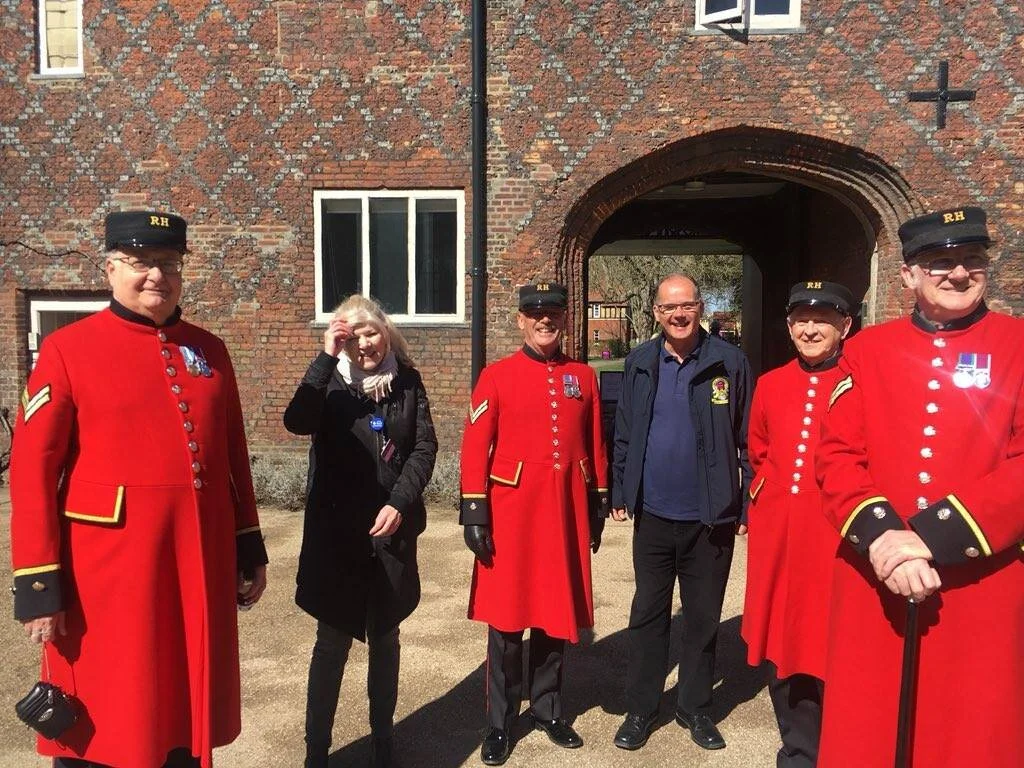
A tour with Veterans guided by Lee!

A tour with Veterans guided by Lee!

The Green Meet

Many thanks to Alexander Ogilvie-Graham for writing this reflective piece on an event that took place in the Palace.


The Green Meet was towards the tail end of Lockdown, on May 2, 2021.

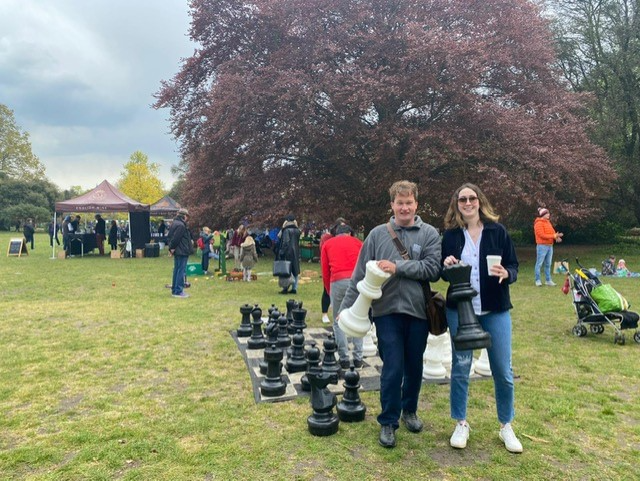
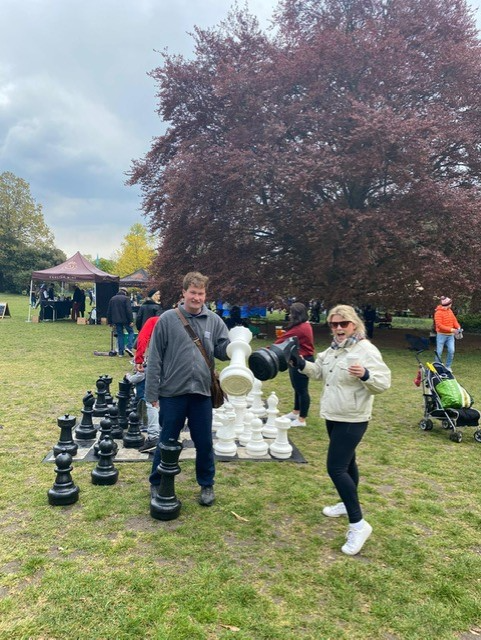
It was a rebirth for the Palace; a chance to welcome visitors back onto the site. It was a roaring success! We had over 1,500 people coming through just the front gate in one afternoon. We had live music and great afternoon talks with various curators . I liked seeing how there were tents in the walled garden workshop happening throughout the front lawn.

Giant chess on the Palace lawn.

Giant chess on the Palace lawn.

The Queens Gambit. What a chess move! The Palace has managed to pull it off towards the end of Lockdown.

download (1).png

It was a honour being at the front gate with my Carer, Helen Cameron. We had got there early to scout out the Palace grounds . It was fantastic to see it teeming with life once more.

Overall, it was like apple day - a complete success. The Green Meet had the final check mate. I think this could become the beginning of events at Fulham Palace again.