
Volunteer Susan Richards discovered how a decorative Tudor oak panel in West Sussex is connected to Fulham Palace and the Bishops.
The Steyning Screen is an amazing oak screen made up of decorated panels which I saw very recently in Steyning Parish Church in West Sussex.
It may have been commissioned by or for Bishop Richard FitzJames for display at Fulham Palace to celebrate the marriage of Henry VIII and Catherine of Aragon in 1509. Given that it was not finished until 1522, the same year Bishop FitzJames died, it also could have been created as a memorial to him.
After 1522, when Henry was beginning proceedings to divorce Catherine, the screen would have become somewhat of an embarrassment and may have been moved out of sight. It came to Steyning seemingly via the granddaughter of Bishop Juxon’s brother who married the Rector of Steyning Parish Church.
The panels forming the screen display Henry’s Tudor Rose and Catherine’s Pomegranate symbol. There are also grapes and roses intertwined on a trellis symbolising the marriage. The arms of the Bishop of London are also displayed together with Bishop FitzJames’s own family arms, including wavy crosses, dolphins, and spread eagles.
The panels have suffered quite a bit during their journey from London to Sussex having been cut to fit different spaces and some parts have been discarded altogether. In 1983 the screen found its final home as the reredos behind the high altar in the Parish Church.
I couldn’t find any more information other than a link on the church website to the research carried out by Steyning Museum.
See: https://steyningparishchurch.org/tudor-panels/.
This includes interesting mentions of Bishop FitzJames’s support of Catherine, Bishop Juxon hiding from Cromwell’s men disguised as a bricklayer, and the Rector at Steyning being a Jacobite secret agent! I do hope that it’s all true!
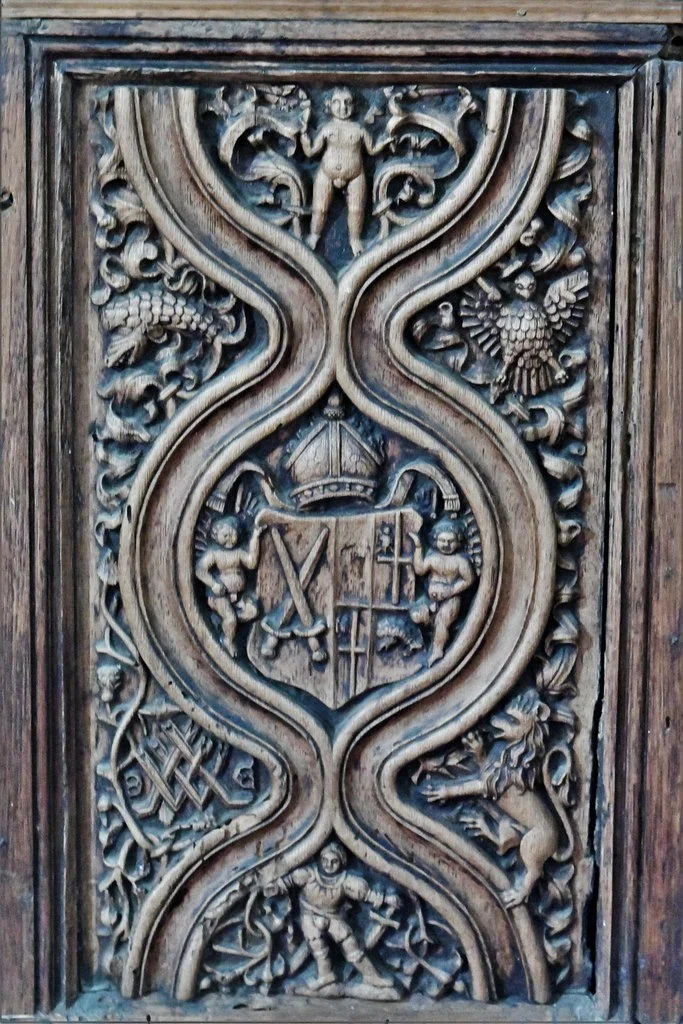
The arms of Richard FitzJames, Bishop of London (1506-1522).
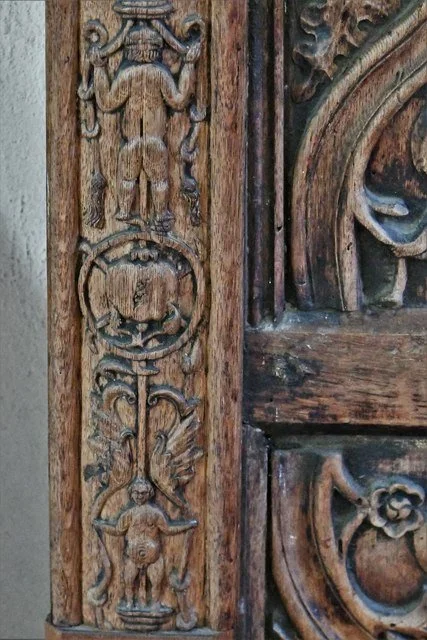
The Steyning screen was carved in 1522.