
Anne Connaughton, front of house volunteer, has completed some very impressive research for this fascinating and fruity historical post on Bishop Winnington-Ingram and the Public Morality Council.
The London Council for the Promotion of Public Morality (PMC) was founded in 1899 to campaign against ‘the torrent of vice which floods our streets.’ The Bishop of London, by virtue of his office, became President of the organisation. Like other office holders, Bishop Winnington-Ingram’s (WI) presidency coincided with his tenure as Bishop of London. The Council and the Executive of the PMC consisted of representatives of the church and political establishments, and others from among the great and the good. Although early records are lost, the London Metropolitan Archive holds a range of sources, including Annual Reports of the PMC; Patrol Workers’ Reports; and a later sermon preached by WI.
During the Borough elections in 1901, the PMC lobbied candidates running for office ‘to press on the Police authorities the need for acting resolutely and energetically for the prevention of open soliciting to vice on the streets, from both men and women and using the powers they possess for the prosecution of those who live on immoral earnings of women.’
The PMC grapples ‘with the horrors of procuration, the offensive indecency of the streets and the existence of houses of ill-fame.....to redeem London from the reproach of being an open market for body and soul’ as it seeks to influence public opinion by ‘disseminating trustworthy information.’ A petition was circulated, claiming that ‘the moral condition of certain streets within the City of Westminster.....is seriously injurious to public morality.......with many of our young men, fresh from school or college, and many of our innocent girls....find themselves assaulted by temptations and solicitations to vice, insulted by those who live an openly vicious life.’ This ‘open exhibition of vice renders many of our streets late in the day unsuitable for free use by respectable persons of all ages.’ Its Watch Committee recommended immediate action ‘to clear the streets of prostitutes, and for the prevention of solicitation...more vigorous exercise of the powers already possessed by the Police.’
It was expected that borough councils would ‘uphold and work towards the moral uplifting of the citizens, and guard against the rising generation from being ensnared by vicious people in the public streets.’ PMC activists claimed that ‘a large majority of street women and those who keep disorderly houses are foreigners’, and were affronted by how such places masqueraded as ‘quasi medical establishments.’ Not surprisingly, they welcomed the establishment of the Royal Commission of Alien Immigration and the subsequent Aliens Act 1905. At around this time, the PMC highlighted the licensing trade, including whether legislation should be sought to prevent young women working as bar maids.
Members campaigned against ‘the sale of noxious literature’, in the hope that the London County Council would pass a by-law ‘to improve the procedure for the suppression of evil.’ Given that “the evils of noxious literature have grown to such an extent ‘the Headmasters’ Conference lobbies Borough and County authorities in ‘suppressing the publication of such poisonous literature.’ The PMC’s earlier preoccupation with unsuitable literature focused on a cheap illustrated Mutoscope, an early form of cine photography, and a popular medium for erotic entertainment, which became associated with a controversial divorce case in late-Victorian London. In 1902, the PMC alleges that ‘descriptions of abominable scenes in these machines’ were sent to MPs. Moreover, ‘shameful traps were being laid to destroy the purity of the rising generation.’ The PMC complained that publications of ‘a most disgraceful character’ were available for sale in thousands of newsagents. The prevalence of ‘lewd, illustrated postcards.......in hundreds of shop windows’ constituted ‘a direct incentive to vice.’ Once again, The Headmasters’ Conference intervened by appealing to Council and Borough authorities to help ‘stem the torrent of pernicious literature’ and use the law to punish publishers and traders ‘who flourished upon this vile traffic.’
The PMC wanted censorship in public entertainment to be ‘as far as possible free from any political influence or control.’ In a sermon delivered towards the end of his tenure, Bishop Winnington-Ingram saw the cinema as ‘a real asset to the life of the nation...it can be a very dangerous thing indeed.’ Working in conjunction with censors would ensure that plays and films seen by young people ‘are good ones and ones that will not do them any harm.’ The public, he argued, ‘don’t really want the sex plays.’ The theatre should be ‘a clean, improving, amusing place to go.’ Nudity on the stage was ‘dishonouring to the girl and extremely bad for the decadent young men who find pleasure in it.’ Open spaces were intended for recreation and ‘not to be open air brothels.’ Winnington-Ingram proudly championed the PMC’s role in closing down hundreds of brothels during his tenure, and in making open spaces as safe as they were. He saw London as the heart of the Empire, ‘a happy place, (with) a clean theatre, cinemas that will amuse them, open spaces where they can go without temptation, books - periodicals.....which will be good for their minds.’ The sermon gave him another opportunity to counsel against the unhealthy influence of ‘filthy books...filthy periodicals.’
Under Winnington-Ingram’s aegis, other areas of public life, such as the influence of drink shops; inequalities of the gambling laws as between rich and poor; the inequality of the law relating to solicitation as between men and women, and the falling birth rate would fall under the scrutiny of the PMC’S patrol work.
The referenced material in Part 1 comes from the following sources:
The London Council for The Promotion of Public Morality : Report(s) and Statement(s) of Accounts for 12 Months Ending 28 February, 1901; 28 February, 1902; 28 February, 1903; 28 February, 1904 and 10 Months Ending 31 December, 1905 (London Metropolitan Archive)
A Report on Cinema Films Presented by the Special Films Sub-Committee to the Public Morality Council at a Meeting on 29th October, 1938 (London Metropolitan Archive)
Statement of Work and Programme of the Council as approved at its meeting on 31 January, 1938 (London Metropolitan Archive)
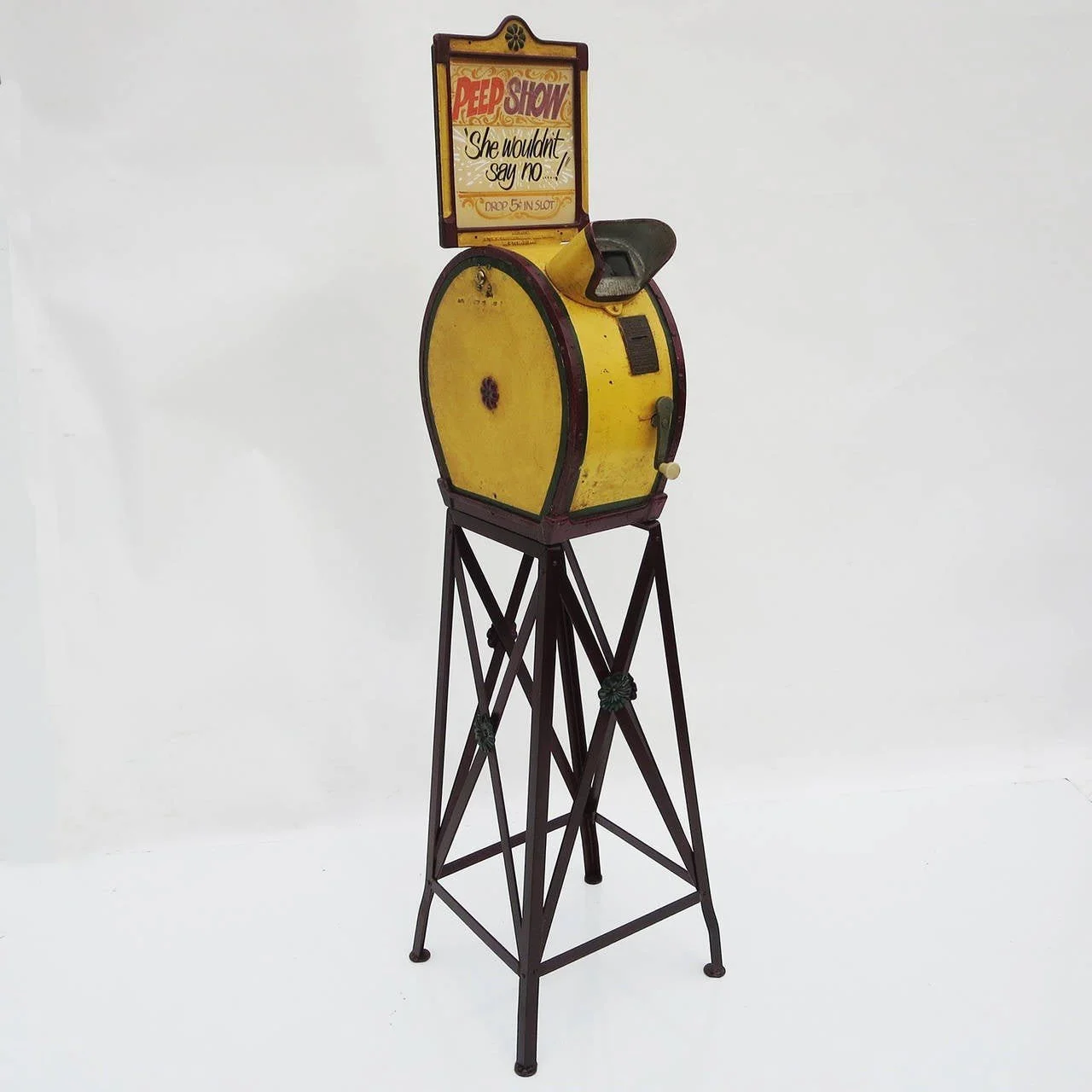
The Mutoscope- an early motion picture device allowing one person to view at a time.