Specimen of the Month - Recently Discovered Extract from the Diary of Samuel Pepys 

Every month we feature two blogs written by volunteers, one describes an object in the Palace and one a plant from the Garden. It is a great way for us all to learn more about the Palace, if you would like to contribute there is no set format so please do send us your ideas!

Wednesday 2nd September 1687

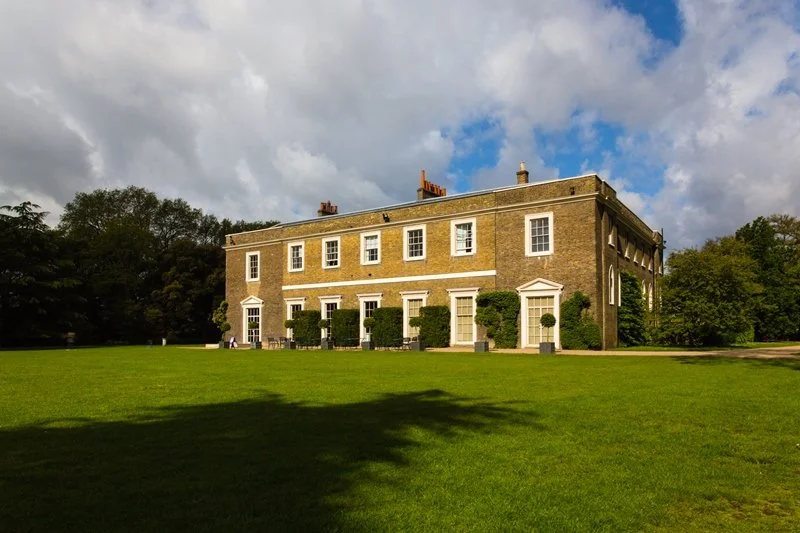
Up betimes and after breakfast by water, the day being mightily pleasant and the tide serving finely - I up as far as His Grace Bishop Compton's Palace at Fulenham. His Grace being away from home, I was received by his Head Gardener Mistress Hart - whose knowledge of matters pertaining to the horitcultural arts exceedeth that of anyone in this realm. And Mistress Hart shewed me some of the specimens growing and flourishing there that have lately been sent back from our American possessions and I did marvel to see the Magnolia bush and the great tree, aptly named the Black Walnut.

 There was introduced, and provided for my inspection,  other members of the garden workforce (all arrayed neatly in a line outside the entrance way to the Walled Garden constructed by the late Bishop Fitzjames during his time) - Master Christopher R and Master Christopher A, together with the 3 prentices - one of whom hath travelled hither from Alpine lands - so great is the reputation of Fulenham Palace in all matters pertaining to horticulture.

From thence, into the Walled Garden and in particular the hothouse known as "The Vinery" where I was pleased to see the quickening of the tomata plant and other exotiques from the West Indies - I did bite into a chilli plant which caused me such a storm of perspiration that perforce I was obliged to remove my perruque  ! 

To the rear of The Vinery is the area called, I believe, "The Bothy" - there were gathered together a group of ragamuffins and other poor labourers from neighbouring parishes -  yclept by Mistress Hart "The Volunteers". They were all engaged in the drinking of Tee. In return for a day's labour, these poor souls are not only rewarded with Tee but also the dark and mysterious beverage "Caffee" and, on red letter days, with sweetmeats from His Grace's kitchen - in particular the delicacy known in the common parlance as "Fig Roll".

And so to the Ferry Steps and took boat again; and so home and there to write down my Journall; and after supper to bed, mightily pleased with my Botanique Day.

S.P.

Jamie Atwell, Garden Volunteer

Please send your ideas for Object / Specimen of the Month blogs to rachel.bray@fulhampalace.org If you would like some help, let us know.
5 Things to Know about the Data Protection Regulations Coming in May 2018

Less of a juicy Palace blog this time, but hopefully one that will help you feel more in the know about how organisations can use your personal data after the Data Protection Regulations come into play. Here's a breakdown of what the jargon really means, and why it should make your life a little bit better…


1. It’s the biggest change to UK data privacy law in 20 years

The law needed updating to better protect people because the amount of personal data being generated every day is rapidly increasing. As part of the General Data Protection Regulation (GDPR) all companies have to review how they manage all personal data and ensure they are in line with the new changes by 25th May 2018.

2. It will give you more control over your personal data

GDPR came into play in order to give you more control on how your personal data is used. You’ll have greater visibility and control over the personal data organisations hold about you. This means you can have confidence that information about you is accurate, up-to-date and properly managed.

3. Choose who contacts you, and how

Over the coming months you should notice organisations asking for your consent so they can contact you about offers, products or services they think you’ll find useful or interesting. To comply with GDPR, these requests must be really clear and straightforward. You get to choose who contacts you and how, such as by email, social media or phone.

4. You can also change your mind at any time

If you give an organisation permission to contact you, it doesn’t mean you can’t change your mind in the future. Under the new rules, it should be easier to update your preferences on what you want to receive and how.

5. Your data will be better protected

GDPR also aims to make sure that all organisations holding personal data have the correct processes in place to protect it. Organisations who put customer data at risk will face hefty penalties.

What happens next? As a Fulham Palace volunteer, we’ve been asking you to choose how you‘d like to receive updates from us on: 1. Events at the Palace and our 2. Restoration Project. If you didn't manage to sign up at the Volunteer Start of Season meetings in March, then please drop Rachel a line to let her know if you'd like to receive updates on either of these topics. As a regular volunteer you'll stay on our Active Volunteers mailing list, meaning you receive a monthly email from Rachel, as this is essential to keeping you in the loop about the volunteering programme at Fulham Palace. 

At Fulham Palace we're taking the new regulations very seriously, as we know how important the security and use of your personal data is. We have a working group who meet with the Sian Harrington, CEO, every couple of months, and have been attending external training about the regulations since early Autumn 2017. You can have every confidence that how your data is dealt with at Fulham Palace is done so according to best practice GDPR recommendations.

Object of the Month: Courtyard Brickwork

Every month we feature two blogs written by volunteers, one describes an object in the Palace and one a plant from the Garden. It is a great way for us all to learn more about the Palace, if you would like to contribute there is no set format so please do send us your ideas!

Conservation In Action (C.I.A.) On Tour: A Visit to Fulham Palace's Brick Manufacturers

How many people look at the brickwork closely when walking through the arch into the courtyard of Fulham Palace?  I certainly didn’t, and my overall impression was that we had ageing Tudor bricks which had been subjected to a bit of weathering over time.  

The reality is that the Palace’s Tudor brickwork has been subjected to one or two past ‘make-overs’ where for example, some Tudor bricks have been replaced by modern bricks that are not of the same size or quality.  More importantly where repointing has been carried out a black ash mortar has been used which is dull and holds water causing a more rapid deterioration of the bricks. Closer examination reveals that the brickwork is, at best ‘not aesthetically pleasing’ and at worst, has been subject to a bit of a ‘bodge job’. Experts have recommended that we replace 1700 bricks (700 of which will be specials) and that the ‘wrong’ mortar is dug out and replaced by a traditional ‘hot lime’ mortar which allows the brickwork to breath and dry out.

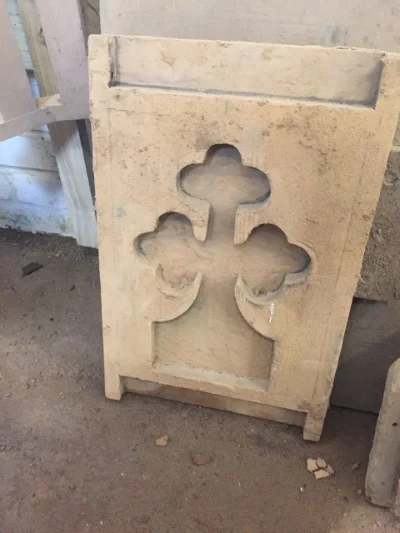
Decorative mould used by H. G. Matthews

Decorative mould used by H. G. Matthews

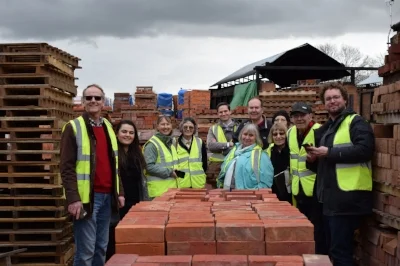
The good news is that Fulham Palace is using H. G. Matthews, a traditional and expert brick maker and a group of volunteers and Palace management went to visit them this month to see the new Palace bricks being made.

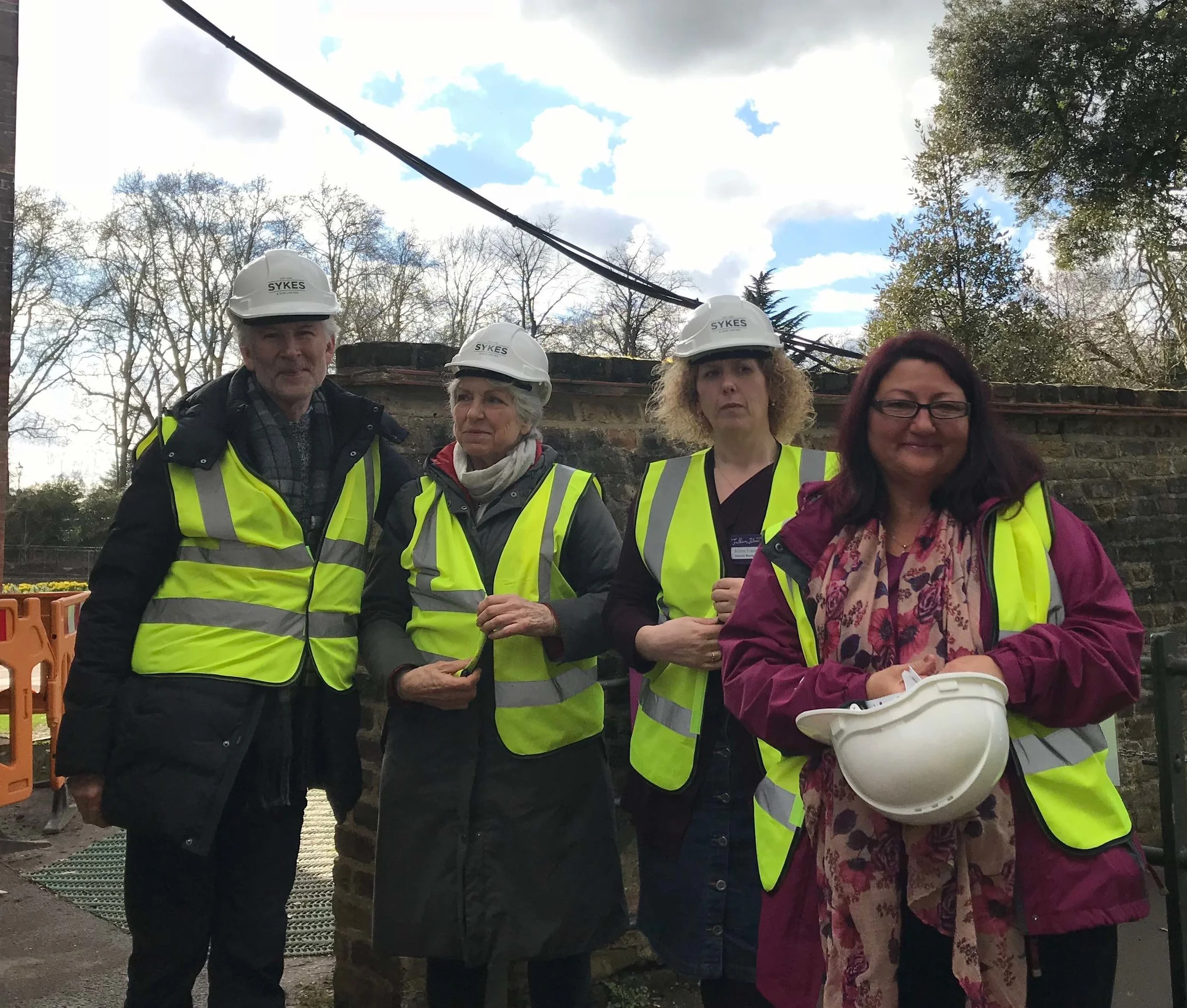
A group of volunteers and Palace management at H. G. Matthews' expert brick makers

A group of volunteers and Palace management at H. G. Matthews' expert brick makers

The brickworks is set in Buckinghamshire farmland close to where the quality clay lies, and as you arrive your attention is drawn to the piles of timber, 25 tons of which is used each week for burning in the boilers and kilns. Looking down you see a rich yellowish red sludge (clay residue) seeping over your boots and become aware of constant buzz of activity between the buildings involved in the various processes.

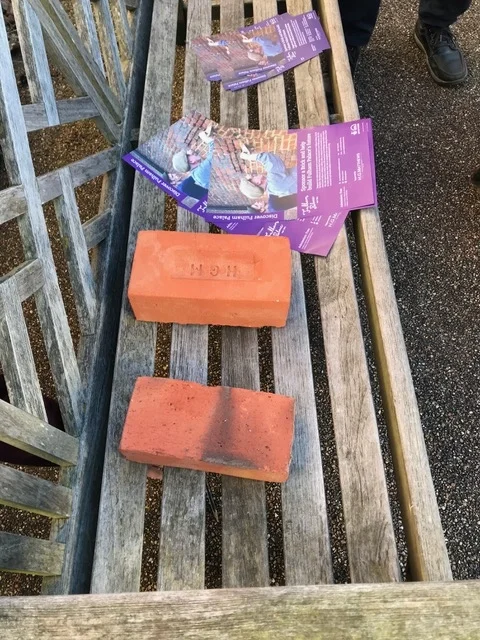
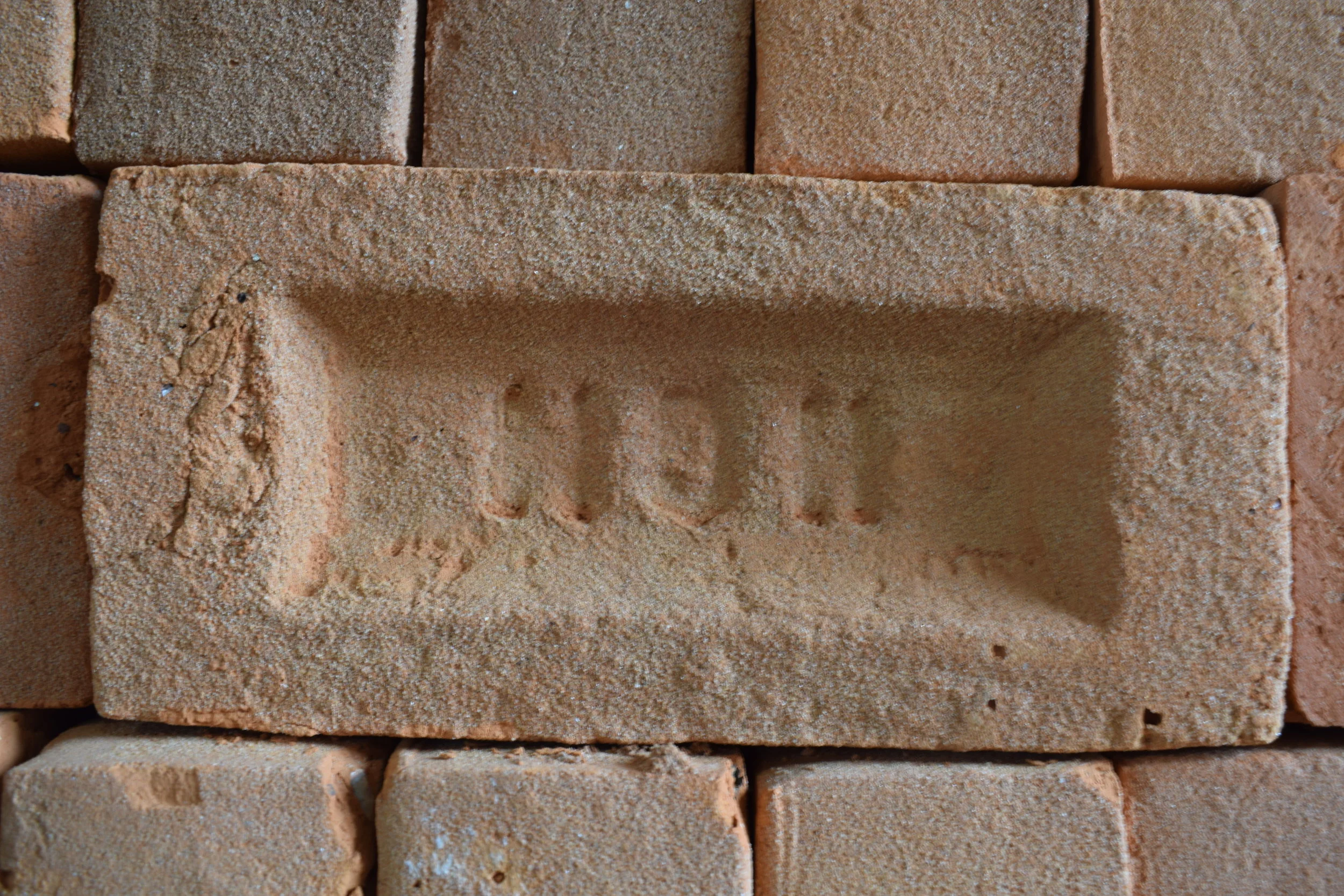
An H. G. Matthews brick

An H. G. Matthews brick

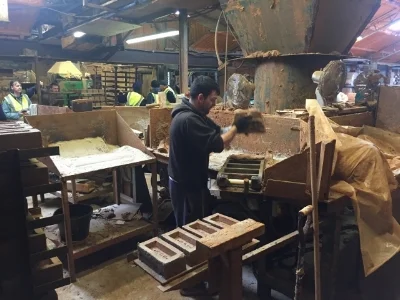
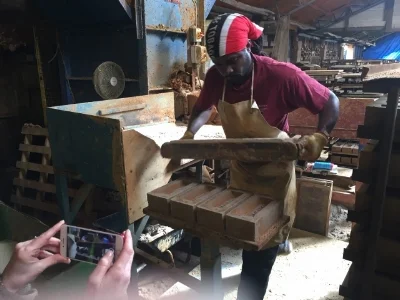
H. G. Matthews is a family concern, manufacturing bricks since 1923, and Trafford Matthews, one of the current directors, took us through each stage of brick making. His enthusiasm was contagious. He explained that they extract about 6 months' supply of clay at a time largely in the Summer when digging is easier. This is then stored at the works, but before it is used they mix the clay with rainwater from the shed roofs to make it workable; it is then fed through rollers to crush flints, chalk and stones. Too much chalk in the clay causes the brick to explode during firing. Once rolled, the mound of clay is fed into the sheds where the brick makers grab a lump and work it, rather like bread dough. The brick maker scatters sand into each mould to line it, before slapping the worked clay into it and removing any surplus from the top. The moulds are placed onto boards, four at a time, and the bricks are then turned out of the moulds onto another board before putting on a rack (stillage) which holds up to 216 bricks. These stillages are then moved to a drying room, where boilers fed by wood chips keep a steady temperature (50 degrees Centigrade) dry up to 17,000 bricks slowly over 5 days. During this process, they shrink by 10% and lose about a pint of water. If the drying is too fast, the bricks crack and are useless.

What impressed us all most was the speed and accuracy at which the brick makers worked. They fill at least 4 stillages a day, i.e. they make 864 bricks. Think of the weight of a brick and add 10% ,multiply by 4 on a board and you get very fit brick makers. 

After drying, the bricks can then be fired. I was expecting something like the Fulham Pottery shaped kiln, but those at Matthews were more like rectangular sheds, 12 ‘ high with fire openings at the side and a wide door opening to allow forklifts to enter.  Just before firing, a door is hung, fire bricks are added to the top layer of the kiln and the roof is removed. Matthews use both oil and wood fired kilns, the latter being used for the more specialist bricks such as ours.

There are three kilns being worked at any one time.  One is being filled, one is being fired and one is being emptied. Why so many? It is because each kiln takes approximately a week to fill with 70,000 bricks, which all have to be manually set on their side. When the kiln is fired, it takes at least 24 hours to reach temperatures of 1100 degrees centigrade throughout the kiln, another 2-3 days for the bricks to cool down and a further week to remove them to a storage area. We noticed that the bricks coming out of the kiln were different in colour and found out that there are different temperature zones within the kiln and those bricks closest to the fire openings get the greatest heat which affects the colouration. Those nearest the firing, are generally darker and may get a greyer hue.

Seeing skilled brick-making was amazing and I know that most of the volunteers would like to go back for another visit, but  work has started at Fulham Palace and Sykes who are carrying out the conservation building works are already chipping out the old mortar and removing broken bricks. Sykes will lay the new bricks with new hot lime mortar, so we will all be busy showing visitors the work and hoping that they will sponsor one of the bricks made especially for us in a traditional way by F. G Matthews. The Tudor courtyard will look fantastic when the works are completed but any sponsorship we can get will be fantastic.

Ann Russell, Conservation In Action and Archaeology Volunteer

Please send your ideas for Object / Specimen of the Month blogs to rachel.bray@fulhampalace.org If you would like some help, let us know.
Volunteers' Hard Hat Tour

With the Palace Restoration Project now well underway a group of Volunteers were given an early opportunity to see the recently exposed spaces on the top floor of the north and west ranges of the courtyard. Construction is very much in progress and these spaces have now been stripped back to reveal historical features and details not seen for many years and that will be covered up very soon as the new offices will be ready for tenants from the summer. The historical integrity of the building will be retained and as much of the existing fabric and features will be retained as is possible but much of it will be hidden from view.

hard hat smaller.jpg


After an introductory talk from Nia the tour began with us donning hard hats and high-vis jackets as the site is very much a working building site. Led by volunteer guides we were taken through a series of rooms on the upper floor starting with a room in an area of the courtyard marked as the Brew House on early plans and with the Malt Room next-door, where original ventilation holes provided further evidence that these were working rooms from very early times at the Palace.

The tour continued through what had been servant's bedrooms, Bishop Bonner's library and ordinands room amongst others. Many rooms featured beautiful quality wide, oak floorboards but it was clear that over the centuries many floors had sunk and a number of old ceilings were dangerously bowed giving the building team some challenging repairs. Below are a few of the historical highlights that have been brought to light.

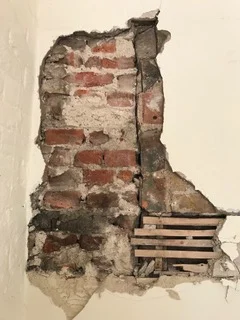
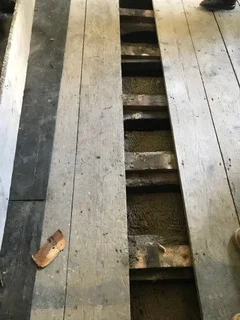
Historical Details revealed (working from left to right):

1. All kinds of wall construction have been uncovered, including lathe and plater, alongside brickwork from many different eras

2. With the floorboards lifted, very early support beams are visible beneath later struts put in to raise the floor.

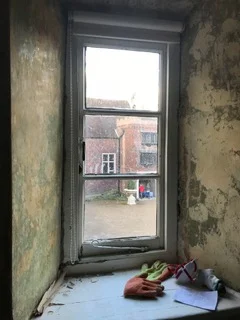
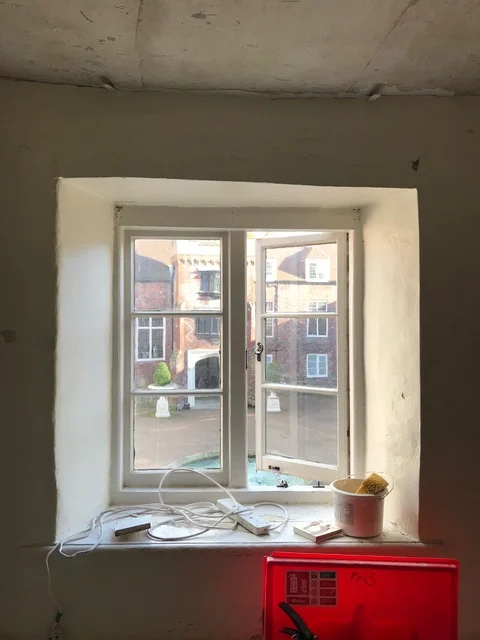
3. A number of the windows remain relatively unchanged since their original installation, many are in this 'flared' style, designed to maximise light, the thickness of the wall is evident in this image.

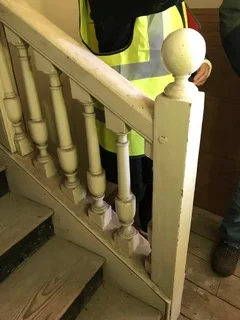
4. This quite ordinary looking banister on a back stairway is in fact very old and may date back to Tudor times.

5. At the very top of this picture two small metal supports are just visible - these are very early curtain supports.

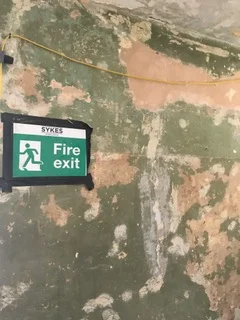
6. The green distemper that has been uncovered on some the walls may date from the First World War when this part of the Palace was used as a hospital.

New discoveries are coming to light all the time and understanding and interpreting them is still on going. More precise information regarding dates and certain features will be forthcoming as further research is undertaken.

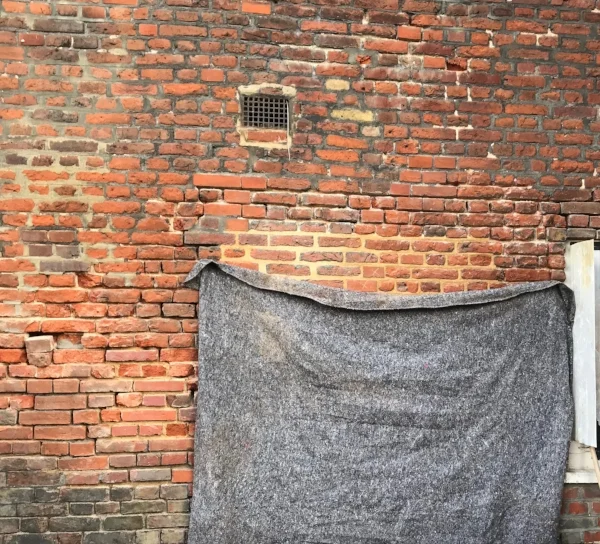
The tour finished with a look at the restoration of the brick work and the painstaking work that is being undertaken. The earliest bricks date back to very early times c. 1500 and, as with the rest of the project, as much of the existing material is being retained as is possible. The old mortar (mainly Victorian) is being removed and being replaced with breathable lime mortar, in the process some badly decayed bricks will need to be replaced.

The area above the grey blanket shows experimenting with treatments with the new lime mortar. Areas where bricks will have to be replaced are also clear.

The area above the grey blanket shows experimenting with treatments with the new lime mortar. Areas where bricks will have to be replaced are also clear.

We concluded with questions and answers with Steve the very knowledge site supervisor, a chance to handle the new (very heavy) bricks along with an explanation of the traditional firing process of these authentic bricks. The sponsor a brick programme was given a new relevance and seems a fitting way to be part of the redevelopment project at the Palace. For more on Sponsor a Brick.

IMG_4701.jpeg

Recipe of the Month - March

Irish Soda Bread

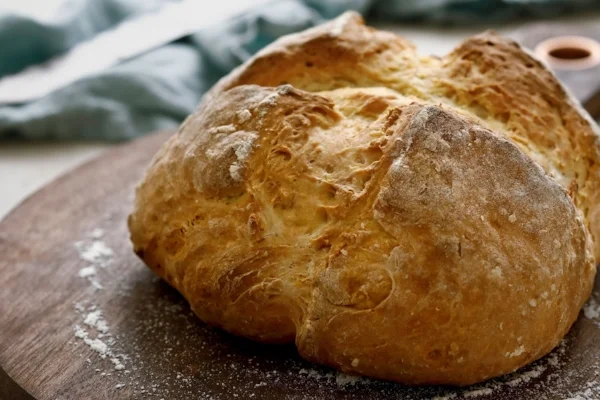
With St Patrick's Day a recent memory and with it the celebration of all things Irish it seems fitting that Soda Bread should be the recipe of the month. Soda Bread uses very basic ingredients and the method is very simple as befits a staple food from a poor country. Traditionally Irish Soda Bread would have been cooked on a griddle or in large black iron pots on top of the hearth. The method is quick and simple and the raising agent is bicarbonate of soda rather than yeast, so there is no waiting for the bread to rise.

images.jpeg

Traditional Irish Soda Bread

  • 375g strong stoneground wholemeal flour
  • 75g plain flour, plus a little extra for dusting
  • 1 level teaspoon bicarbonate of soda
  • 1 level teaspoon fine salt
  • 1 x 284ml carton buttermilk
  • 75ml water

Preheat the oven to 200C, gas mark 6

Begin by placing the dry ingredients in a large roomy bowl, mix to combine, then add the buttermilk followed by the water. Start mixing; first with a spatula then finish off with your hands, to form a soft dough. All you do now is shape the dough into a ball, adding a dusting of flour if needed and place it on the baking sheet and pat it down a little.

Cut a third of the way through the loaf with a sharp serrated knife, one way, then do the same the other way, forming a cut cross which will form the loaf into four crusty sections. Then dust with flour and bake straightaway in the centre of the oven for 40 minutes then cool it on a wire rack.

This has a wonderful crust when eaten fresh but the next day it stays beautifully moist and makes excellent toast.

(there are many versions of this recipe, this one is from deliaonline.com )

01COOKING-IRISH-SODA-BREAD3-threeByTwoMediumAt2X-v4.jpg


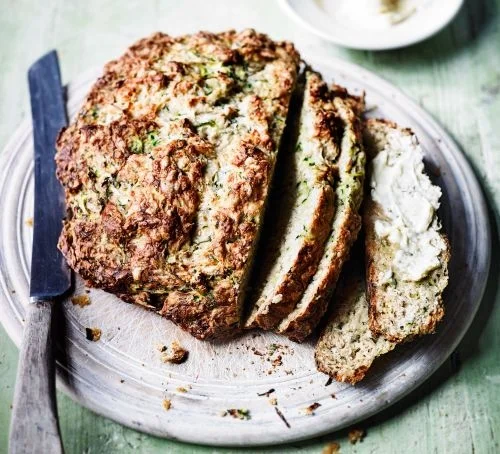
Courgette and Cheddar Soda Bread

This is a tasty savoury variation on traditional soda bread.

  • 400g self-raising flour, plus extra for dusting
  • 2 medium courgettes
  • 50g rolled oats
  • 1½ tsp bicarbonate of soda 
  • 1tsp fine salt
  • 75g mature cheddar, grated
  • small bunch thyme, leaves only
  • 284ml pot buttermilk
  • 1 tbsp clear honey
  • 1 egg, beaten
courgette-cheddar-soda-bread.jpg


  • Heat oven to 200C/180C fan/gas 6 and dust a baking sheet with a little flour. Place a box grater on top of a clean tea towel and coarsely grate the courgettes. Lift the corners of the tea towel and, holding it over the sink, twist to compact the courgettes and squeeze out as much liquid as you can.

  • Put the flour, oats, bicarb and 1 tsp fine salt in a large bowl. Add most of the cheddar (save a little for the top), the thyme and the courgette. Mix the buttermilk and honey, then pour into the flour mixture. Stir with a wooden spoon until the dough starts to clump together, then tip onto a work surface and knead briefly to bring all the loose bits together – try not to overwork the dough or the bread will be heavy.

  • Shape into a round loaf and place on the baking sheet. Brush with egg and sprinkle with the remaining cheese. Use a sharp knife to score a deep cross on top of the loaf, then bake for 40 mins until deep golden brown. Best served warm, but leftovers will keep for 1-2 days.

Recipe from BBC GoodFood

Specimen of the Month - Spring Time Pruning

Every month we feature two blogs written by volunteers, one describes an object in the Palace and one a plant from the Garden. It is a great way for us all to learn more about the Palace, if you would like to contribute there is no set format so please do send us your ideas!

This month, with a spring in our step, Jamie gives us his take on pruning.

Spring time arrives all too soon - 
Time for me to have my "hard" prune.
More than one hundred years old but must submit
To secateurs and loppers, as bit by bit
The gardening team exercise their craft,
(And on their part a lot of hard graft),
To make me presentable, trim and neat,
So that in May you can say how sweet
Are my racemes and pedicels -
Lovelier far than phlox or harebells.
I have neither secretary nor amanuensis,
So this is written by Wisteria sinensis.

Poem by Jamie Atwell

Please send your ideas for Object / Specimen of the Month blogs to rachel.bray@fulhampalace.org If you would like some help, let us know.
Object of the Month - Mitre

Every month we feature two blogs written by volunteers, one describes an object in the Palace and one a plant from the Garden. It is a great way for us all to learn more about the Palace, if you would like to contribute there is no set format so please do send us your ideas!

Firstly I would like to say how much I enjoy coming to Fulham Palace and work as a volunteer. Secondly, I want to say that my favourite room is Bishop Howley’s Dining Room (the Museum). I love all the photographs, information, paintings and the video.

I am impressed with what the bishops have to wear, especially the various hats shown in this room. I am particularly fascinated by the bishop’s mitre with its characteristic kite-like shape.

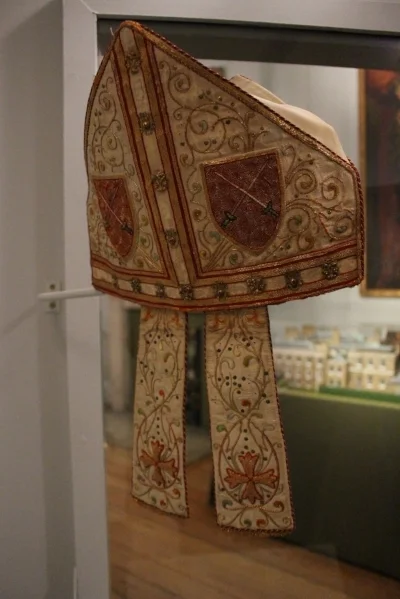
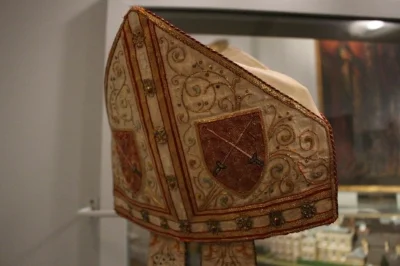
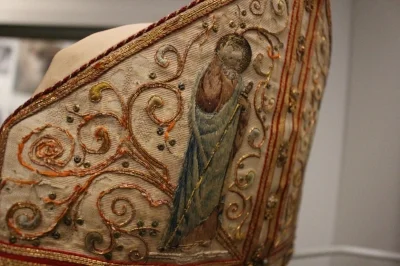
The mitre on display in the museum was made for Bishop Winnington-Ingram around 1901-1910. It is made of silk damask with embroidery and is set with semi-precious stones. The bishop wore the mitre on many occasions, including the 1937 coronation of King George VI.

Bishop Winnington-Ingram's mitre, ca. 1901-1910.

Bishop Winnington-Ingram's mitre, ca. 1901-1910.

The mitre is the ceremonial head-dress of bishops and wearing it is a Christian tradition. In the Church of England; however, the mitre fell out of use after the Reformation, but it was restored in the late 19th and early 20th centuries. Bishop Creighton, Bishop of London from 1897 to 1901 is supposed to have been the first Anglican Bishop to re-introduce the mitre. Most bishops of the Anglican Communion now wear it on at least a few occasions each year.

To get an idea of the alternative hats bishops used to wear, we have several pictures of specimens on the mirrored display next to the mitre. On top of the information board we can see Bishop Winnington-Ingram wearing a top hat and a friend next to him wearing a mortar board. The mortar board is the stiffer version of the square cap, the hat of choice for the bishops from the 16th to the 17th century. The square cap had various designs over the centuries and at times was fairly large and floppy. It was often worn over a flat skull cap. The latter would also be worn on its own, for example by Bishop Edmund Grindal (Bishop of London from 1559-1570).

The wig then became the popular fashion in the 18th century and was mostly worn on its own until it disappeared in the 1830s. The Victorian bishops wore either a mortar board or a top hat.

I have seen many children being very impressed with the different hats during my stewarding sessions so far and I am looking forward to discover many more interesting things around this beautiful palace.

Sandra Cooper, Museum Steward

Please send your ideas for Object / Specimen of the Month blogs to rachel.bray@fulhampalace.org If you would like some help, let us know.