
Every month we feature two blogs written by volunteers, one describes an object in the Palace and one a plant from the Garden. It is a great way for us all to learn more about the Palace, if you would like to contribute there is no set format so please do send us your ideas!
Conservation In Action (C.I.A.) On Tour: A Visit to Fulham Palace's Brick Manufacturers
How many people look at the brickwork closely when walking through the arch into the courtyard of Fulham Palace? I certainly didn’t, and my overall impression was that we had ageing Tudor bricks which had been subjected to a bit of weathering over time.
The reality is that the Palace’s Tudor brickwork has been subjected to one or two past ‘make-overs’ where for example, some Tudor bricks have been replaced by modern bricks that are not of the same size or quality. More importantly where repointing has been carried out a black ash mortar has been used which is dull and holds water causing a more rapid deterioration of the bricks. Closer examination reveals that the brickwork is, at best ‘not aesthetically pleasing’ and at worst, has been subject to a bit of a ‘bodge job’. Experts have recommended that we replace 1700 bricks (700 of which will be specials) and that the ‘wrong’ mortar is dug out and replaced by a traditional ‘hot lime’ mortar which allows the brickwork to breath and dry out.
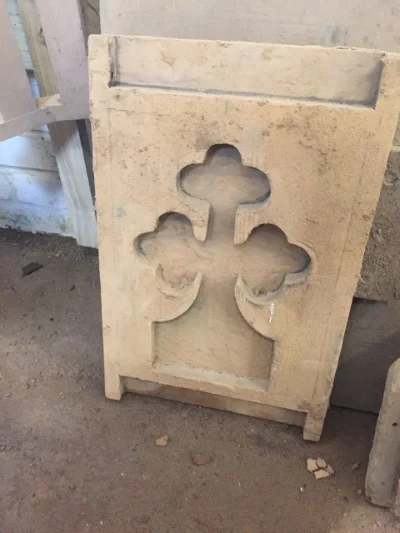
Decorative mould used by H. G. Matthews
The good news is that Fulham Palace is using H. G. Matthews, a traditional and expert brick maker and a group of volunteers and Palace management went to visit them this month to see the new Palace bricks being made.
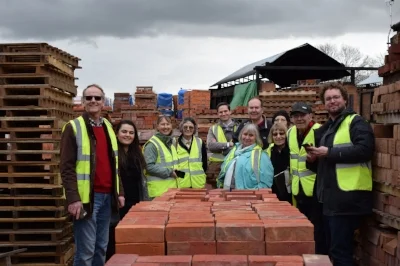
A group of volunteers and Palace management at H. G. Matthews' expert brick makers
The brickworks is set in Buckinghamshire farmland close to where the quality clay lies, and as you arrive your attention is drawn to the piles of timber, 25 tons of which is used each week for burning in the boilers and kilns. Looking down you see a rich yellowish red sludge (clay residue) seeping over your boots and become aware of constant buzz of activity between the buildings involved in the various processes.
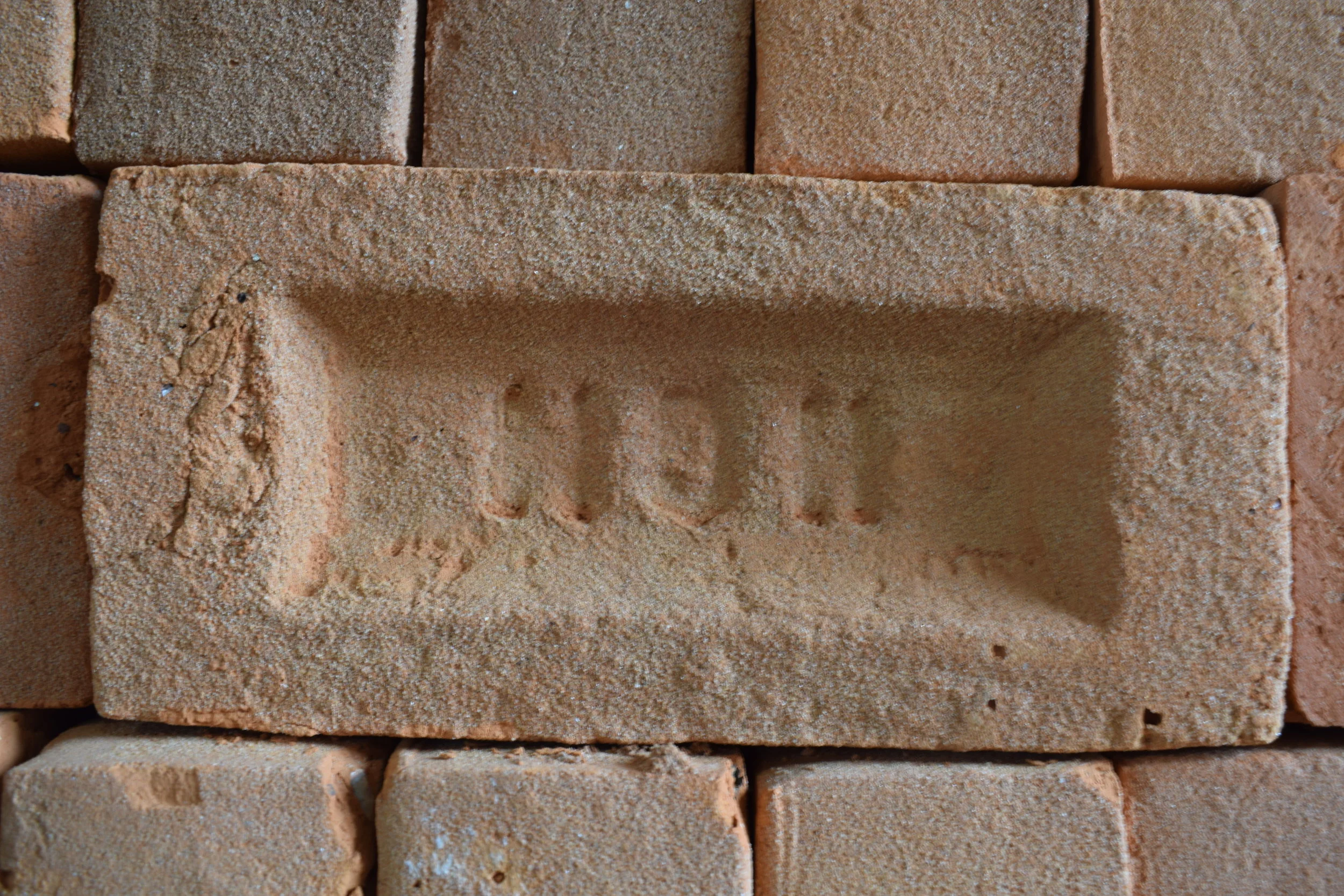
An H. G. Matthews brick
H. G. Matthews is a family concern, manufacturing bricks since 1923, and Trafford Matthews, one of the current directors, took us through each stage of brick making. His enthusiasm was contagious. He explained that they extract about 6 months' supply of clay at a time largely in the Summer when digging is easier. This is then stored at the works, but before it is used they mix the clay with rainwater from the shed roofs to make it workable; it is then fed through rollers to crush flints, chalk and stones. Too much chalk in the clay causes the brick to explode during firing. Once rolled, the mound of clay is fed into the sheds where the brick makers grab a lump and work it, rather like bread dough. The brick maker scatters sand into each mould to line it, before slapping the worked clay into it and removing any surplus from the top. The moulds are placed onto boards, four at a time, and the bricks are then turned out of the moulds onto another board before putting on a rack (stillage) which holds up to 216 bricks. These stillages are then moved to a drying room, where boilers fed by wood chips keep a steady temperature (50 degrees Centigrade) dry up to 17,000 bricks slowly over 5 days. During this process, they shrink by 10% and lose about a pint of water. If the drying is too fast, the bricks crack and are useless.
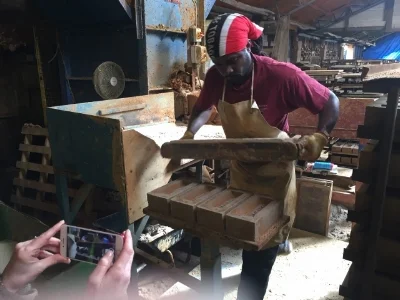
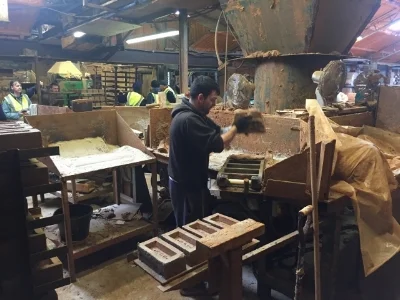
What impressed us all most was the speed and accuracy at which the brick makers worked. They fill at least 4 stillages a day, i.e. they make 864 bricks. Think of the weight of a brick and add 10% ,multiply by 4 on a board and you get very fit brick makers.
After drying, the bricks can then be fired. I was expecting something like the Fulham Pottery shaped kiln, but those at Matthews were more like rectangular sheds, 12 ‘ high with fire openings at the side and a wide door opening to allow forklifts to enter. Just before firing, a door is hung, fire bricks are added to the top layer of the kiln and the roof is removed. Matthews use both oil and wood fired kilns, the latter being used for the more specialist bricks such as ours.
There are three kilns being worked at any one time. One is being filled, one is being fired and one is being emptied. Why so many? It is because each kiln takes approximately a week to fill with 70,000 bricks, which all have to be manually set on their side. When the kiln is fired, it takes at least 24 hours to reach temperatures of 1100 degrees centigrade throughout the kiln, another 2-3 days for the bricks to cool down and a further week to remove them to a storage area. We noticed that the bricks coming out of the kiln were different in colour and found out that there are different temperature zones within the kiln and those bricks closest to the fire openings get the greatest heat which affects the colouration. Those nearest the firing, are generally darker and may get a greyer hue.
Seeing skilled brick-making was amazing and I know that most of the volunteers would like to go back for another visit, but work has started at Fulham Palace and Sykes who are carrying out the conservation building works are already chipping out the old mortar and removing broken bricks. Sykes will lay the new bricks with new hot lime mortar, so we will all be busy showing visitors the work and hoping that they will sponsor one of the bricks made especially for us in a traditional way by F. G Matthews. The Tudor courtyard will look fantastic when the works are completed but any sponsorship we can get will be fantastic.
Ann Russell, Conservation In Action and Archaeology Volunteer
Please send your ideas for Object / Specimen of the Month blogs to rachel.bray@fulhampalace.org If you would like some help, let us know.