
Every month we feature two blogs written by volunteers, one describes an object in the Palace and one a plant from the Garden. It is a great way for us all to learn more about the Palace, if you would like to contribute there is no set format so please do send us your ideas!
Firstly I would like to say how much I enjoy coming to Fulham Palace and work as a volunteer. Secondly, I want to say that my favourite room is Bishop Howley’s Dining Room (the Museum). I love all the photographs, information, paintings and the video.
I am impressed with what the bishops have to wear, especially the various hats shown in this room. I am particularly fascinated by the bishop’s mitre with its characteristic kite-like shape.
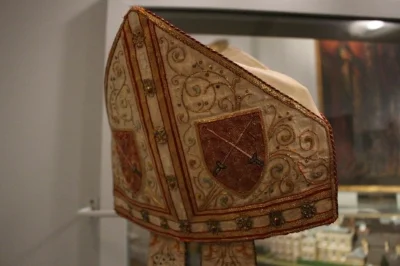
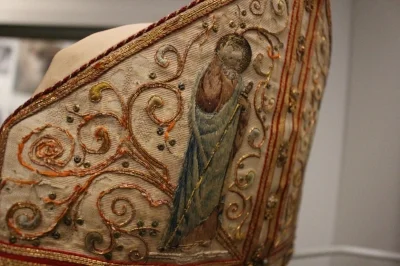
The mitre on display in the museum was made for Bishop Winnington-Ingram around 1901-1910. It is made of silk damask with embroidery and is set with semi-precious stones. The bishop wore the mitre on many occasions, including the 1937 coronation of King George VI.
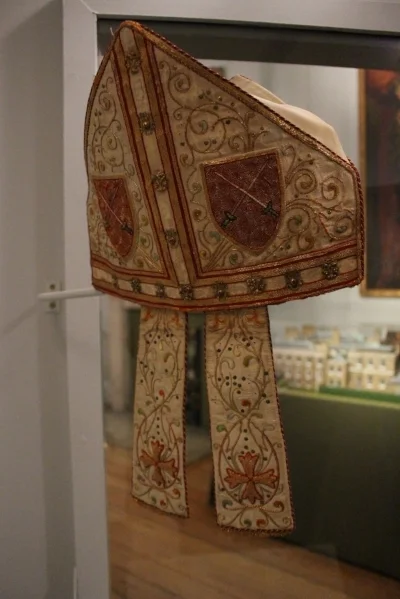
Bishop Winnington-Ingram's mitre, ca. 1901-1910.
The mitre is the ceremonial head-dress of bishops and wearing it is a Christian tradition. In the Church of England; however, the mitre fell out of use after the Reformation, but it was restored in the late 19th and early 20th centuries. Bishop Creighton, Bishop of London from 1897 to 1901 is supposed to have been the first Anglican Bishop to re-introduce the mitre. Most bishops of the Anglican Communion now wear it on at least a few occasions each year.
To get an idea of the alternative hats bishops used to wear, we have several pictures of specimens on the mirrored display next to the mitre. On top of the information board we can see Bishop Winnington-Ingram wearing a top hat and a friend next to him wearing a mortar board. The mortar board is the stiffer version of the square cap, the hat of choice for the bishops from the 16th to the 17th century. The square cap had various designs over the centuries and at times was fairly large and floppy. It was often worn over a flat skull cap. The latter would also be worn on its own, for example by Bishop Edmund Grindal (Bishop of London from 1559-1570).
The wig then became the popular fashion in the 18th century and was mostly worn on its own until it disappeared in the 1830s. The Victorian bishops wore either a mortar board or a top hat.
I have seen many children being very impressed with the different hats during my stewarding sessions so far and I am looking forward to discover many more interesting things around this beautiful palace.
Sandra Cooper, Museum Steward
Please send your ideas for Object / Specimen of the Month blogs to rachel.bray@fulhampalace.org If you would like some help, let us know.