Specimen of the month: Abundant April

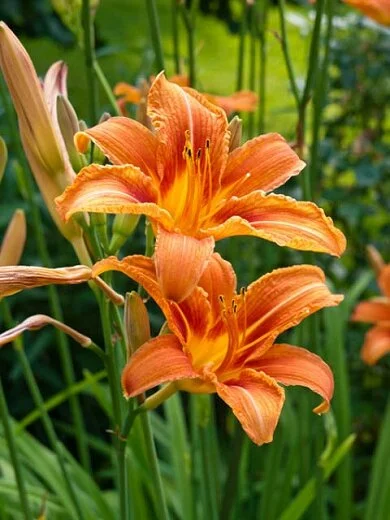
A blooming day lily

A blooming day lily

Every month we feature two blogs written by volunteers, one describes an object in the Palace and one a plant from the Garden. It is a great way to learn more about the Palace. If you would like to contribute there is no set format so please do send in your ideas.

This April we are grateful to Simon Titley, garden volunteer, for his vivid virtual tour of the Palace garden in April.

It’s April 2020 and everything is bursting into bud, leaf and blossom. Sadly, as we are in the middle of CV 19 lockdown, we can’t visit Fulham Palace but we can enjoy the pictures on the website and of course our memories. So, let us instead look forward to late spring and early summer when hopefully we might be back out and about.

I have always found it interesting how plants come in and out of fashion over time. For much of my gardening years, whites, blues, pastel shades and mauves were in vogue but I have noticed how hot colours have once again become desirable. Bright orange shades are back!!

Marigolds in the walled garden beds at Fulham Palace

Marigolds in the walled garden beds at Fulham Palace

In Fulham Palace we grow many summer flowering annual plants including; Marigolds - Tagetes, several traditional varieties and also the stunning larger silvery green leaved orange and yellow calendula, all of which are planted around the vegetable beds to great effect. Mexican Sunflower – Tithonia orange is one I had never seen, until I worked in Fulham Palace.  60-90cms in height with soft slightly hairy leaves, covered in bright orange or red/orange flowers, it looks great in the borders and the flowers are ideal for cutting.

Of course Dahlias come in many shades and apart from the traditional Palace Bishop varieties we also grow Dahlias with exciting names like disco dancer and clangers mix, both of which have orange variations. Zinnias, those very upright rather stiff plants, the flowers great for cutting also come in many shades including orange. The Day Lily – Hemerocallis is a great border plant. Don’t forget, the trumpet like flowers which usually open in the morning but die by nightfall. However, each flower stem called a scape typically carry at least a dozen flower buds so the plant stays in bloom for several weeks.
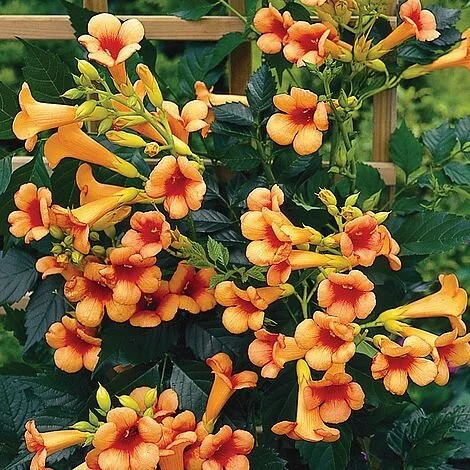
A close up of the wonderful climber Campsis

A close up of the wonderful climber Campsis

So, is there anything new? 

Last year on the outside of the walled garden facing east towards the church, we planted several Campsis-radicans – trumpet vine. This is a great climber originating from the USA and with the wired support, just in front of the wall, will eventually cover large sections of the wall. The ash-like green foliage produce rather exotic large trumpet looking red /orange blooms from mid to late summer.
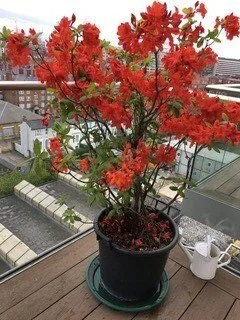
Simon’s azalea in full bloom

Simon’s azalea in full bloom

Last May we planted an Azalea – firework, which had flourished in a large pot in my garden in West Dorset. Its flowers are bright orange and scented in mid-May, then its leaves gradually turn to a lovely copper colour into the autumn. I didn’t want to leave it behind so brought it to London. Sadly, it didn’t like my west facing balcony, too windy and wet in the winter, too dry and hot in the summer. The leaves got mildew, dried out and dropped off. Rather than letting it decline further, I offered it to Lucy and it is now planted in front of the south wall in the walled garden in a bed with a cooler shady north east aspect. We hope it recovers.

Alstromeria bouquet

Alstromeria bouquet

Finally, I will mention another of my favourites – Alstroemeria – Indian Summer. Originating from South America and otherwise known as the ‘Peruvian Lily’ or ‘Lily of the Incas’, it is named after a Swedish baron, Claus von Alstromer, who brought the seeds back to Europe in the mid-1700s. This flower symbolises friendship, while each of the six Alstroemeria petals supposedly representing a special characteristic: understanding, humour, patience, empathy, commitment and respect. Its tubular roots are rather invasive but kept under control it is very rewarding producing many 30-45cm spikes of orange flowers. The petals are intricately patterned with fine brush stroke markings and flowers from early June to the first frosts. It is great for flower displays.

So, I am looking forward to mid-May and beyond, when the first of these orange flowers will start to make an appearance and hope that we will all be able to come back to Fulham Palace and enjoy them.

Simon Titley,

Fulham Palace Garden Volunteer

Thank you to Simon for this fantastic blog. Please send your ideas for object or specimen of the month blogs to rachel.bagnall-bray@fulhampalace.org. If you would like some help, please let me know.
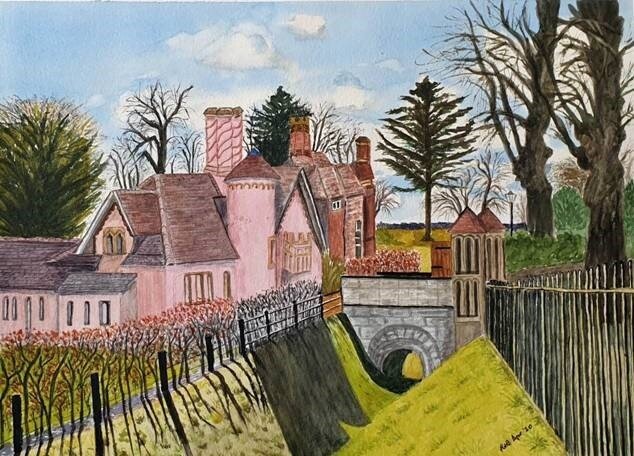

Rosemary Arbiter, A Watercolour Painting

Garden volunteer Ronny kindly shared his friends Rosemary Arbiter’s beautiful watercolour of the main Palace entrance, painted during the lockdown.

Enjoy Rosemary’s wonderful depiction of Gothic lodge and the moat bridge - a familiar view for all of us of the entrance to the Palace from Bishop’s Avenue.

Rosemary has kindly given me permission to share the image of her watercolour with you on this website, but please don’t take this image and use it elsewhere else.

FP Gates - Rosemary Arbiter.jpg

Architecture Quiz

Since most of you have been looking at the same four walls for the past few weeks, Naomi, a volunteer in the Learning Department, has put together a fun quiz to test how well you remember the lovely red-bricked walls of the Palace. Click below to take this Fulham Palace Architecture Quiz!

Hint: Most of the questions are derived from blogs on either the main website or volunteers portal.

powered by Typeform

Remember, through these difficult circumstances, we really hope you will get in touch with us at any time, over phone or email, if you need anything or would like a chat.

Bountiful bird song

One of the positives at such a difficult time is how the natural world is thriving, in part due to lower carbon emissions while we stay local to home. I hope you’ve had chance to spend some time outside enjoying the lovely weather we’ve had over the last few weeks, and also perhaps soaking up some springtime birdsong.

Suzanne Taylor, archaeology volunteer, has kindly shared this wonderful feature from the website of the Museu del Ter, Catalonia. Here you can enjoy listening to birdsong from home… and why not also see if you can identify any of the birds. Happy listening: https://coneixelriu.museudelter.cat/ocells.php

Virtual bird song.jpg

Online shop launch - Monday 6 April

You heard it here first… we’re launching an online shop on Monday 6 April!

Fulham Palace book.jpg

Please take a look here where you’ll see the shop from Monday onwards.

You will receive your volunteer discount by typing BishopHope into the promotional code box. The same exceptions apply so your discount applies to everything apart from plants, Palace preserves and jewellery.

Happy shopping!

Take care,

Rachel

Volunteer and communities manager

Specimen of the month: Wellingtonia

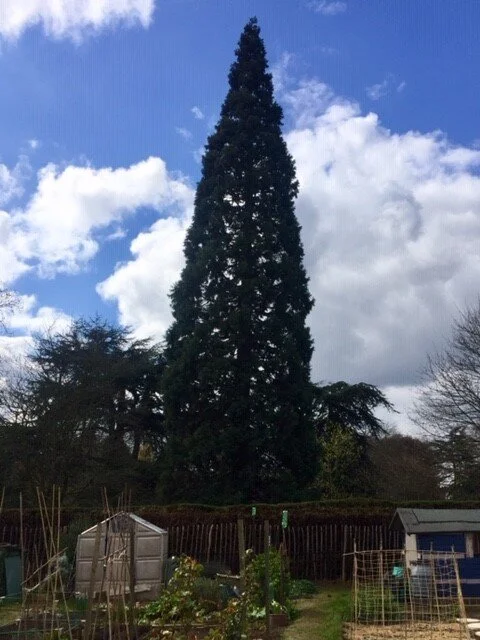
Wellingtonia, as seen from the allotments

Wellingtonia, as seen from the allotments

Every month we feature two blogs written by volunteers, one describes an object in the Palace and one a plant from the Garden. It is a great way to learn more about the Palace. If you would like to contribute there is no set format so please do send in your ideas.

This March we are grateful to George Chamier, Garden volunteer.

Take the path which runs beside the yew hedge separating the Palace grounds from the allotments, and you will come upon one of Fulham Palace’s specimen trees. This is a Wellingtonia (Sequoiadendron giganteum), otherwise known as giant sequoia, giant redwood, sierra redwood or simply ‘the big tree’.

Planted probably in the 1950s, ours is already a fine tree at more than 50ft tall. But this is nothing compared to what it might become. Put simply, mature Wellingtonias are the most massive living things on the planet. In the Sierra Nevada mountains of California, their home, the biggest are around 300ft tall (three times the height of a good mature oak) and more than 3,000 years old. The statistics of ‘General Sherman’, the largest still standing, are mind-boggling: 275ft high, 103ft in circumference at the base and containing 52,000 cubic feet of timber weighing 2,100 tons.

These trees have been in Britain since Victorian plant hunters brought seeds and cuttings back from California in the 1850s and christened them after the Duke of Wellington, victor of Waterloo and recently deceased national hero. The name remains peculiar to the UK; the Americans attempted to name them ‘Washingtonia’, and in most places they are known as redwoods or sequoias.  They like our moist, fairly cool climate and grow well here, especially in the north; the tallest is at Benmore in south-west Scotland, a young giant of almost 200ft.

Seen from the allotments (the best view of it) ours is a beautifully regular tapering cone of dark green – so perfect, in fact, that it might almost be a piece of topiary.  

Climbing trees is not permitted in the Palace grounds, but this failed to deter a young friend of mine, a ‘guerrilla tree-climber’ for whom the Wellingtonia presented an irresistible challenge. This is how he described his climb:

A few feet off the ground and the wall of leaves seems to heat the wind. I am cocooned inside the tree’s veil and bathed in a warm, scented air – the fragrance of the American West. I could be lost on the tree’s native slopes in the Sierra Nevada, with bears instead of tourists moving about below . . . I climb until the branches taper to twigs, taking care to move slowly and avoid breaking off smaller limbs. Stopping some way shy of the summit, I breathe hard, an arm round the soft trunk.*

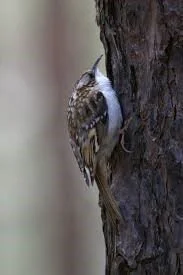
Treecreeper

Treecreeper

A feature of the Wellingtonia which Jack noticed is its remarkable bark (‘Putting hand to trunk, the bark is orange and fibrous; a thick, fire-resistant skin.’)  This bark can be as much as 3ft thick at the base of the biggest trees, it is soft and spongy and it provides a home for one of our most delightful small birds, the treecreeper (Certhia familiaris). As its name suggests, this little bird creeps up the trunk and branches of trees probing the bark with its hooked bill for the small invertebrates on which it feeds and looking more like a mouse than a bird – I cannot remember ever seeing one in flight. Like all very small birds, they suffer in hard winters, but the Wellingtonia provides them with a perfect refuge; the bark is so soft that they can excavate a roosting hole in it, where its insulating qualities keep them warm on the coldest nights. I have yet to see a treecreeper in the Palace grounds, but I know they are here – gardener Chris Richardson has seen them.

What I should really like is to come back to Fulham Palace in a hundred years time to see our Wellingtonia, now heading for 200ft, a landmark visible from Chelsea to Barnes and home to several pairs of treecreepers.

George Chamier, Garden volunteer

*For more stories of climbing London’s trees (he also had a go at the Copper Beech on the main lawn and the ‘Split Yew’ in All Saints churchyard), see: Jack Cooke, The Tree Climber’s Guide: adventures in the urban canopy, Harper Collins, 2016.

Thank you to George for this fantastic blog about such a distinctive tree at the Palace. Please send your ideas for object or specimen of the month blogs to rachel.bagnall-bray@fulhampalace.org. If you would like some help, please let me know.

Call for Christmas card designs

PicsArt_03-23-11.44.57.jpg

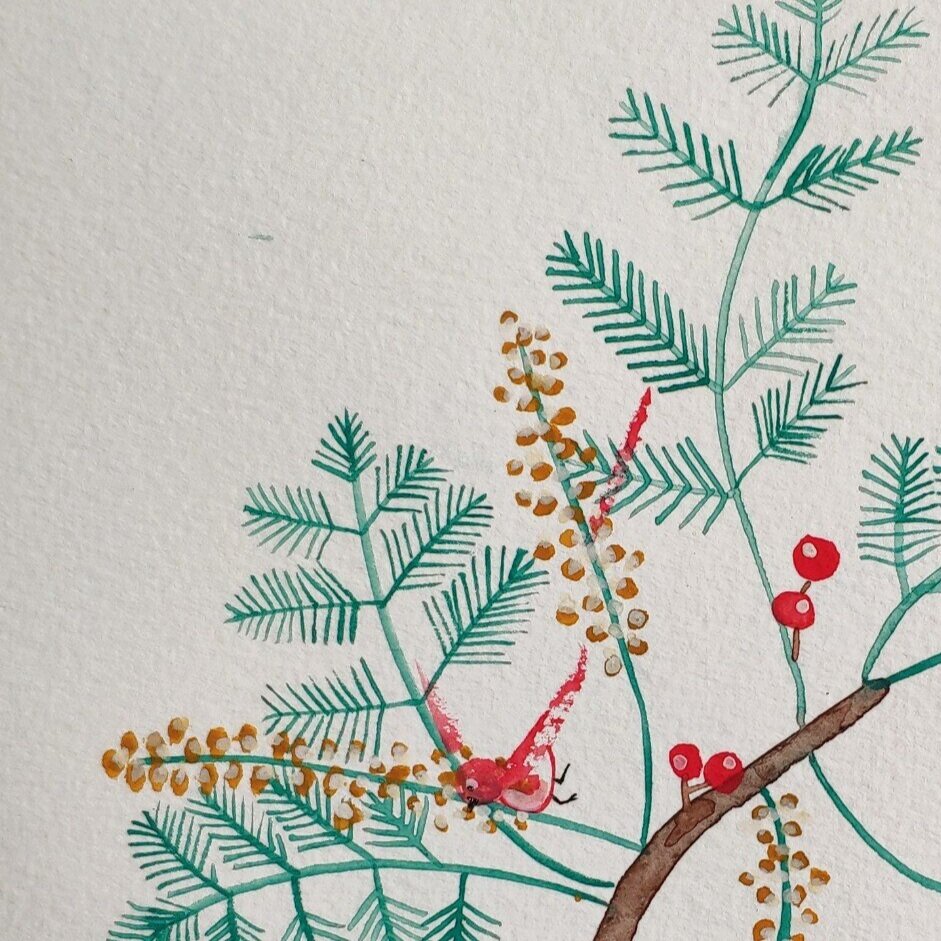
We are very excited to announce our Fulham Palace illustrated Christmas card competition! With some of you having a bit more free time on your hands (cutting out the commute) this is a chance to get creative and bring out your inner Bob Ross.

PicsArt_03-24-01.24.42.jpg

The prize

The winning design will be used to make Fulham Palace Christmas cards, which will be sold to raise valuable funds for the charity. This is a great way to channel your creativity to support the Palace.

The winner will receive a £20 gift card to spend in the wonderful Palace shop, as well as a complimentary pack of cards so you can spread the Christmas cheer to your nearest and dearest.

The details

The design can be produced in any medium of your choice - paint, printing, textiles, or mixed media - the world is your oyster. Please bring to your design what makes you express yourself and what will make your design stand out as uniquely your own. It can be A5 or A6 sized.

Naturally, it must be Christmas and Fulham Palace themed. This can be interpreted in any way you like. The Palace has a rich and layered history to find inspiration from. The site has been traversed by Late Mesolithic people, occupied by Romans, Vikings and Tudors, and still has its history developing today! You could look at one of the Bishops that lived in the Palace or perhaps portray Christmas at the Palace through the eyes of lesser-known people that experienced it on a daily basis.

Or, maybe you’ll choose something from the historic garden to inspire your design.

Submitting your piece

Please submit your design by Monday 18 May via email to the Palace retail manager, at retail@fulhampalace.org or by post, addressed to the retail manager, Fulham Palace, London, SW6 6EA.

We look forward to seeing what you come up with!

PicsArt_03-24-01.23.59.jpg

Blog post and illustrations by Naomi Jennings - O’Toole