
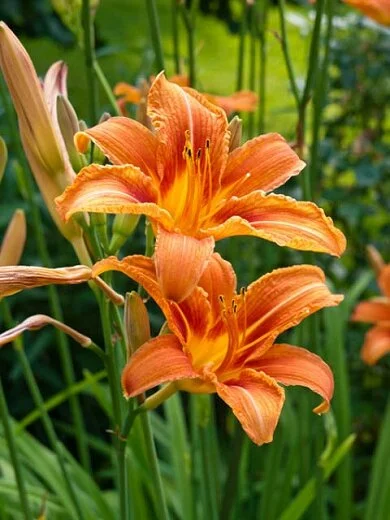
A blooming day lily
Every month we feature two blogs written by volunteers, one describes an object in the Palace and one a plant from the Garden. It is a great way to learn more about the Palace. If you would like to contribute there is no set format so please do send in your ideas.
This April we are grateful to Simon Titley, garden volunteer, for his vivid virtual tour of the Palace garden in April.
It’s April 2020 and everything is bursting into bud, leaf and blossom. Sadly, as we are in the middle of CV 19 lockdown, we can’t visit Fulham Palace but we can enjoy the pictures on the website and of course our memories. So, let us instead look forward to late spring and early summer when hopefully we might be back out and about.
I have always found it interesting how plants come in and out of fashion over time. For much of my gardening years, whites, blues, pastel shades and mauves were in vogue but I have noticed how hot colours have once again become desirable. Bright orange shades are back!!

Marigolds in the walled garden beds at Fulham Palace
In Fulham Palace we grow many summer flowering annual plants including; Marigolds - Tagetes, several traditional varieties and also the stunning larger silvery green leaved orange and yellow calendula, all of which are planted around the vegetable beds to great effect. Mexican Sunflower – Tithonia orange is one I had never seen, until I worked in Fulham Palace. 60-90cms in height with soft slightly hairy leaves, covered in bright orange or red/orange flowers, it looks great in the borders and the flowers are ideal for cutting.
Of course Dahlias come in many shades and apart from the traditional Palace Bishop varieties we also grow Dahlias with exciting names like disco dancer and clangers mix, both of which have orange variations. Zinnias, those very upright rather stiff plants, the flowers great for cutting also come in many shades including orange. The Day Lily – Hemerocallis is a great border plant. Don’t forget, the trumpet like flowers which usually open in the morning but die by nightfall. However, each flower stem called a scape typically carry at least a dozen flower buds so the plant stays in bloom for several weeks.
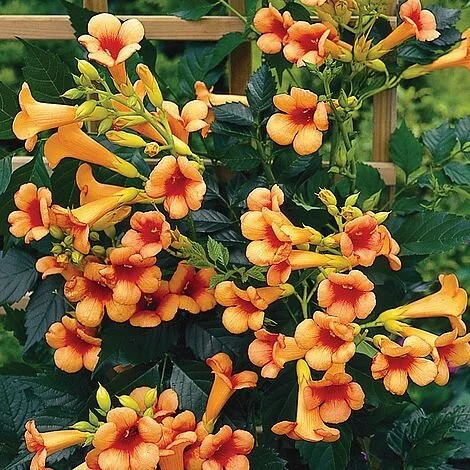
A close up of the wonderful climber Campsis
So, is there anything new?
Last year on the outside of the walled garden facing east towards the church, we planted several Campsis-radicans – trumpet vine. This is a great climber originating from the USA and with the wired support, just in front of the wall, will eventually cover large sections of the wall. The ash-like green foliage produce rather exotic large trumpet looking red /orange blooms from mid to late summer.
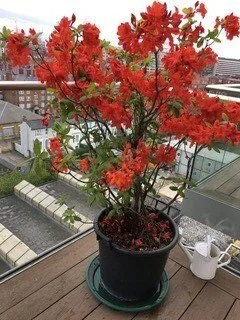
Simon’s azalea in full bloom
Last May we planted an Azalea – firework, which had flourished in a large pot in my garden in West Dorset. Its flowers are bright orange and scented in mid-May, then its leaves gradually turn to a lovely copper colour into the autumn. I didn’t want to leave it behind so brought it to London. Sadly, it didn’t like my west facing balcony, too windy and wet in the winter, too dry and hot in the summer. The leaves got mildew, dried out and dropped off. Rather than letting it decline further, I offered it to Lucy and it is now planted in front of the south wall in the walled garden in a bed with a cooler shady north east aspect. We hope it recovers.
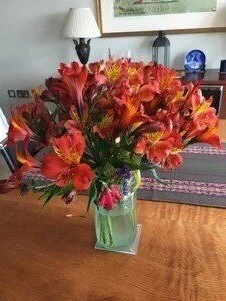
Alstromeria bouquet
Finally, I will mention another of my favourites – Alstroemeria – Indian Summer. Originating from South America and otherwise known as the ‘Peruvian Lily’ or ‘Lily of the Incas’, it is named after a Swedish baron, Claus von Alstromer, who brought the seeds back to Europe in the mid-1700s. This flower symbolises friendship, while each of the six Alstroemeria petals supposedly representing a special characteristic: understanding, humour, patience, empathy, commitment and respect. Its tubular roots are rather invasive but kept under control it is very rewarding producing many 30-45cm spikes of orange flowers. The petals are intricately patterned with fine brush stroke markings and flowers from early June to the first frosts. It is great for flower displays.
So, I am looking forward to mid-May and beyond, when the first of these orange flowers will start to make an appearance and hope that we will all be able to come back to Fulham Palace and enjoy them.
Simon Titley,
Fulham Palace Garden Volunteer
Thank you to Simon for this fantastic blog. Please send your ideas for object or specimen of the month blogs to rachel.bagnall-bray@fulhampalace.org. If you would like some help, please let me know.