
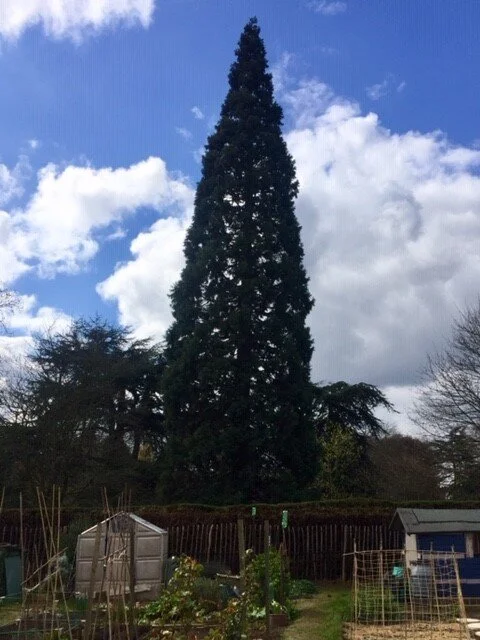
Wellingtonia, as seen from the allotments
Every month we feature two blogs written by volunteers, one describes an object in the Palace and one a plant from the Garden. It is a great way to learn more about the Palace. If you would like to contribute there is no set format so please do send in your ideas.
This March we are grateful to George Chamier, Garden volunteer.
Take the path which runs beside the yew hedge separating the Palace grounds from the allotments, and you will come upon one of Fulham Palace’s specimen trees. This is a Wellingtonia (Sequoiadendron giganteum), otherwise known as giant sequoia, giant redwood, sierra redwood or simply ‘the big tree’.
Planted probably in the 1950s, ours is already a fine tree at more than 50ft tall. But this is nothing compared to what it might become. Put simply, mature Wellingtonias are the most massive living things on the planet. In the Sierra Nevada mountains of California, their home, the biggest are around 300ft tall (three times the height of a good mature oak) and more than 3,000 years old. The statistics of ‘General Sherman’, the largest still standing, are mind-boggling: 275ft high, 103ft in circumference at the base and containing 52,000 cubic feet of timber weighing 2,100 tons.
These trees have been in Britain since Victorian plant hunters brought seeds and cuttings back from California in the 1850s and christened them after the Duke of Wellington, victor of Waterloo and recently deceased national hero. The name remains peculiar to the UK; the Americans attempted to name them ‘Washingtonia’, and in most places they are known as redwoods or sequoias. They like our moist, fairly cool climate and grow well here, especially in the north; the tallest is at Benmore in south-west Scotland, a young giant of almost 200ft.
Seen from the allotments (the best view of it) ours is a beautifully regular tapering cone of dark green – so perfect, in fact, that it might almost be a piece of topiary.
Climbing trees is not permitted in the Palace grounds, but this failed to deter a young friend of mine, a ‘guerrilla tree-climber’ for whom the Wellingtonia presented an irresistible challenge. This is how he described his climb:
A few feet off the ground and the wall of leaves seems to heat the wind. I am cocooned inside the tree’s veil and bathed in a warm, scented air – the fragrance of the American West. I could be lost on the tree’s native slopes in the Sierra Nevada, with bears instead of tourists moving about below . . . I climb until the branches taper to twigs, taking care to move slowly and avoid breaking off smaller limbs. Stopping some way shy of the summit, I breathe hard, an arm round the soft trunk.*
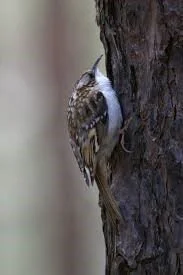
Treecreeper
A feature of the Wellingtonia which Jack noticed is its remarkable bark (‘Putting hand to trunk, the bark is orange and fibrous; a thick, fire-resistant skin.’) This bark can be as much as 3ft thick at the base of the biggest trees, it is soft and spongy and it provides a home for one of our most delightful small birds, the treecreeper (Certhia familiaris). As its name suggests, this little bird creeps up the trunk and branches of trees probing the bark with its hooked bill for the small invertebrates on which it feeds and looking more like a mouse than a bird – I cannot remember ever seeing one in flight. Like all very small birds, they suffer in hard winters, but the Wellingtonia provides them with a perfect refuge; the bark is so soft that they can excavate a roosting hole in it, where its insulating qualities keep them warm on the coldest nights. I have yet to see a treecreeper in the Palace grounds, but I know they are here – gardener Chris Richardson has seen them.
What I should really like is to come back to Fulham Palace in a hundred years time to see our Wellingtonia, now heading for 200ft, a landmark visible from Chelsea to Barnes and home to several pairs of treecreepers.
George Chamier, Garden volunteer
*For more stories of climbing London’s trees (he also had a go at the Copper Beech on the main lawn and the ‘Split Yew’ in All Saints churchyard), see: Jack Cooke, The Tree Climber’s Guide: adventures in the urban canopy, Harper Collins, 2016.
Thank you to George for this fantastic blog about such a distinctive tree at the Palace. Please send your ideas for object or specimen of the month blogs to rachel.bagnall-bray@fulhampalace.org. If you would like some help, please let me know.