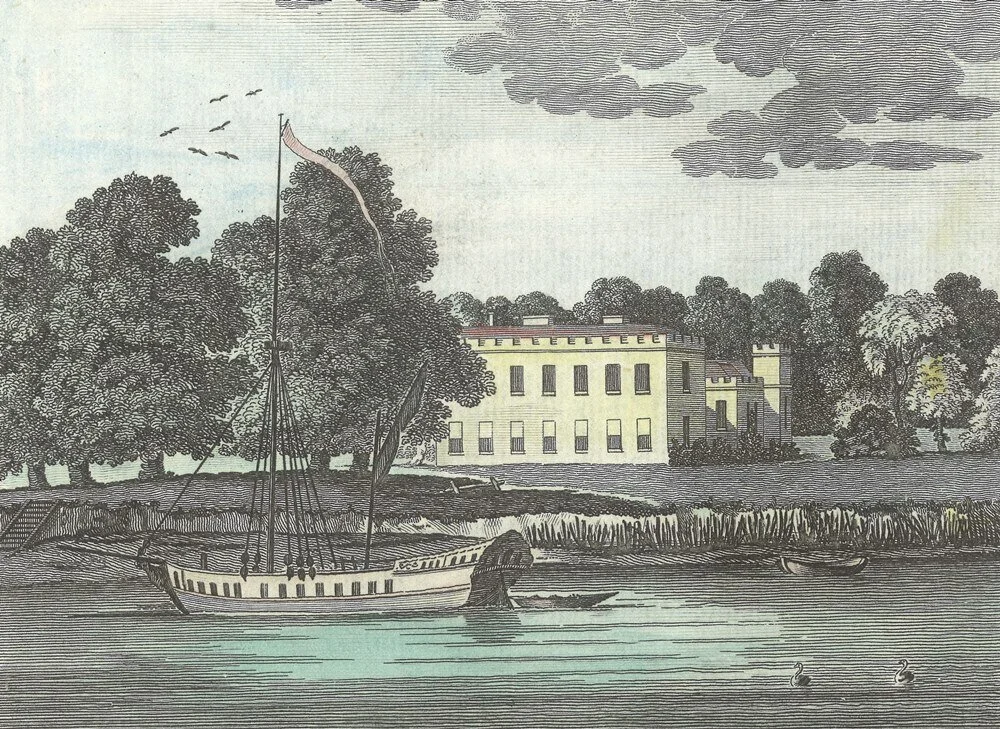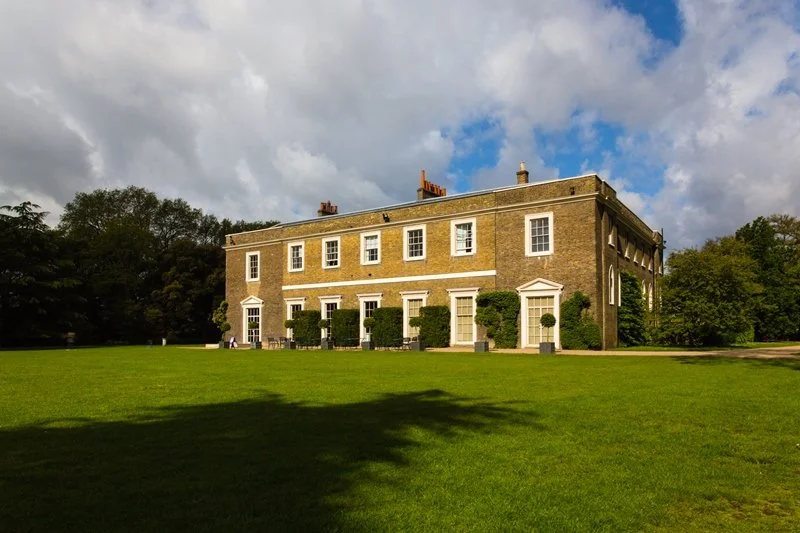
Freemasons Hospital at Fulham Palace

We’re grateful to Naomi Jennings-O’Toole for this fantastic blog.


The story of Fulham Palace as a hospital for injured soldiers during World War I is still being told today, over 100 years later. The Palace volunteer archivists have pieced together the evidence, telling us information about the lives of the staff and patients, the units they served in and the lives they went on to lead following the War. Alexis Haslam, community archaeologist, delivered a presentation that dug into the history of the Palace as a hospital, shedding light on a different perspective to view the Palace.

The lecture was deeply informative, recognising the unimaginable horrors of the front, the healing, peaceful environments of the garden and house as well as the kindness and love extended towards Sister Latchmore, a nurse who served wounded soldiers at the Palace. The lecture also underlined the invaluable input of many volunteers involved in the project, who searched many records for information and the stories of the ordinary people doing extraordinary things.
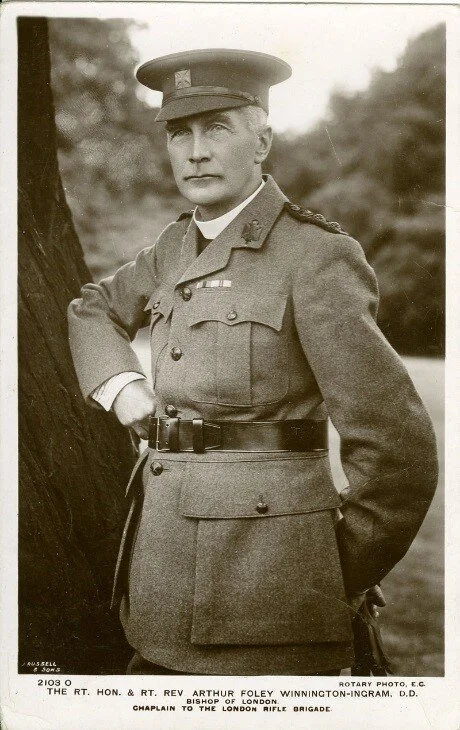
Bishop Winnington-Ingram in his military uniform at Fulham Palace.

Bishop Winnington-Ingram in his military uniform at Fulham Palace.

The Freemasons’ initial plan was to purchase 237 Fulham Road from the Chelsea Hospital for women, which cost them £10,000. It was intended to become a hospital for Freemasons but instead became a war hospital for injured troops returning from the front. Bishop Arthur Winnington-Ingram, who served as the Bishop of London from 1901 to 1939, welcomed war patients to Fulham Palace. Bishop Winnington-Ingram was known for being an active recruiter for the armed services during World War I. However, his adamant support was often controversial. The Prime Minister at the time, Herbert Henry Asquith, described Ingram’s pitches as “jingoism of the shallowest kind”.

In a similar vein, the poem ‘They’, written by Siegfried Sassoon, articulated his views on the church’s recruitment efforts. Siegfried Loraine Sassoon, CBE, MC (8 September 1886 – 1 September 1967) was an English poet, writer, and soldier. Decorated for bravery on the Western Front, he became one of the leading poets of the First World War.

‘They’, by Siegfried Sassoon

The Bishop tells us: ‘When the boys come back

'They will not be the same; for they'll have fought

‘In a just cause: they lead the last attack

'On Anti-Christ; their comrades' blood has bought '

New right to breed an honourable race,

'They have challenged Death and dared him face to face.'

'We're none of us the same!' the boys reply.

'For George lost both his legs; and Bill's stone blind;

'Poor Jim's shot through the lungs and like to die;

'And Bert's gone syphilitic: you'll not find

'A chap who's served that hasn't found some change.

And the Bishop said: 'The ways of God are strange!'


In April 1918, the Bishop offered the Palace to the British Red Cross Society. The offer was passed to the Freemasons, who duly accepted. The opening was a formal occasion, undertaken by the Duke of Connaught. Renamed as ‘Freemasons Hospital No.2’, the Palace was able to house 100 patients. As an auxiliary hospital, most patients were healing from war injuries, many with lost limbs.

The Great Hall was used as the dining room, while the Drawing room and Dining room were converted into wards. According to the Palace’s photography archives, the café we use today was ‘Ward A’. With views stretching over the Palace grounds, the tranquillity and beauty was considered an aid to the patients’ ‘shell shock’. To aid mental healing, patients were encouraged to get involved with the gardens and farming activities, as well as drawing, painting and writing poetry.
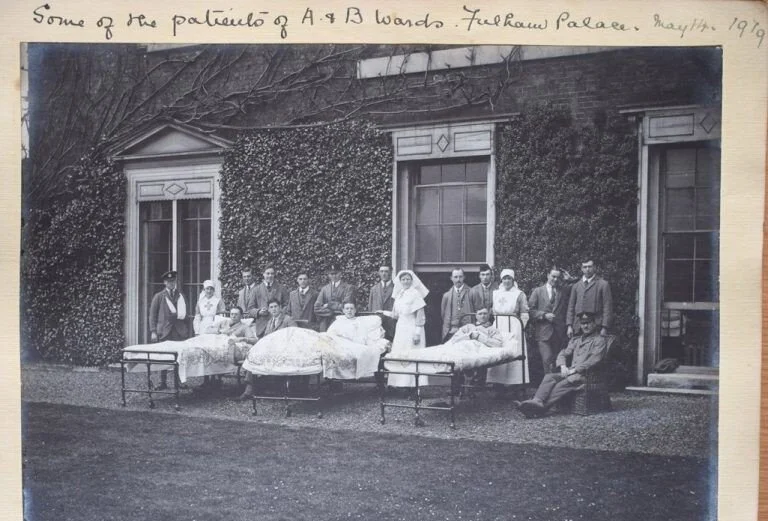
Patients and staff outside Fulham Palace.jpg


Lady Maude Fox-Symons

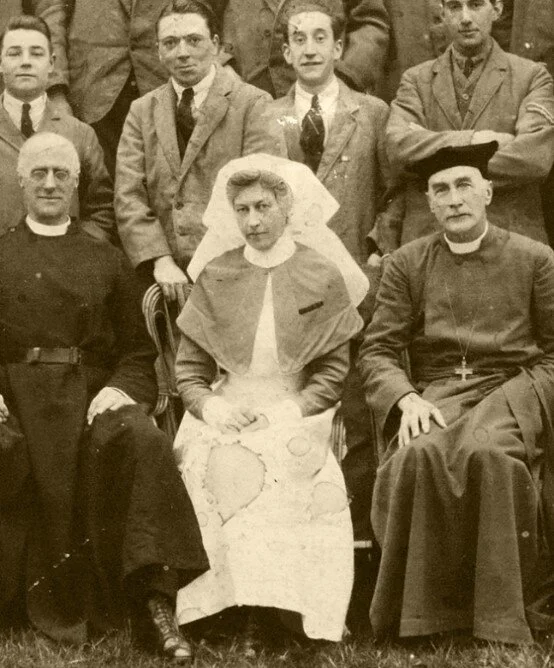
Lady Maude Fox-Symons, Matron at Fulham Palace

Lady Maude Fox-Symons, Matron at Fulham Palace

Also known as ‘Minnie’, Lady Maude Fox-Symons was appointed Matron at the Freemason’s Hospital No.2. Born in Camberwell in 1868, Symons was training as a nurse by 1897 at St. Bartholemew’s. During the Boer War (1899-1902), she sailed to South Africa as part of the Princess Christian Army Nursing Services. Lady Symons became Acting Sister at the Freemasons Hospital in 1916, then transferred to Fulham Palace at its opening as a hospital.


Sister Mary Latchmore
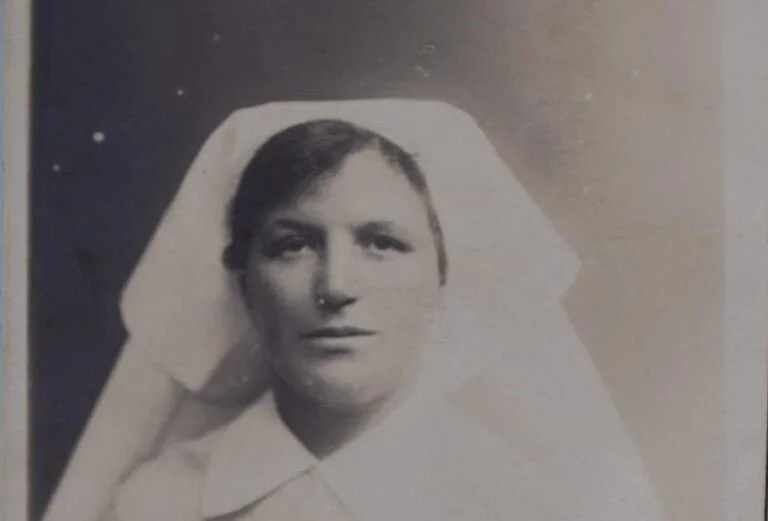
Photograph of Sister Mary Latchmore

Photograph of Sister Mary Latchmore

It is with thanks to Sister Mary’s diary that the story of Fulham Palace during the war is still alive today. Born 1871 in Tyne Dock, South Shields, Latchmore spent her life travelling to serve the community. Documentary evidence, including ship passenger records and midwives books, reveal she spent 1909 as a midwife in New Zealand. On 30th September, 1914, Latchmore signed up for the British Red Cross and travelled to France, where she worked in Base Hospitals and in various VAD hospitals. Sister Mary was awarded the Mons Ribbon and the Vistory Medal for her service. During the War, Sister Mary nursed at the Freemason’s Hospital No.2 at the Palace, and was a personal friend of Bishop Winnington-Ingram. After the war, Latchmore returned to New Zealand to continue nursing. She served under the New Zealand Health Department and was a matron at Whangaroa Hospital. She later became the co-principle of Fitzroy School, in Napier, with her friend Nancy Sheath. When Mary died in 1931, she was buried alongside Nancy.
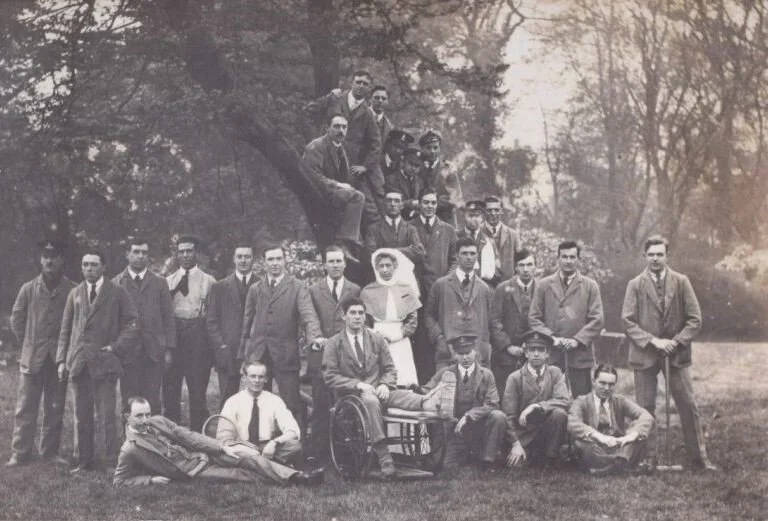
A photograph from Sister Mary Latchmore’s scrapbook

A photograph from Sister Mary Latchmore’s scrapbook

This photograph shows the patients wearing Hospital Blues Uniform, also known as the Blue Invalid, Convalescent Blues or Hospital Undress. This was made of a blue flannel material, worn with a white shirt and red tie. Regimental caps and medals could be worn on the left breast.

Leslie Arthur Condren
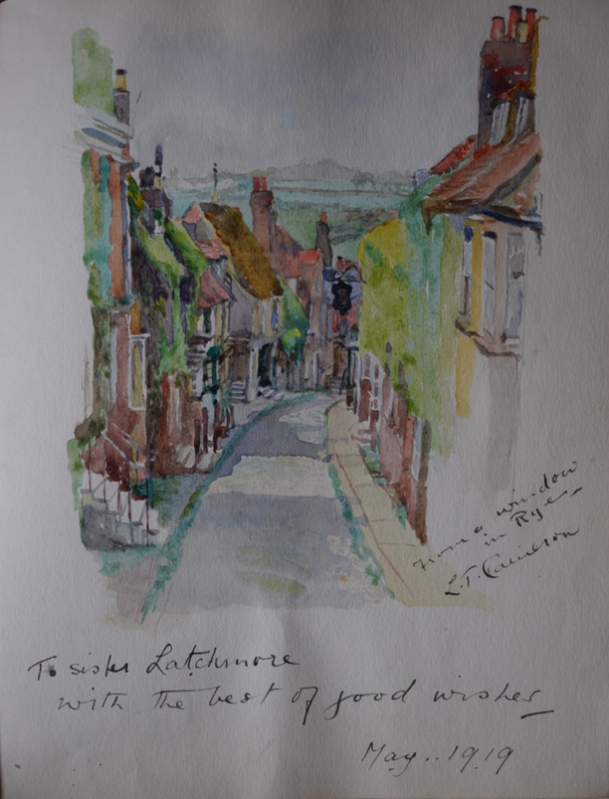
Painting given by patient Leslie Condren to Sister Latchmore, 1919

Painting given by patient Leslie Condren to Sister Latchmore, 1919

Leslie was ‘a thoroughly satisfactory and reliable boy’, according to his school reports from Beaufory Institute. A technical school for boys, Leslie earned a distinction in electricity and workshop practice. He later worked at E. R. Watts and Son in Camberwell where he manufactured surveying equipment for the military. On the 26 January 1914, Leslie joined the Royal Engineers, only 6 months before the war broke out. He was injured on the 23 October, 1917 at Passchendaele, having received gunshot wounds to his side and back. Leslie was treated at the Palace, where he spent a lot of time painting. Leslie gave a vibrant watercolour painting of a street in Rye to Sister to Mary Latchmore in May, 1919.

After the War, Leslie became a civil servant and clerical officer. He continued his artistic practice and later exhibited his piece ‘To the West Country’ at the Royal Academy, 1952.


John ‘Jack’ Stephen Low
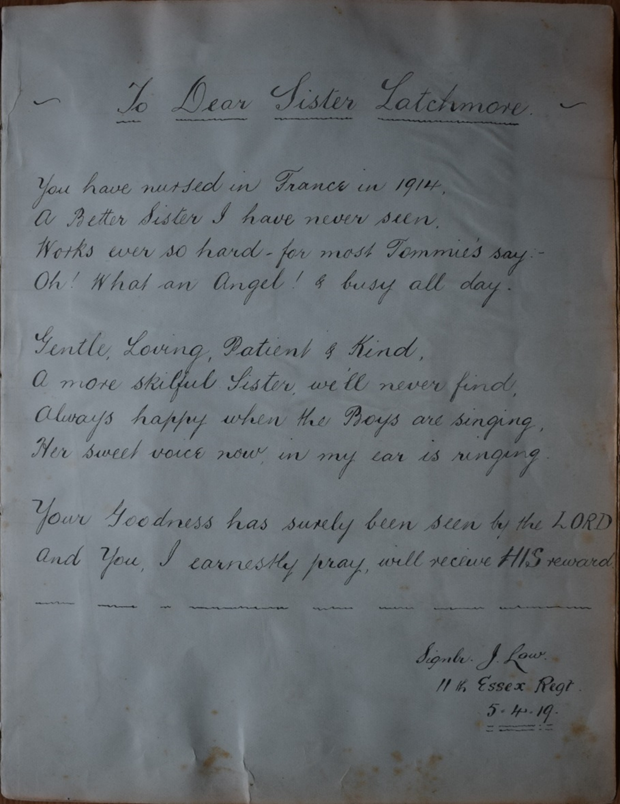
Poem written by patient John ‘Jack’ Low to Sister Latchmore

Poem written by patient John ‘Jack’ Low to Sister Latchmore

John was another patient admitted to the Palace during its time at the hospital. Born in Stepney in December 1894 to John (a fish curer) and Mary, John was a true Cockney. He initially signed up to the 8th Battalion of the Bedfordshire Regiment in August, 1914. The following year, John disembarked in France. At some point, he transferred to the 11th Essex, working as a signaller, running communications and spotting.

Like Leslie Condren, Jack was fond of Sister Latchmore, as seen in this poem he wrote for her, praising her hard work, diligence and compassion.

In October 1919, Jack was discharged and returned to his family, entering the fish trade. He married Hilda Lucy Harman in 1936 and lived in East Grinstead with her. He passed away only 8 years later in Cell Barnes Hospital. Sadly, it is possible Jack was injured during a bombing raid.

John Edward McKenzie

John was a Sergeant of the Australian Imperial Force, born in Victoria in 1884. In 1915, he signed up in Brisbane, his former occupation being listed as a farmer. On the 25th September, 1916, John was wounded, most likely during the Battle of Mouquet Farm on the Somme.

A letter sent to the Palace hospital by John’s father, Hugh, expresses his gratitude. Apparently, John’s arm was almost lost, but managed to be saved at the Palace. Hugh ran a stock and station agency with his partner John Chanter. Hugh was Mayor of Echuca twice, eventually becoming the Minister of Railways and Water Supply. John returned to Echuca after the War and became a clerk.
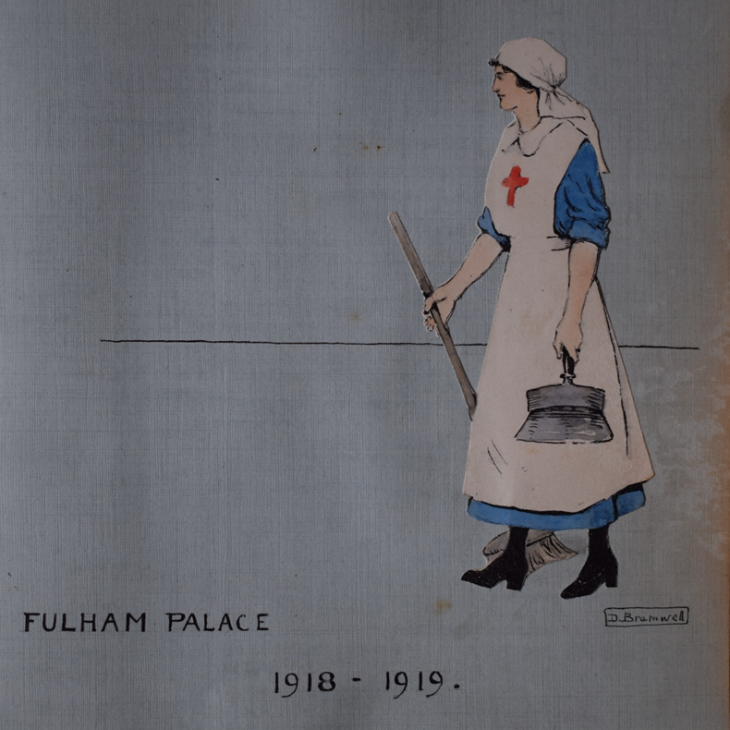
Image of nurse at Fulham Palace 1918-1919.png

The Palace’s time as a hospital came to an end in June 1919. On closing, Maude Fox-Symons was presented with a bouquet and a set of silver knives and spoons.

Fulham Palace is built on a variety of histories and stories, including Saxon, Tudor and Victorian occupation of the site, all unearthed by archaeological and documentary research. We are generating a wealth of information about the people who, through circumstance, were drawn to the Palace.

It was common for nurses to keep diaries or scrapbooks during the First World War. The invaluable personal stories and friendships rooted in Sister Mary Latchmore’s scrapbook reveals another layer to the Palace’s past, and the people that enriched the building.

This research could not have been possible without the hard work and dedication of our archive volunteers:

Lois Reynolds, Moyra Gardener, Simon Butt, Catherine Weiss, Pamela Greene, Vernon Burgess, Oliver Snaith, Stanley Slaughter & Barbara Tysome,

and Collections Team: Lisa Voden-Decker and Antia Dona.

Thank you very much to Naomi for this fascinating post and to Jean Shipton, Education officer for taking copious notes at Alexis’ lecture.

Please send your blogs to rachel.bagnall-bray@fulhampalace.org. If you would like some help, please let me know.

Specimen of the month: What am I?

Every month we feature two blogs written by volunteers, one describes an object in the Palace and one a plant from the Garden. It is a great way to learn more about the Palace. If you would like to contribute there is no set format so please do send in your ideas.

We’re grateful to Jamie Atwell for this fantastic specimen of the month blog.

What Am I ?

I am not made out of green cheese,

Nor full nor waning if you please.

I help to keep the grass at bay,

Producing lines in neat array.

Reliant on my handlers’ feet

To make the garden look so neat.

Fifty percent of the night sky

Is what, at times, you could descry -

If you wanted to crack the code,

Or just a pub in Lower Richmond Road.

‘Mezzaluna’, the Italians jape,

In honour of my distinctive shape.

Jamie Atwell, Garden volunteer

[Answer below]

Thank you very much to Jamie for this intriguing poem.

Please send your ideas for object or specimen of the month blogs to rachel.bagnall-bray@fulhampalace.org. If you would like some help, please let me know.
[Answer = Half Moon]

Job opportunities at the Palace

We have a few job opportunities going at the Palace at the moment. Please do take a look if you’re interested in applying and pass these on to anyone who may like to apply.

Front of house assistant

The front of house assistant is a key role in providing an excellent visitor experience at Fulham Palace. The post-holder will provide a visitor reception function at the Palace between the hours of 09.15 and 16.45/17.45 (winter/summer) two days per week usually Sunday and Monday. This will include Bank Holidays. There may also be additional hours to cover annual leave.

Closing date for applications is Thursday 23 January 2020

Garden apprentice (2 x vacancies: starting March and April 2020)

This London based horticultural placement will provide a unique opportunity to be part of the Fulham Palace garden team, working closely with permanent staff, other apprentices and garden volunteers. The post holder will be required to assist in the skilled care, maintenance and development of the horticultural features and gardens within the Fulham Palace grounds, working under guidance and supervision.

Closing date for applications is 9.00 on Monday 27 January 2020 

Interviews are expected to take place on 3 and 4 February 2020

Specimen of the month: The plant-astic four

Every month we feature two blogs, one describes an object in the Palace and one a plant from the Garden. It is a great way to learn more about the Palace. If you would like to contribute there is no set format so please do send in your ideas.

Say hello to four members of Sir Hans Sloane’s Vegetable Substances Collection!

Sir Hans Sloane, Mezzotint by J. Faber, junior, 1729, after Wellcome

Sir Hans Sloane, Mezzotint by J. Faber, junior, 1729, after Wellcome

Our newest temporary display in Fulham Palace museum comes to us from Sir Hans Sloane’s Vegetable Substance collection housed at the Natural History Museum.

Sir Hans Sloane was quite a fascinating and well-educated character. Born in 1660 in Killyleagh, County Down, Northern Ireland, he spent his youth fascinated by flora and fauna which set him up for a life-long passion for collecting and studying the natural world.

Sloane moved to London to study chemistry with the Worshipful Society of Apothecaries, and botany at the Chelsea Physic Garden in 1679 where he learned the ins and outs of the human body. This set him up for a prosperous career as a physician. Among his friends were John Ray, the celebrated English naturalist, and Robert Boyle, the father of modern chemistry. Sloane toured France, met more famous botanists, and was inspired by their collecting habits. After receiving his Doctorate of Physics he returned to London and was made a Fellow of the Royal Society in 1685. He would later become the Royal Society's Honorary Secretary and President (taking over from Sir Isaac Newton). As if that wasn’t enough responsibility, he was also made a Fellow of the Royal College of Physicians two years later!

As well as his work in London, Sloane was able to combine work and travel in a rather dreamy way. He set sail for the swaying palms of Jamaica to become the personal physician to Christopher Monck, 2nd Duke of Albemarle and newly appointed governor of the island. During this time, Sloane collected over 1,000 plants specimens and made detailed notes of local customs and nature which formed the basis for his enormous 7-volume Catalogus Plantarum of 1696 (these same dried plant specimens are still pressed in its pages in the store of the Natural History Museum today).

Upon the Duke’s death Sloane found himself back in London and set up a very successful medical practice – so successful, in fact, that Dr Sloane became the Physician Extraordinary to Queen Anne and King George I, and a slightly less glamorous Physician in Ordinary to King George II. If that wasn’t enough to secure him fame and fortune, he is also credited with being the creator of drinking chocolate!

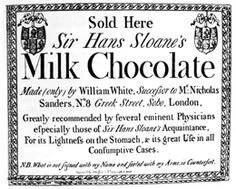
Hans Sloane Chocolate.jpg

(From his Wikipedia page: ‘Sloane encountered cacao while he was in Jamaica, where the locals drank it mixed with water, though he is reported to have found it nauseating. Many recipes for mixing chocolate with spice, eggs, sugar and milk were in circulation by the seventeenth century. Sloane may have devised his own recipe for mixing chocolate with milk, though if so, he was probably not the first. (Some sources credit Daniel Peter as the inventor in 1875, using condensed milk; other sources point out that milk was added to chocolate centuries earlier in some countries.) Nonetheless, the Natural History Museum lists Sloane as the inventor of that concoction. By the 1750s, a Soho grocer named Nicholas Sanders claimed to be selling Sloane's recipe as a medicinal elixir, perhaps making "Sir Hans Sloane's Milk Chocolate" the first brand-name milk chocolate drink. By the nineteenth century, the Cadbury Brothers sold tins of drinking chocolate whose trade cards also invoked Sloane's recipe.’

His collections became vast. If he didn’t collect it, he was given it, and before long he had amassed over 71,000 objects including books, manuscripts, drawings, coins and medals, and many plant specimens. Sloane asked in his will that his collection '[...] may remain together and not be separated and that chiefly in and about the city of London, where I have acquired most of my estates and where they may by the great confluence of people be most used.' In keeping with that, his collections have formed the basis of three great educational institutions: the British Library, British Museum, and Natural History Museum. For the past 300 years his collections have provided invaluable information to researchers and scientists, and his plant specimens are occasionally loaned to museums around London.

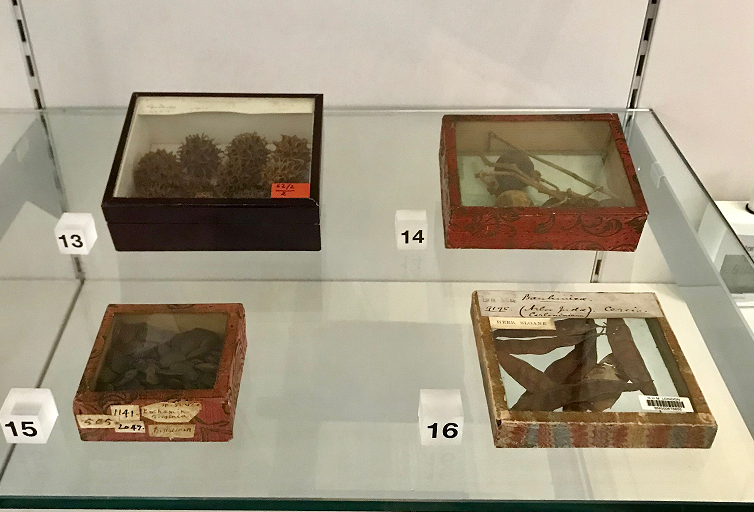
This brings us to our very own Fab Four: as of 14 January, Fulham Palace became the temporary caretaker for some of Hans Sloane’s enormous collection, whom will be with us until December 2020! I have copied their labels from the museum display below:

The loans on display in the Fulham Palace museum

The loans on display in the Fulham Palace museum

13: Fruit of sweetgum (Liquidamber styraciflua) This tree is famous for the autumn colour and is popular in gardens. It was first recorded growing in England I 1656 at the Tradescant family garden in Lambeth. 32 years later, the natural historian John Ray saw it growing in Bishop Compton’s garden.

14: Persimmon seeds (Diospyros virginiana) Writing in 1713, James Petiver comments that “there is a large Tree of this in the Bishop of London’s Garden at Fulham”, this is probably the same tree that Leonard Plukenet, royal professor of botany and gardener to Queen Mary, depicted in his Phytographia in 1692.

15: Fruit of a wild relative of aubergine (Solanum melongena) Sloane was clearly a little mystified by these fruit, in his catalogue, he described them as “The fruit of Solanum spinosum, an pomum amoris?”, alluding to their relationship to the tomato, which at the time, was also known as ‘love apple’.

16: Eastern redbud seed pods (Cercis canadensis) This tree is one of the most beautiful in North America. It is related to the Judas tree (C. Siliquastrum) from southern Europe and western Asia. Richard Bradley, botany professor at Cambridge University, described how Bishop Compton enjoyed scattering redbud flowers on his ‘sallets’ [salads!].

My favourite part about our vegetable substances is their handcrafted wooden boxes, lovingly covered in hand-printed paper which has not faded too much during the last three centuries. You can see them in our temporary exhibition room, and access Sloane’s Herbarium with his Jamaican plant specimens via the Natural History Museum’s online database here: https://data.nhm.ac.uk/dataset/sloane-herbarium

Do come say hello to our new plant-astic brethren when you get a chance! The museum is open from 10.30 - 16.00 in the winter hours, and we look forward to showing you our newest acquisitions.

Elowyn Stevenson, front of house supervisor

All items on loan from the Trustees of the Natural History Museum, London.

Thank you very much to Elowyn for this wonderful blog about the newest object loans to the Palace museum. I hope you’ll feel inspired to visit the museum as a result!

Please send your ideas for object or specimen of the month blogs to rachel.bagnall-bray@fulhampalace.org. If you would like some help, please let me know.
Rase High the Roof Beam Carpenters

Hear from Alexis Haslam (MCIfA), community archaeologist, as he tells of us his latest findings at Fulham Palace….

For those of you who have been wondering where I have been for the last few months (or for those of you who haven’t noticed one way or another and were never really quite sure what I did anyway), I am currently writing up the standing building report for the restoration project. This is essentially a record that is required as part of the planning consent, recounting the history of each room that has undergone repair, redecoration or alteration throughout the works. An absolutely fascinating read it will certainly be, and I’m sure none of you can wait to get your hands on a copy of this epic tome.

Anyway, having now finished both the ground and first floors, I have moved on to my personal favourite part of the Palace, the roof. A place where wonderful elements of Tudor craftsmanship and carpentry reside in quiet contemplation next to botched repairs from the 20th century, spaghetti junctions of poor wiring and long abandoned wasps nests. It’s a great place to hang out, especially if you’re feeling a desperate need to escape yet another onslaught of ‘5 Little Men in a Flying Saucer’ emanating from the Carriage Room on a Thursday morning.

What I’m going to write about now however concerns the more recent elements of the Palace’s pretty damned fine roof.

Image+1.jpg

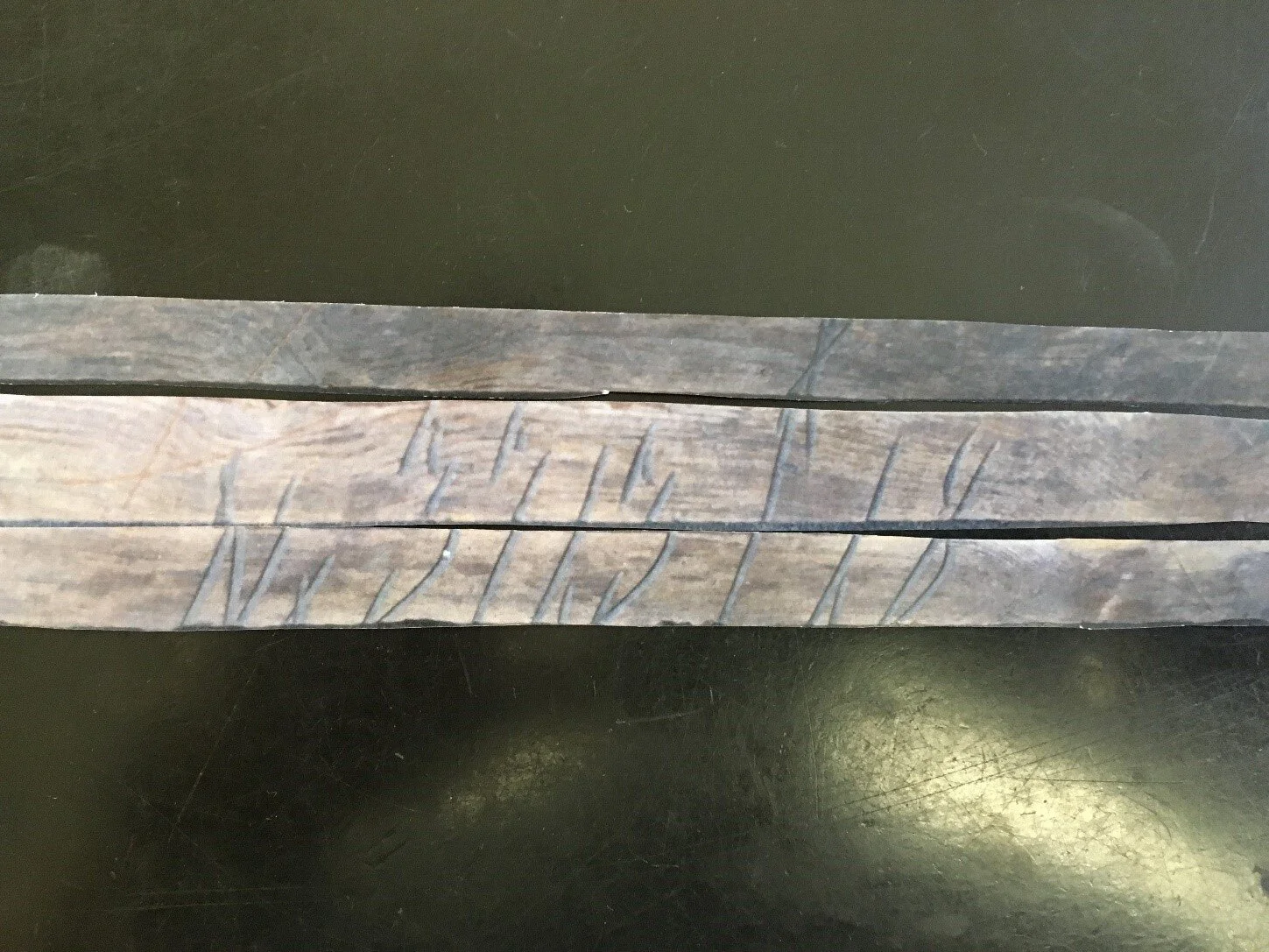
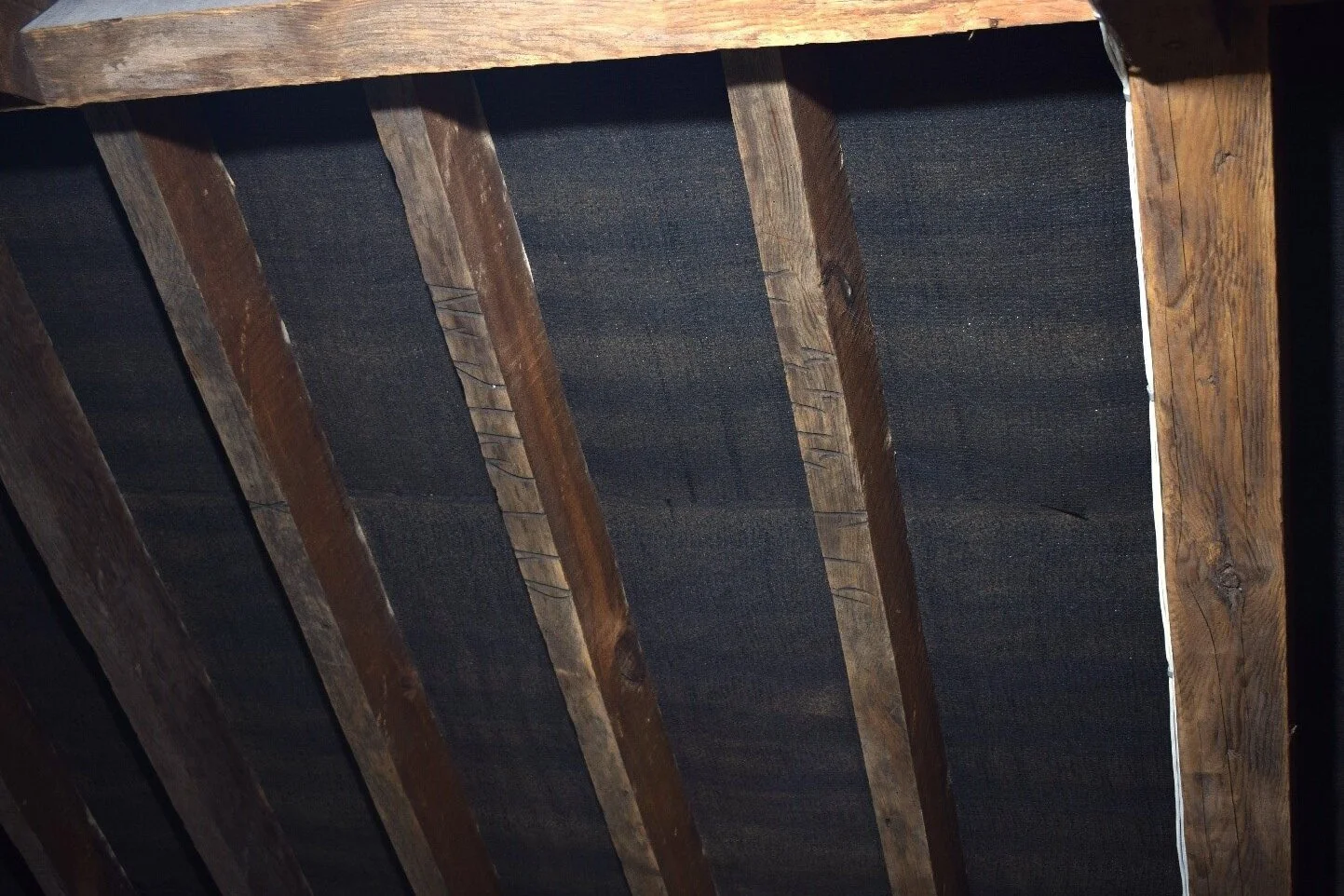
In the picture above are the rafters belonging to the north wing of the Tudor Quadrangle. Look closely and you can see a series of marks on them. Despite looking like the etchings of a troubled soul imprisoned in the roof space by a callous Bishop for some kind of religious heinousness, they are in fact what are known as ‘Baltic Shipping Marks’ and they date to the 19th century. So what can they tell us about our roof, other than it was built at some point in the 1800s, replacing an earlier and presumably irreparable version?

Well, after reading that well known and thoroughly engrossing paper ‘Baltic shipping marks on nineteenth-century timber: their deciphering and a proposal for an innovative characterization of old timber’ I decided some detective work was necessary. I tried to contact one of the authors of this totally mind altering piece, Louis Vandenabeele, at the Vrije Universiteit Brussel, but according to the email bounceback he has ‘scarce access to the internet until April 1st 2019’. So more fool me.

Still, undeterred by this initial setback I took a closer look at those timbers and an idea dawned on me. What if I was to print off a copy of that photo, cut the rafters out and see if they fitted together?

Image 2.jpg

Holy cow! Check that out! They fit together! Who’d have thunk it?! But what does it all mean? What are these bizarre runes trying to tell us about the 19th century timber industry in northern and eastern Europe? Now there is absolutely no way I’m going to be able to sleep until I have solved this utterly bizarre mystery. My thoughts are distressed. A 19th century timber merchant is clearly trying to communicate something to me from beyond the grave. Things have just become very serious indeed.

Well, using the aforesaid paper, we can determine that these marks, inscribed into the timber using a tool known as a rase knife (now you see what I did with the title), read (possibly) as follows:

Nx3763 ж 68

But why? What does this madness mean I hear you ask? Now we’re going to get deeply technical…

Much of the timber supplied to Western Europe throughout the 19th century originated from Norway and other countries around the Baltic Sea such as Germany, Poland, Lithuania, Latvia, Estonia, Russia, Finland and Sweden. This was usually in the form of Scots Pine (often known as Baltic fir, Red deal or Yellow deal) or Norway Spruce (otherwise known as Norway fir or White deal). The situation in Britain however was somewhat more complex as there had been a continual raising of taxes on European timber from the late 18th century onwards. This was an attempt to protect the timber industry within the North American colonies and It wasn’t until the 1860s that the tax levels became more balanced. If this is true, then our roof post-dates 1860, and is unlikely to have been constructed during Blomfield’s renovations of 1853. 

Timber was generally felled in the winter, and come the rising spring thaw it was floated downriver to the Baltic shores. It was here that the sawmills cut the timber to size, and by the 1850s these mills were steam powered and heavily industrialised, creating a huge boom in timber export. Once cut, the timber was then stacked and housed in storage grounds according to size and quality before being shipped abroad in the period between May and mid-December, at which point the sea began to freeze.

What many of the newly established sawmills didn’t have however was a good understanding of the timber markets, and for this they used merchants’ houses as middlemen. This is where the marking system becomes important as exporters needed to distinguish between different sources, qualities and sizes of timber. The consumer would also be able to verify that their purchase was correct. Assessment was undertaken by individuals known as ‘brackers’ who were trained to sort and mark timber upon inspection. In Danzig, Riga, Memel and Stettin brackers were employed directly by the authorities and official marks were used on the timber due for export.

So what do our marks symbolise then, what do they mean? The most important symbol present on the rafters is the ж. This is the official stamp of Danzig, with one x symbolizing first grade timber, two symbolising second grade and three symbolising third grade. Our timber has one x, although it is possible we are missing others. Nx3763 refers to the balk number, whilst the 68 is probably a measurement, although these values have yet to be clarified.

So the work of a bracker in Danzig tells us that our roof was built with timber from this port, most probably after 1860. Quite a journey for a considerable lump of lumber. It still isn’t clear under which Bishop the roof was rebuilt, although if I were to hazard a guess I’d probably go with Bishop Tait (1856–1868). A plane man, but knot averse to branching out and spending a few leaves when required…

Alexis Haslam (MCIfA), community archaeologist

Free furniture on 'Freecycle' website

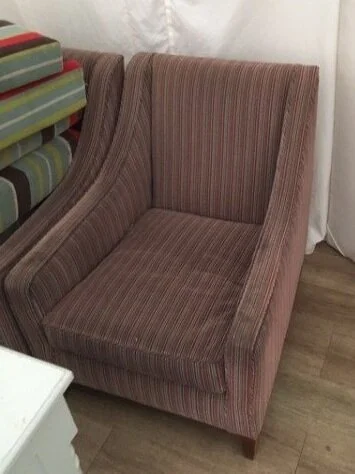
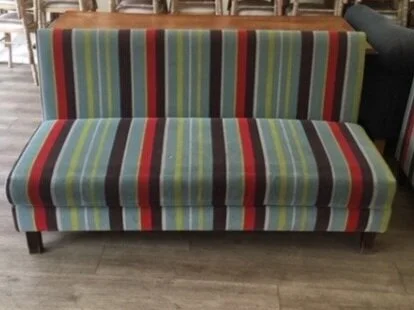
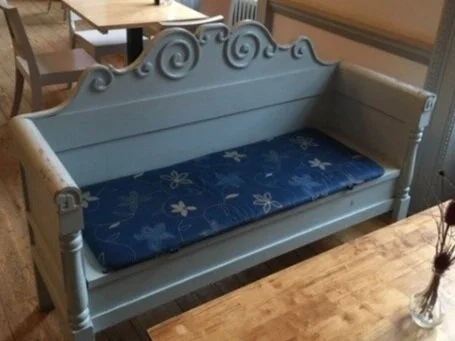
As part of the current drawing room cafe renovation we are getting new furniture, and so our cafe furniture has been put on the ‘Freecycle’ website to go to a good home. If you would like any of the furniture or know anyone who would then please follow this link:

I’ve had a good think about if we can fit it in the mess room in the main Palace, but unfortunately it won’t fit with the current layout. We’ve got our thinking caps on though to see if we can get some more comfy furniture in there in the coming months.

In the mean time we’d be delighted if the cafe furniture could go to a new home!

Armchair.jpg
Banquette.jpg
Wooden+bench.jpg

Become a Fulham Palace Trustee

Are you passionate about heritage? Do you enjoy history, gardens or archaeology? Or are you already familiar with Fulham Palace and want to get involved? We are looking for experienced professionals to join our existing Board of Trustees.

0252_001low res crop.jpg

Fulham Palace has witnessed the transformation of society, from the upheaval of the Reformation to the opening of a war hospital in World War I. We are a registered charity and our mission is to share the stories of the Palace, which was home to Bishops of London for over 1,300 years, in inclusive and innovative ways.

Help shape the Palace for the future and become a vital part of its present.

You can find out more here. Please share this with friends or colleagues who may be interested.