
We’re grateful to Naomi Jennings-O’Toole for this fantastic blog.
The story of Fulham Palace as a hospital for injured soldiers during World War I is still being told today, over 100 years later. The Palace volunteer archivists have pieced together the evidence, telling us information about the lives of the staff and patients, the units they served in and the lives they went on to lead following the War. Alexis Haslam, community archaeologist, delivered a presentation that dug into the history of the Palace as a hospital, shedding light on a different perspective to view the Palace.
The lecture was deeply informative, recognising the unimaginable horrors of the front, the healing, peaceful environments of the garden and house as well as the kindness and love extended towards Sister Latchmore, a nurse who served wounded soldiers at the Palace. The lecture also underlined the invaluable input of many volunteers involved in the project, who searched many records for information and the stories of the ordinary people doing extraordinary things.
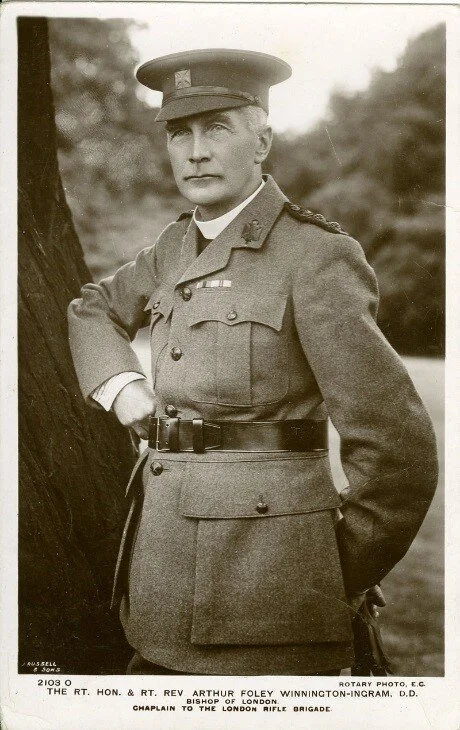
Bishop Winnington-Ingram in his military uniform at Fulham Palace.
The Freemasons’ initial plan was to purchase 237 Fulham Road from the Chelsea Hospital for women, which cost them £10,000. It was intended to become a hospital for Freemasons but instead became a war hospital for injured troops returning from the front. Bishop Arthur Winnington-Ingram, who served as the Bishop of London from 1901 to 1939, welcomed war patients to Fulham Palace. Bishop Winnington-Ingram was known for being an active recruiter for the armed services during World War I. However, his adamant support was often controversial. The Prime Minister at the time, Herbert Henry Asquith, described Ingram’s pitches as “jingoism of the shallowest kind”.
In a similar vein, the poem ‘They’, written by Siegfried Sassoon, articulated his views on the church’s recruitment efforts. Siegfried Loraine Sassoon, CBE, MC (8 September 1886 – 1 September 1967) was an English poet, writer, and soldier. Decorated for bravery on the Western Front, he became one of the leading poets of the First World War.
‘They’, by Siegfried Sassoon
The Bishop tells us: ‘When the boys come back
'They will not be the same; for they'll have fought
‘In a just cause: they lead the last attack
'On Anti-Christ; their comrades' blood has bought '
New right to breed an honourable race,
'They have challenged Death and dared him face to face.'
'We're none of us the same!' the boys reply.
'For George lost both his legs; and Bill's stone blind;
'Poor Jim's shot through the lungs and like to die;
'And Bert's gone syphilitic: you'll not find
'A chap who's served that hasn't found some change.
And the Bishop said: 'The ways of God are strange!'
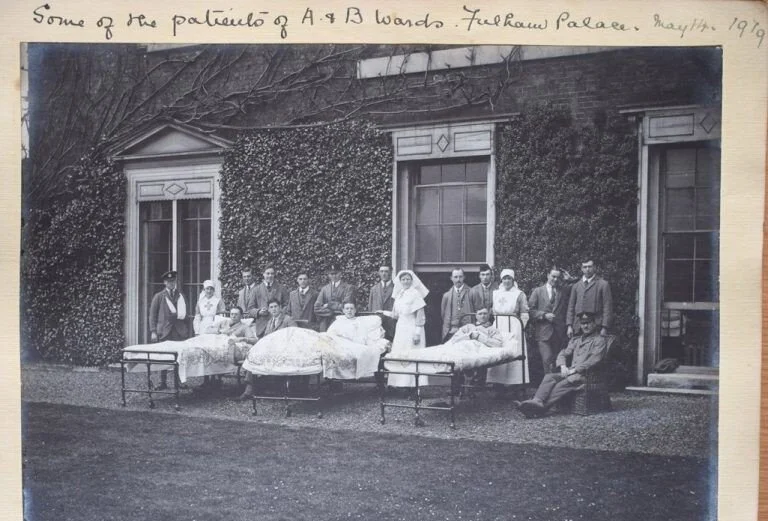
In April 1918, the Bishop offered the Palace to the British Red Cross Society. The offer was passed to the Freemasons, who duly accepted. The opening was a formal occasion, undertaken by the Duke of Connaught. Renamed as ‘Freemasons Hospital No.2’, the Palace was able to house 100 patients. As an auxiliary hospital, most patients were healing from war injuries, many with lost limbs.
The Great Hall was used as the dining room, while the Drawing room and Dining room were converted into wards. According to the Palace’s photography archives, the café we use today was ‘Ward A’. With views stretching over the Palace grounds, the tranquillity and beauty was considered an aid to the patients’ ‘shell shock’. To aid mental healing, patients were encouraged to get involved with the gardens and farming activities, as well as drawing, painting and writing poetry.
Lady Maude Fox-Symons
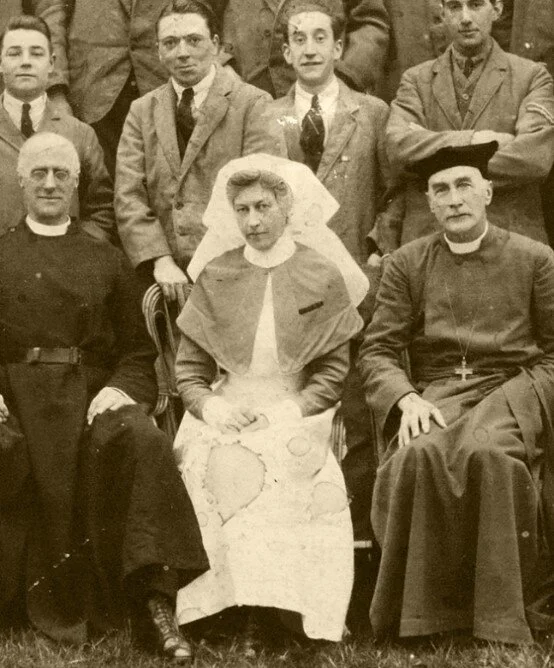
Lady Maude Fox-Symons, Matron at Fulham Palace
Also known as ‘Minnie’, Lady Maude Fox-Symons was appointed Matron at the Freemason’s Hospital No.2. Born in Camberwell in 1868, Symons was training as a nurse by 1897 at St. Bartholemew’s. During the Boer War (1899-1902), she sailed to South Africa as part of the Princess Christian Army Nursing Services. Lady Symons became Acting Sister at the Freemasons Hospital in 1916, then transferred to Fulham Palace at its opening as a hospital.
Sister Mary Latchmore
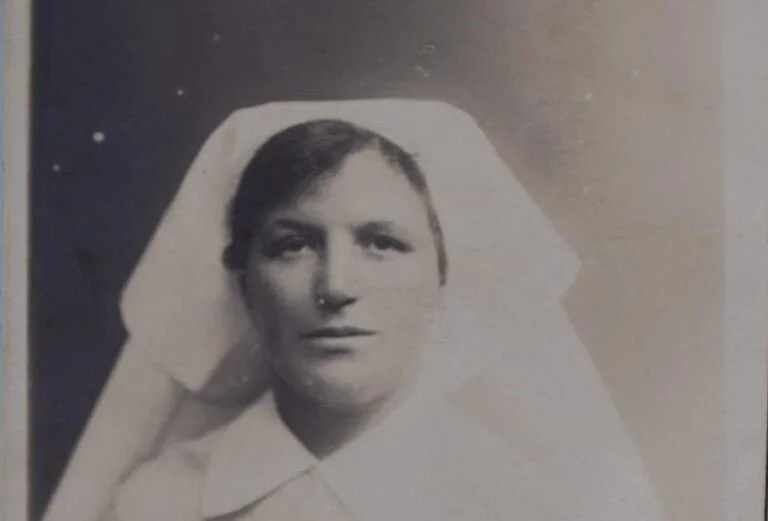
Photograph of Sister Mary Latchmore
It is with thanks to Sister Mary’s diary that the story of Fulham Palace during the war is still alive today. Born 1871 in Tyne Dock, South Shields, Latchmore spent her life travelling to serve the community. Documentary evidence, including ship passenger records and midwives books, reveal she spent 1909 as a midwife in New Zealand. On 30th September, 1914, Latchmore signed up for the British Red Cross and travelled to France, where she worked in Base Hospitals and in various VAD hospitals. Sister Mary was awarded the Mons Ribbon and the Vistory Medal for her service. During the War, Sister Mary nursed at the Freemason’s Hospital No.2 at the Palace, and was a personal friend of Bishop Winnington-Ingram. After the war, Latchmore returned to New Zealand to continue nursing. She served under the New Zealand Health Department and was a matron at Whangaroa Hospital. She later became the co-principle of Fitzroy School, in Napier, with her friend Nancy Sheath. When Mary died in 1931, she was buried alongside Nancy.
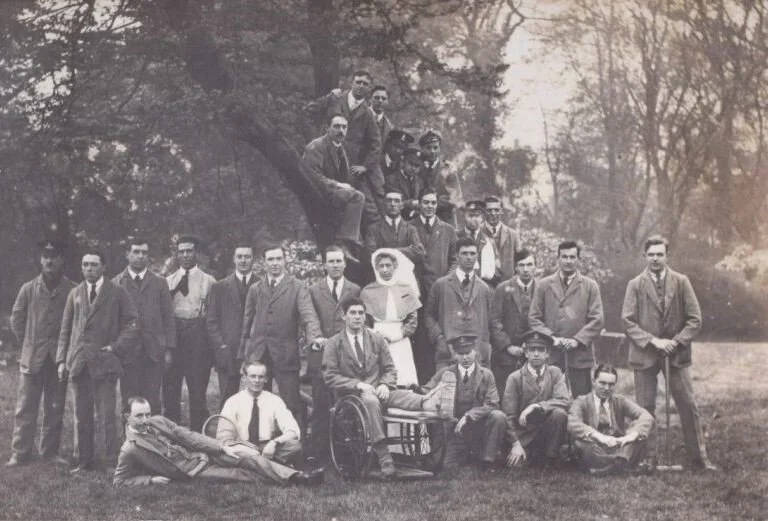
A photograph from Sister Mary Latchmore’s scrapbook
This photograph shows the patients wearing Hospital Blues Uniform, also known as the Blue Invalid, Convalescent Blues or Hospital Undress. This was made of a blue flannel material, worn with a white shirt and red tie. Regimental caps and medals could be worn on the left breast.
Leslie Arthur Condren
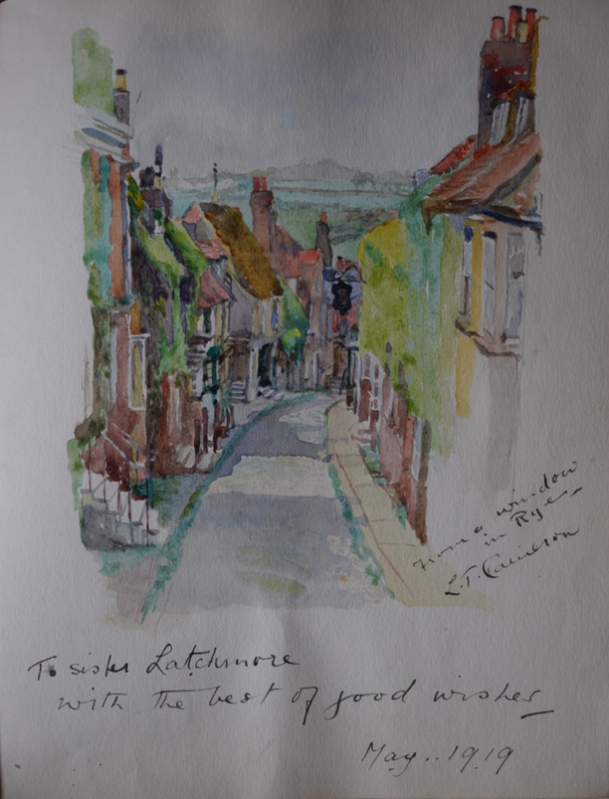
Painting given by patient Leslie Condren to Sister Latchmore, 1919
Leslie was ‘a thoroughly satisfactory and reliable boy’, according to his school reports from Beaufory Institute. A technical school for boys, Leslie earned a distinction in electricity and workshop practice. He later worked at E. R. Watts and Son in Camberwell where he manufactured surveying equipment for the military. On the 26 January 1914, Leslie joined the Royal Engineers, only 6 months before the war broke out. He was injured on the 23 October, 1917 at Passchendaele, having received gunshot wounds to his side and back. Leslie was treated at the Palace, where he spent a lot of time painting. Leslie gave a vibrant watercolour painting of a street in Rye to Sister to Mary Latchmore in May, 1919.
After the War, Leslie became a civil servant and clerical officer. He continued his artistic practice and later exhibited his piece ‘To the West Country’ at the Royal Academy, 1952.
John ‘Jack’ Stephen Low
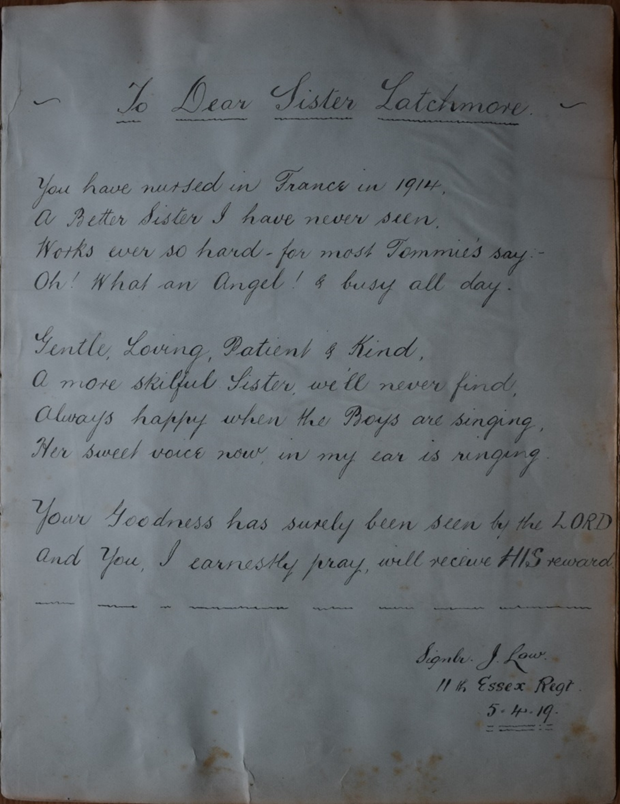
Poem written by patient John ‘Jack’ Low to Sister Latchmore
John was another patient admitted to the Palace during its time at the hospital. Born in Stepney in December 1894 to John (a fish curer) and Mary, John was a true Cockney. He initially signed up to the 8th Battalion of the Bedfordshire Regiment in August, 1914. The following year, John disembarked in France. At some point, he transferred to the 11th Essex, working as a signaller, running communications and spotting.
Like Leslie Condren, Jack was fond of Sister Latchmore, as seen in this poem he wrote for her, praising her hard work, diligence and compassion.
In October 1919, Jack was discharged and returned to his family, entering the fish trade. He married Hilda Lucy Harman in 1936 and lived in East Grinstead with her. He passed away only 8 years later in Cell Barnes Hospital. Sadly, it is possible Jack was injured during a bombing raid.
John Edward McKenzie
John was a Sergeant of the Australian Imperial Force, born in Victoria in 1884. In 1915, he signed up in Brisbane, his former occupation being listed as a farmer. On the 25th September, 1916, John was wounded, most likely during the Battle of Mouquet Farm on the Somme.
A letter sent to the Palace hospital by John’s father, Hugh, expresses his gratitude. Apparently, John’s arm was almost lost, but managed to be saved at the Palace. Hugh ran a stock and station agency with his partner John Chanter. Hugh was Mayor of Echuca twice, eventually becoming the Minister of Railways and Water Supply. John returned to Echuca after the War and became a clerk.
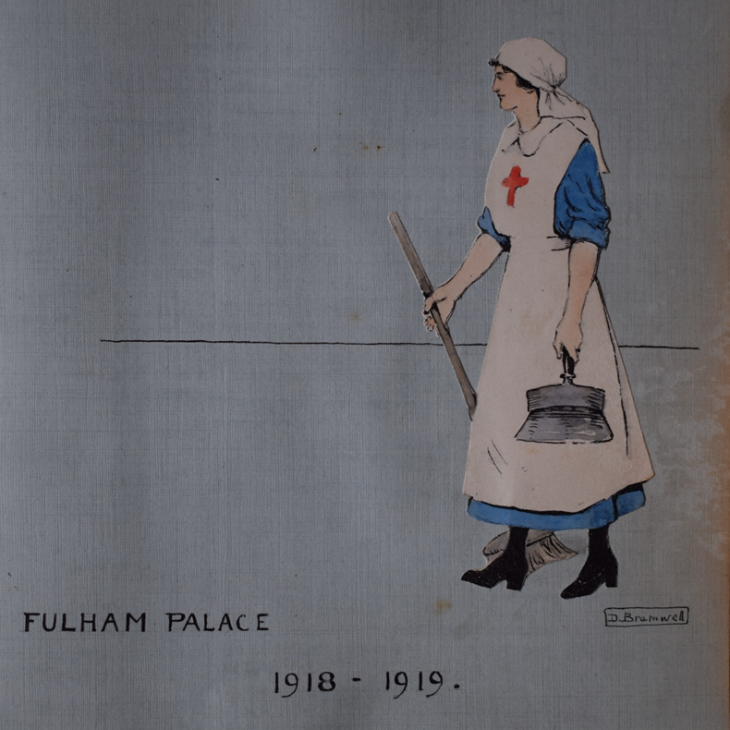
The Palace’s time as a hospital came to an end in June 1919. On closing, Maude Fox-Symons was presented with a bouquet and a set of silver knives and spoons.
Fulham Palace is built on a variety of histories and stories, including Saxon, Tudor and Victorian occupation of the site, all unearthed by archaeological and documentary research. We are generating a wealth of information about the people who, through circumstance, were drawn to the Palace.
It was common for nurses to keep diaries or scrapbooks during the First World War. The invaluable personal stories and friendships rooted in Sister Mary Latchmore’s scrapbook reveals another layer to the Palace’s past, and the people that enriched the building.
This research could not have been possible without the hard work and dedication of our archive volunteers:
Lois Reynolds, Moyra Gardener, Simon Butt, Catherine Weiss, Pamela Greene, Vernon Burgess, Oliver Snaith, Stanley Slaughter & Barbara Tysome,
and Collections Team: Lisa Voden-Decker and Antia Dona.
Thank you very much to Naomi for this fascinating post and to Jean Shipton, Education officer for taking copious notes at Alexis’ lecture.
Please send your blogs to rachel.bagnall-bray@fulhampalace.org. If you would like some help, please let me know.