
A dive into the Palace’s 1,300 years of history and it’s current role as a community hub - by Lee (events, tour guide and front of house volunteer) .
Fulham Palace is a place with 1,300 years of history, which is also roughly the amount of time it can feel like you’ve spent looking for parking in West London.
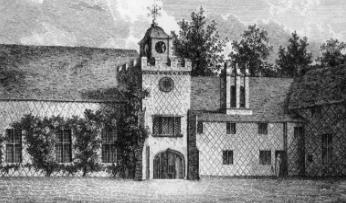
The Fulham Palace estate was sold to Colonel Edmund Harvey for £7,617 2s 6d. After the restoration of the monarchy in 1660, the estate was restored to the Bishops of London.
We’ll explore two questions in this blog. First: how did this riverside house become one of the most enduring sites in the city, occupied and adapted across more than 1,300 years? And second: why does it matter now - not as a relic, but as a living community hub where you can learn something, meet someone, and - crucially - find a bench.
That second question is where I hope this will resonate: because the Palace today isn’t just about conserving the past - it’s about serving the present through access, education, volunteering, and connection.
1. A place shaped by the Thames
To understand Fulham Palace, start with geography. The Palace sits beside the Thames on ground that has attracted people for thousands of years- partly because rivers are routes, resources, boundaries, and meeting points all at once. The Thames, in other words, has always been a bit like a London group chat: everyone ends up in it sooner or later.
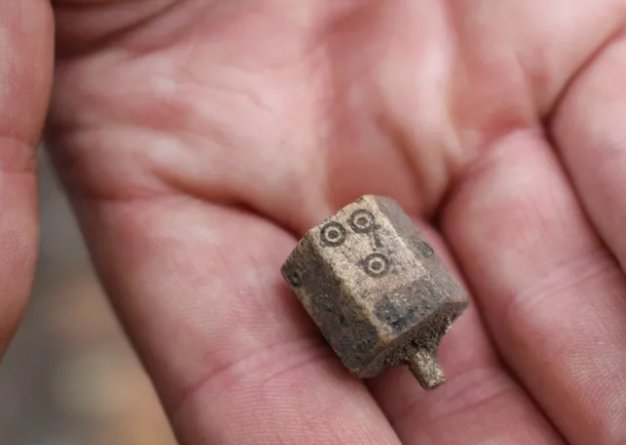
A six-sided Tudor teetotum made from antler between 1480 and 1550. Teetotums were spinning tops used in gambling games. Discovered during our Dovecot Dig in 2017.
Archaeology at the site points to very early activity - tools and finds that suggest travellers moving through the area in the late Mesolithic and early Neolithic, and later evidence of farming landscapes in the Bronze Age. There are also Roman-period finds indicating settlement nearby, possibly connected to a villa landscape along the river.
But the story we can tell most clearly begins in the early medieval period. In AD 704, Bishop Waldhere acquired the Manor of Fulham, beginning a relationship between this place and the Bishops of London that would last well over a millennium.
That continuity is remarkable: Fulham Palace remained in the bishops’ possession from the early Middle Ages into the modern era, and it served as the principal residence of the Bishop of London for centuries, right up to 1973. In other words, this isn’t just one historic building - it’s a long-running institution, repeatedly rebuilt to meet the needs of its time.
2. Power, protection, and everyday life: medieval to Tudor Fulham
In the medieval period, the Palace was not simply a comfortable retreat. It was part of a network of church power, landholding, and governance. The bishops were major figures in national life, and the house had to be secure, functional, and capable of hosting important guests.
One striking reminder of that older world is the site’s historic moat. The palace grounds were once enclosed by a substantial moat - part of the identity of Fulham Palace for centuries. In medieval terms, a moat said: “welcome, honoured guest,” while also quietly adding, “and please don’t steal the silver.” There was also a medieval chapel on site, recorded from the early 13th century, reflecting the Palace’s religious life as well as its status.
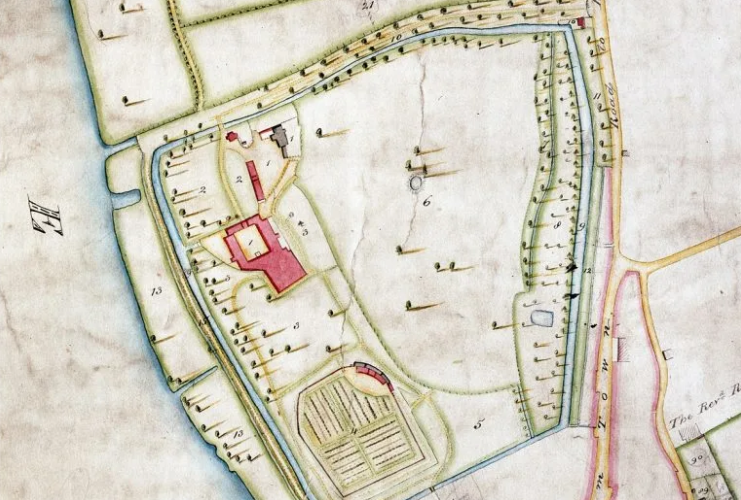
Section from an 1831 estate plan showing the moat, and inlets form the River Thames.
Much of what visitors recognise today - especially the Tudor courtyard and the great hall - comes from late 15th-century building campaigns. Analysis of the timbers in the courtyard gate and great hall roof indicates trees felled in the 1490s.
Then the Reformation changed domestic life across England, including here. When Church of England clergy were permitted to marry in 1549, Fulham Palace became not only an official residence but also a family home. That shift matters, because it reminds us that this wasn’t a frozen monument: it was lived - in space - children, staff, guests, meals, chores, celebrations, and the ordinary rhythms of a household set within extraordinary history.
It was also a place of hospitality at the highest level. Queen Elizabeth I visited in 1601 and was honoured with a lavish banquet; she also visited John Lacy in Putney at least 25 times during her reign - a favoured subject who was a prosperous London clothworker and merchant, and contemporary court records note her repeated visits to him during her reign - an intriguing detail, given he was a wealthy local merchant rather than a court noble; more than a century and a half later King George III visited for something much simpler - breakfast. So: proof that even royal engagements can slide, over time, from “state occasion” to “pop in, have a cuppa.” But the underlying point is serious: Fulham Palace sat at the intersection of local life and national power.
3. Gardens, science, and the wider world
If the great hall tells us about power and ceremony, the gardens tell another story: curiosity, exchange, and learning. In the late 17th century, under Bishop Henry Compton, Fulham Palace became famous for horticulture. Networks of correspondence and collecting brought new species into cultivation, and the Palace gardens gained a reputation as a place where the wider world could be studied through plants.
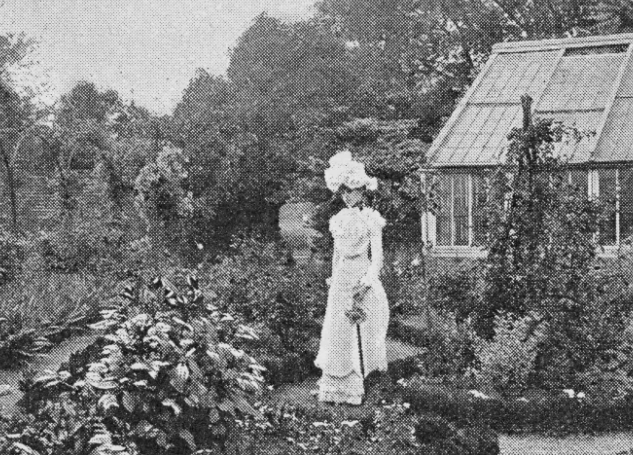
The knot garden c.1899. The wisteria is visible, trained on hoops. The glasshouse shown has since been demolished.
Accounts of the period credit Fulham Palace with cultivating Europe’s first magnolia, alongside other introductions such as cork oak and black walnut. This matters because it shows how a riverside house in Fulham was participating in early modern science and global exchange - long before “community education” became a modern phrase, and long before anyone could buy an “instant jungle” from a garden centre.
Today, the gardens remain central to how people experience the site: not as a fenced - off treasure, but as a place to walk, think, learn, volunteer, and bring children - linking wellbeing with heritage in the most practical way.
4. A palace in hard times: refuge in the 20th century
It’s tempting to think of old buildings as witnesses to history from a safe distance. Fulham Palace wasn’t distant. In the First World War, parts of the house were used as a hospital for wounded soldiers. In the Second World War, the Palace again served as refuge: during the Blitz, around two hundred people are recorded as staying here for several nights after their homes were destroyed.
These episodes shift our understanding. Fulham Palace is not only about elite visitors and historic architecture; it has also been a practical sanctuary. That thread - shelter, welcome, service - becomes crucial when we talk about its role today.
5. From private residence to public place: why Fulham Palace is a community hub
Before we turn to the modern Palace, communities need trusted places where people can gather across generations - places that are welcoming, practical, and outward-looking. Fulham Palace has become one of those places, and its journey from private residence to public asset is a useful case study in civic partnership.
The Bishop of London lived at Fulham Palace until 1973. After that, the site entered a new chapter: moving from an official home into a public-facing heritage place. In 2011, the independent charity Fulham Palace Trust was formed to manage the estate, and the Palace has continued to develop as a museum and historic site with free entry and daily opening.
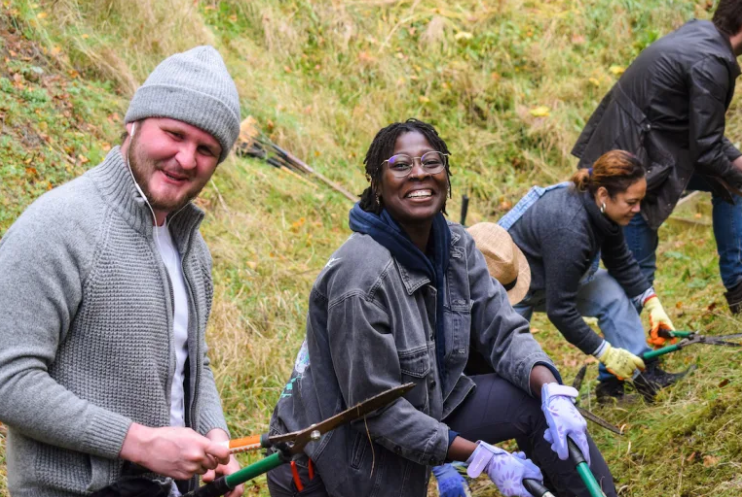
People gather here to enjoy activities and experience joy. Above a group of volunteers helping to maintain the historic moat.
So what do we mean when we call it a “community hub”? Not just that people visit. A hub is a place that connects different groups, meets different needs, and creates shared experiences. Or, put another way: it’s the sort of place where you can arrive for “a quick look” and somehow leave two hours later having learned about Tudor carpentry and also bought a plant.
Access: The Palace offers free entry to its museum and historic rooms, and the gardens provide a welcoming green space. In a city where cost can be a barrier, “free to visit” is not a small detail - it’s a statement about who heritage is for.
Learning: The site supports learning through school and youth engagement, family resources, and interpretation in the rooms and grounds. The Palace’s archaeology and long timeline make it an unusually rich classroom - one that connects local history to bigger national stories.
Programming and events: Talks, tours, exhibitions, seasonal activities, and family days turn the Palace from “somewhere you go once” into “somewhere you return to.” Regular events also create low-pressure ways for neighbours to meet.
Participation: A true hub invites people to help shape it. Volunteering - whether welcoming visitors, supporting events, or working in the gardens - builds skills, friendships, and local pride. The Palace becomes part of people’s routines, not just their weekend plans.
Put simply: the Palace works as a hub because it has multiple “front doors.” Some people come for history. Some come for the gardens. Some come for a coffee and a walk. Some come with children. Some come because volunteering offers structure and belonging. The result is a rare mix - different ages and backgrounds sharing the same space, often without needing an invitation.
6. Closing: keeping the story alive
Fulham Palace matters because it shows how history can be both deep and usable. It holds traces of prehistoric movement along the Thames, medieval authority, Tudor building craft, early modern science in the gardens, and the hard realities of the 20th century. But it also matters because it has become something more than a historic house: a shared civic space.
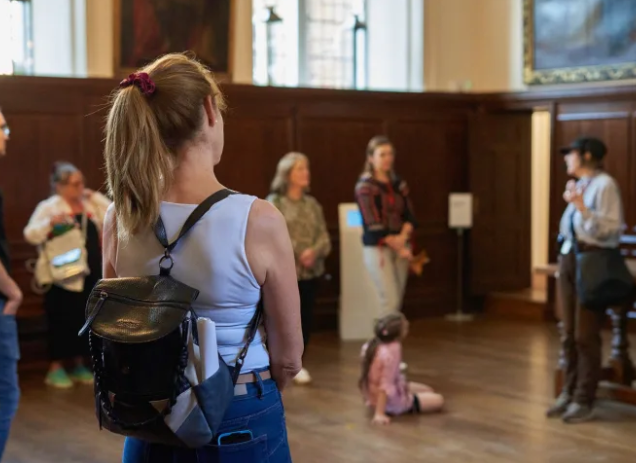
Visitors exploring history in the great hall.
So if you take one idea away in this blog, let it be this: heritage survives when it is lived with. Visit again. Bring someone who hasn’t been. Join a tour. Spend time in the gardens. And if you’re looking for a practical, local way to support community life, consider how anyone in your network might connect with the Palace - through volunteering, attending events, supporting learning programmes, or simply helping more residents discover that this resource is here and open to them. It’s one of the few places where you can do something good for the community and still legitimately end up talking about a moat.