
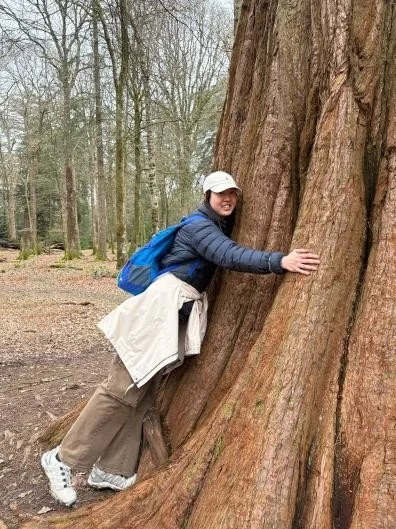
My name is Xinyu, and I come from China. Last September, I came to the UK for the first time to begin my MA in Museum Studies. Before this, I studied conservation and restoration as an undergraduate. At that time, I worked more closely with objects themselves, including their materials, preservation, restoration and care. Since coming to the UK, I have started to understand museums from a broader perspective, thinking more about the relationships between objects, spaces, audiences, education and communities.
At the end of May, I was very lucky to start my placement at Fulham Palace. Each morning, as I walk towards the Palace along the green space beside it, the trees and gardens gradually soften the sounds of the city. Step by step, I feel as if I am moving closer to the deep history of the Bishops of London.
For me, Fulham Palace is special because it brings together the history of the Bishops of London, a historic house and a botanic garden. Through the museum and historic rooms, visitors can learn about the people who lived and worked here, and understand the Bishops as religious figures, estate owners, family members and people who shaped the history of the Palace. In London’s second oldest botanic garden, visitors can also experience the continuing life of nature.
During my placement, I have been involved in different areas of work, including the volunteer programme, front of house and the learning programme. I have also had the opportunity to take part in and observe activities for children and families. Through these experiences, I began to see how Fulham Palace transforms a historic space into a place that the public can enter, experience and feel connected to, through volunteering, learning activities and community engagement.
One of the most moving experiences for me happened during a Stone Age school session with Year 4 students. On that day, the children entered an immersive Stone Age setting and took part in different activities, including handling objects, building shelters, making necklaces, decorating their own homes with drawings and grain grinding. I was responsible for the grain grinding activity.
The children could feel the weight of the stones, hear the sound of friction, repeat the movement, and experience the patience and effort needed to turn grain into flour. Through this physical experience, they began to understand that Stone Age life was not just an abstract historical topic, but a lived practice closely connected with food, tools, labour and materials.
When guiding children through the grain grinding activity, I tried to connect the action with their own everyday experiences. I asked whether they had ever helped their family make bread or cakes at home, and how it might feel if they had to prepare food like this every day. Through these questions, the children could connect the grain, stones and grinding process in front of them with familiar foods and family experiences. I began to understand that museum learning is about using questions to encourage children to observe and express their own ideas. In this way, Stone Age life became less distant, and could be understood through food, bodily movement and everyday life.
There was one very small moment that I will always remember. A girl from Pakistan suddenly said “ni hao” (hello) to me in Chinese. I was surprised and very touched. At the end of the session, she asked me how to say “goodbye” in Chinese. This moment stayed with me because it showed that a learning space can be more than a place for sharing historical knowledge. It can also become a place where different cultures, languages and personal experiences meet. I had thought I was there to help children learn about the Stone Age, but in fact, I was also learning from them. Their curiosity, openness and willingness to communicate showed me how natural and spontaneous learning can be.
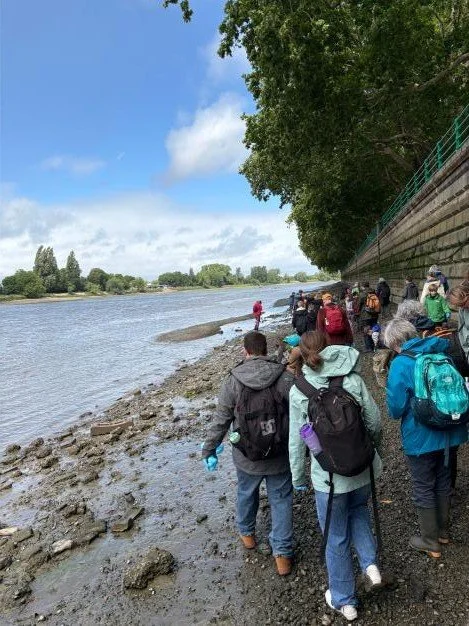
Another memorable experience was joining a Young Archaeologists’ Club activity. Together, children and their families searched for small finds along the Thames foreshore and brought them to the community archaeologist for identification. For children, this was not simply about “picking things up”. It was a way of learning to observe, compare and ask questions in a real environment. They wondered what the objects were made of, where they might have come from, and why they were there. Even when the objects they found were not necessarily of great historical value, the process of searching, identifying and discussing them was meaningful in itself.
I really like the way Fulham Palace positions its Young Archaeologists’ Club. It is the only YAC club in London based at a scheduled ancient monument and a site of significant archaeology. Young people have the chance to get involved with real archaeology, handle historical artefacts, and build skills, confidence and friendships through practice. Taking part in this activity expanded my understanding of where museum learning can happen. The Thames foreshore, mud, fragments, questions and curiosity can all become part of learning.
After returning home, I cleaned some of the small objects I had collected, gave them numbers, and applied a simple clear nail varnish layer. This related to the object numbering practice I had learned in my Collections Management and Care course, where we used professional materials such as Paraloid B-72. This time, I extended that classroom knowledge into my own personal experience. They form a small collection of my own, and in a personal sense, I became responsible for their care.
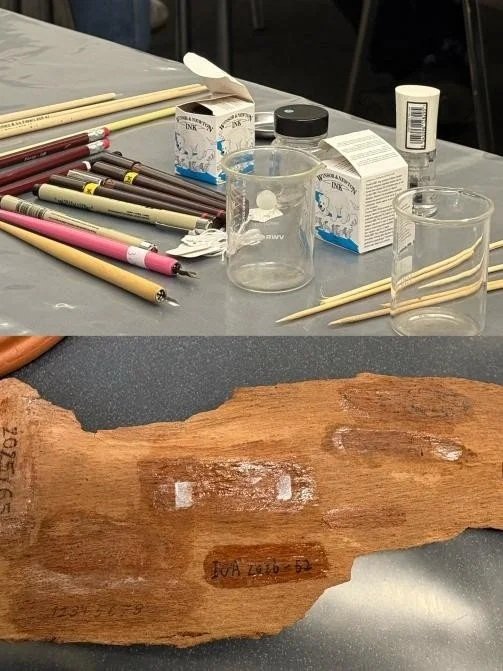
Object numbering tools and practice from my Collections Management and Care course at UCL.
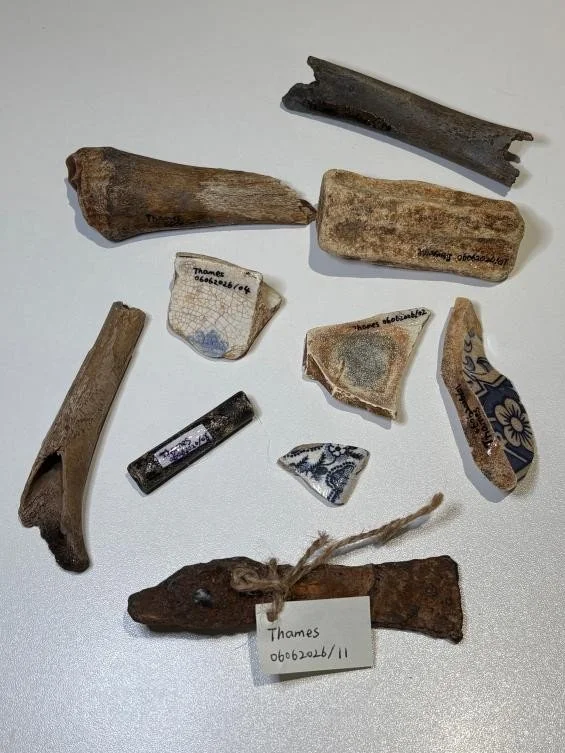
My numbered “treasures” from the Thames foreshore.
To others, these small objects from the Thames foreshore may simply be ordinary fragments. To me, they record a relationship between myself, Fulham Palace, the Thames and my experience of studying and living in the UK. Through them, I began to see how the lives of objects, knowledge and people can sometimes become closely connected in very small ways. I may only be a brief passer-by in the biographies of these objects, but they have also become part of my own story. They record that I came here, learned here, observed here, worked here, and seriously thought about my future career path in the museum sector.
During my days working at Fulham Palace, I have kept learning from children. As an adult, I was struck by their curiosity and by the way they approached the world with questions rather than fixed answers. Learning should not be confined to finding the correct answer. Perhaps one of the most precious things about museum education is that it can protect and encourage this desire to explore, making people want to keep asking, keep observing and keep connecting with the world.
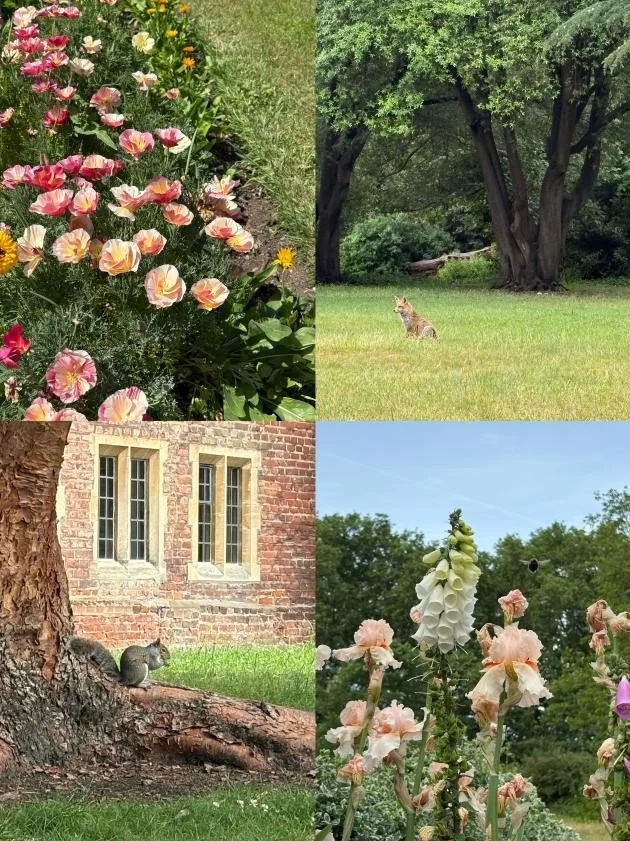
The small living wonders of Fulham Palace.
I have also grown to love the environment here more and more. Before work, I have sometimes seen foxes, squirrels, busy bees among the flowers, and blossoms opening across the garden. This beauty depends on the long-term care and effort of every member of staff, every volunteer and every gardener. It is this everyday and continuous work that makes Fulham Palace a place with both historical depth and living energy.
For me, Fulham Palace is the first heritage organisation in the UK that I have truly been part of, and it may also become the starting point of my journey into the museum sector. I deeply cherish this experience, and I am grateful for the people, children, objects, gardens and unexpected small moments I have encountered here. They have shown me that museum work is as much about creating new connections in the present as it is about preserving the past.
Thank you to every department, every member of staff and every volunteer, especially the managers and supervisors who have guided me during my placement. I am very grateful to have had the chance to become a small part of the Fulham Palace story.