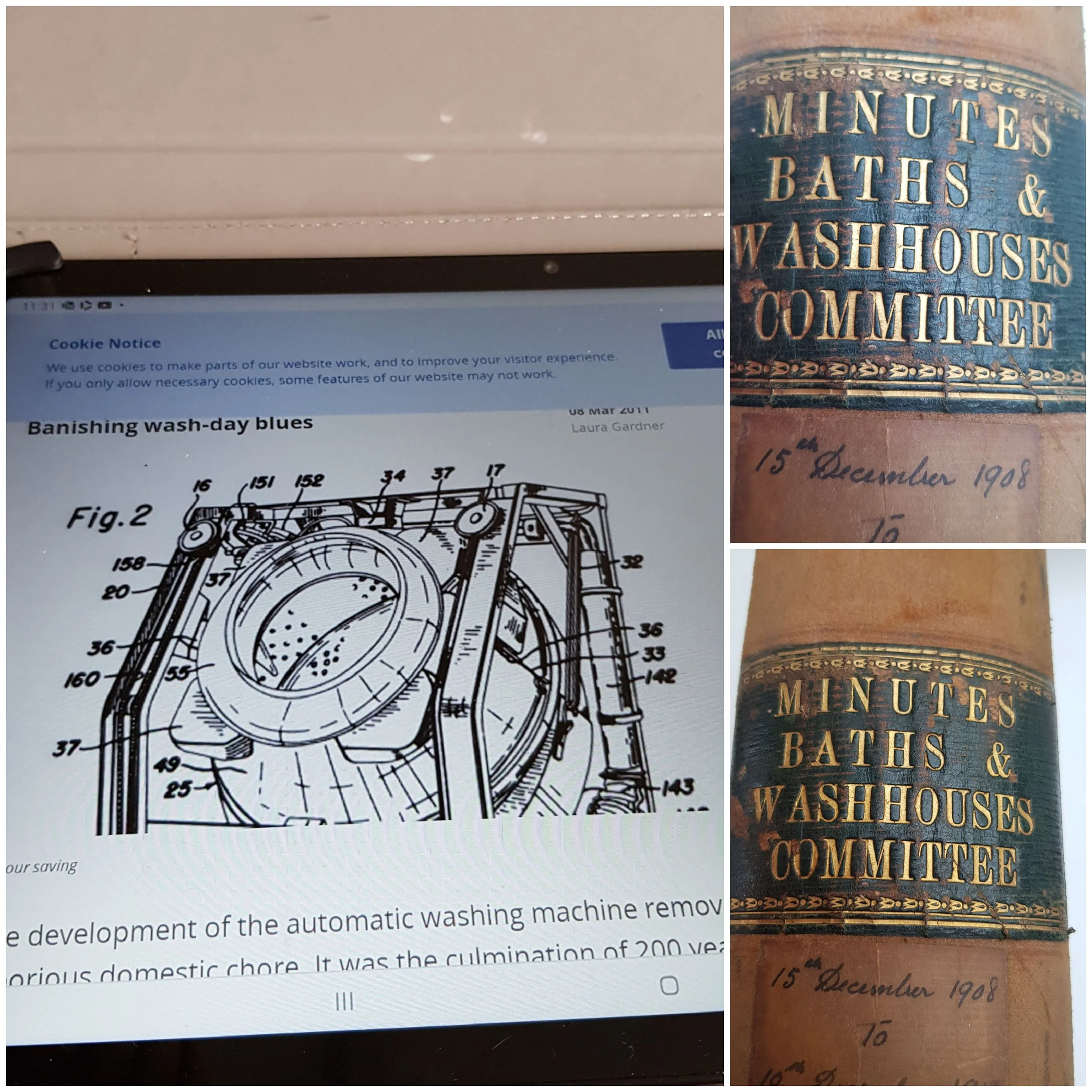
A welcome return to the wash-houses of Hammersmith and Fulham, front of house volunteer Anne Connaughton shares her research on doing the washing at the public laundry in Lime Grove.
Some readers might remember taking the family laundry to the Hammersmith Public Wash-house in Lime Grove. The entrance was actually in Scotts Road. People walking past that site today could be unaware of the history of the immediate locality. Hence the timeliness of this blog.
The records of the Baths and Wash-houses Committee (B&WC) give a fulsome account of the establishment of the Hammersmith Public Baths and Wash-House. Lime Grove like similar places, would have enjoyed regular patronage. They became popular meeting points for customers, who could also use an in-house cafe and place their children in a creche, while they got down to business.
Records show how some northern cities stole a March on London, vis a vis the provision of public wash-houses. By the mid-19th century, some London parishes had opened public washing facilities. Cleanliness campaigners set their sights on buildings “where all the conveniences for washing and drying clothes should be provided free of charge or at a trifling cost per hour...gladly accepted by the classes requiring such conveniences “. They advocated that such buildings “should be arranged as to be capable of enlargement......with its machinery and fittings, should be constructed with the best materials and workmanship, plain but strong, suited to the classes it is intended to accommodate, and with due regard to ventilation, light and order”.
The first electric machines appeared at the start of the 20th century. Early models were produced by adding an electric motor to existing wooden tubs. The first customers of the laundry on the Scotts Road site may well have used machinery based on this design. Users ran the risk of electrocution, so wooden tubs were replaced with metal tubs in enameled cabinets, with waterproof motors. Water was heated separately and added to the tub. By the 1950s it was possible to heat the water electrically.
In its early years, the Hammersmith Public Baths and Wash-house were coal-fired, so for many years, supplies were delivered from the coal fields in South Wales. There was some unoccupied land, with direct access to Scotts Road. The B&WC, subject to council approval, considered a proposal from the Cartage Committee, to purchase this land, on the grounds that it was a suitable site for a deposit, and stabling accommodation for four horses. That tells us that the coal, having reached London, was conveyed to the site by horses. Given what Hammersmith Metropolitan Borough Council had paid for this land, £30* was deemed a fair annual rent.
If anyone recollects the old public wash-houses in either Hammersmith or Fulham, contributory blogs are welcome.
Useful Sources (including italicised extracts)
Hammersmith Metropolitan Borough Council: Minutes of The Baths and Wash-houses Committee (Hammersmith and Fulham Local History Archives)
Baths and Wash-houses for the Labouring Classes (1852) : P, Pritchard Baly (Wellcome Collection)
Baths and Wash-houses Historical Archive
Banishing Wash-Day Blues (2011) : Institute of Mechanical Engineers
London Wash-house (1970-1979) : YouTube
Liverpool 1960s – Public Wash-house: YouTube
The Victorian Wash House - Dickens Museum : YouTube
*£30 in 1907, when Hammersmith Public Baths and Wash-House opened, was the approximate equivalent of £2,781,73 in August 2022 (Bank of England Inflation Calculator)