
Every month we feature two blogs written by volunteers, one describes an object in the Palace and one a plant from the Garden. It is a great way for us all to learn more about the Palace. If you would like to contribute there is no set format so, please do send us your ideas!
This month Learning Placement Student Lucrezia Paggio has chosen to feature the main entrance to the Walled Garden, the Tudor Arch. Please read on to find out more!
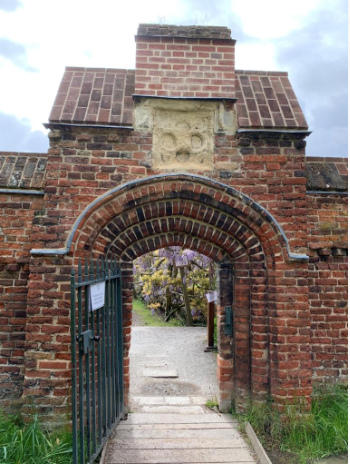
View from the main lawn of the Tudor Arch
Walking across the Palace lawn with the cafe behind, your first glimpse of the wonderful Walled Garden includes the impressive, perhaps some would say iconic, feature of Fulham Palace the Tudor arch. The arch is supported by a 16th century wall, which in turn protects and hides the Walled Garden from open view. Many wonders flourish within the Walled Garden, such as extensive vegetable beds and a knot garden, as well as a vinery, bee hives, an orchard and breathtaking wisteria. Within the garden you can buy organic plants and vegetables. The hard work of the gardens staff and volunteers is clearly evident, and is much appreciated by all who enter the enchanting space.
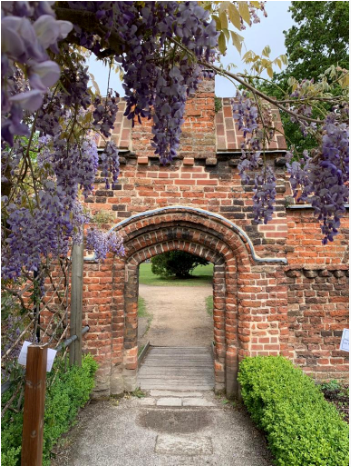
View of the Tudor Arch from inside the Walled Garden
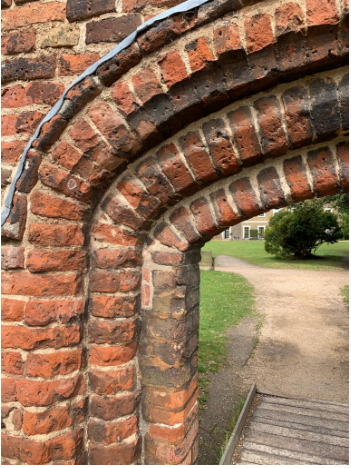
The Tudor Arch from a closer angle
The coat of arms on the arch is of Bishop Richard FitzJames (1506 - 1522). Therefore the 16th century wall was very likely built by FitzJames. Historically the Tudor Arch was nicknamed Henry VII Arch, a particularly fitting title. The Tudor period (1485-1603) is one of the most interesting and revolutionary periods of English history. England - at that time split into Catholicism and Protestantism - needed to emphasise its separation from Rome, both spiritually and architecturally.
Since that time, how many people have walked beneath this beautiful arch and importantly, who? The arch must have seen some very interesting characters.
The Tudor arch is recognisable for not being curved, hence not relying on a single and central point of support but rather on four main pressure points which gives the arch this peculiar shape; shorter but wider at the sides. As a result, it is mainly used in low and wide spaces… so do mind you head when you duck underneath!
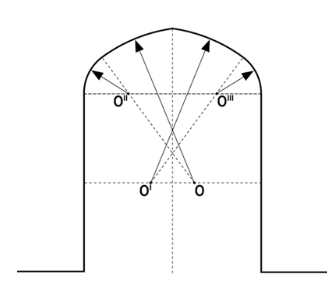
Diagram of a Tudor Arch
As you wander through the gardens and pass beneath the arch, take a moment to soak up the rich heritage of the Henry VII Arch.
Lucrezia Paggio
Learning Placement Student
Please send your ideas for Object / Specimen of the Month blogs to rachel.bagnall-bray@fulhampalace.org. If you would like some help, please let us know.