
Every month we feature two blogs written by volunteers, one describes an object in the Palace and one a plant from the Garden. It is a great way for us all to learn more about the Palace. If you would like to contribute there is no set format so, please do send us your ideas!
This July our Specimen of the month blog comes from Elizabeth Bredin, Garden and Front of House Volunteer.
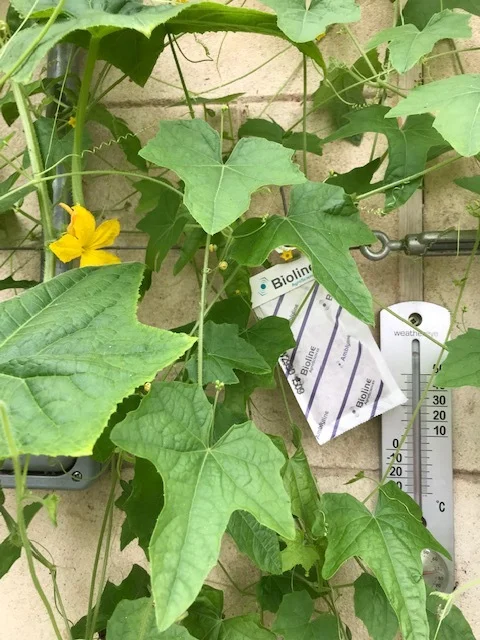
Most everyone enjoys receiving a package in the mail. Perhaps it’s the child-like thrill of anticipation about what is inside? There’s only one way to find out … so, one Thursday this summer when boxes were delivered to the gardener’s bothies, we garden volunteers watched with curiosity as Head Gardener, Lucy Hart, cut open several small cardboard cartons. Cossetted inside was an unusual, and precious cargo—biological predators which Fulham Palace use to control pests in the glasshouses.
At Fulham Palace our lovely plants are selected not only for their historical appropriateness, but also for disease resistance and suitability for environmental controls. We eschew the use of chemicals in the glasshouses and instead, use a variety of methods which fall under the umbrella terms of Integrated Pest Management or Integrated Crop Management. To meet this goal, we work with a biological control producer who have assessed our site and can predict what pests are likely to target our plants and devise a programme which will keep those pests at bay. The result is delivered by post on a 12-month cycle, in boxes kept cool with “blue ice” blocks. The enclosed predatory pests must be distributed in the glasshouses as soon as they arrive.
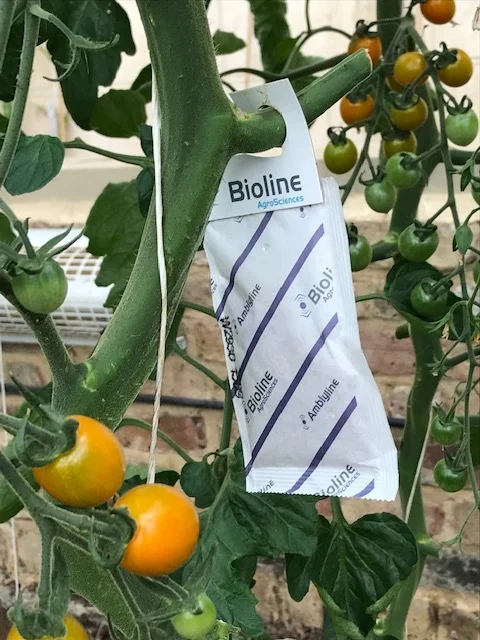
In the July shipment, we received three predators. Encarline is a white fly parisatoid, first successfully used in commercial crop management in 1926. It’s a small parasitic wasp which arrives as a tiny black scale, from which adults emerge a few days later. Amblysies californicus is a 1.25mm predatory mite, which in turn feeds on spider mites. But Lucy’s favourite is Aphidius colemani, whose reproductive lifecycle sounds like something from a sci-fi film. A colemani lays its eggs in its unsuspecting prey—aphids—without the aphids even knowing they’ve been “colonized”. Upon hatching, the infant A colemanii eat their hosts from the inside out. What a way to go…
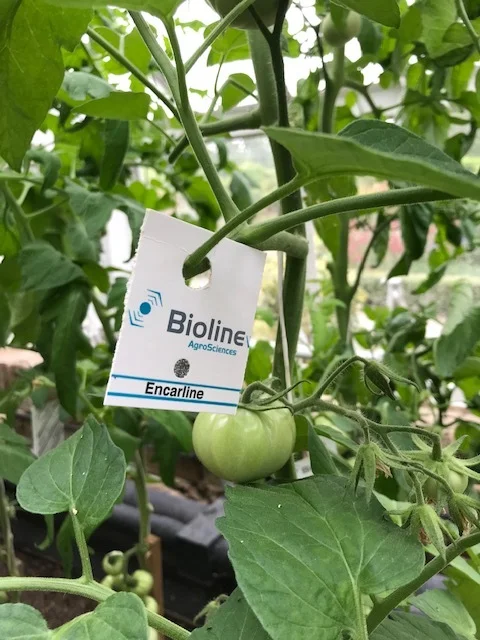
This summer in the vinery we’re growing more than 18 varieties of tomatoes, delicately favoured cucumbers and dozens of other plants which are planted throughout the gardens at Fulham Palace. These plants are protected from insect and arachnid pests by biological controls. In the glasshouse you’ll notice small paper sachets hung from the ceilings, nettings, window sashes and even the plants themselves. Although they may look somewhat like tea bags, these sachets contain the biological predators which we receive every few weeks.
Venture out into the gardens to find another way to attract biological controls—a Bug Hotel, built by garden volunteer Chris Warner. Chris designed and built the hotel entirely out of scrap materials which he found on site. It provides a habit for lone bees, masonry bees, wood lice, and spiders as well as birds. The “hotel” is located adjacent to the All Saint’s Church fence.
There are so many ways which a home gardener can avoid using pesticides and chemicals. Try a bug hotel to attract beneficial insects and arachnids to your garden. You can purchase ladybird larvae online, as well as many of the predators which we use here at Fulham Palace. Companion planting is an effective and attractive way to discourage unwanted garden pests. We all can have a part to play in maintaining and improving the health of our natural environment.
Elizabeth Bredin, Garden and Front of House Volunteer
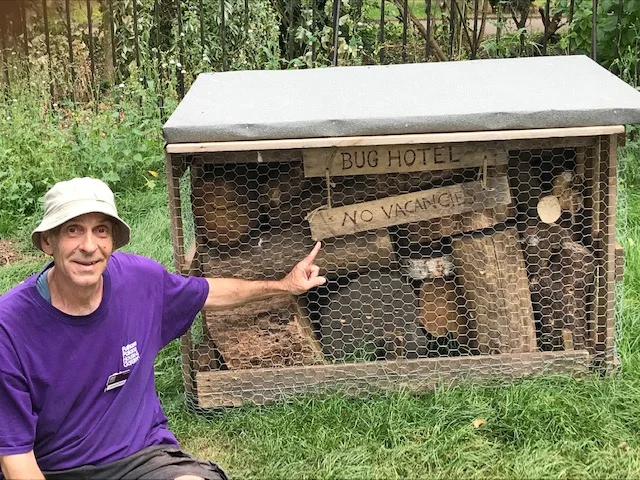
Chris Warner, Garden and Bodger Volunteer
Please send your ideas for Object / Specimen of the Month blogs to rachel.bagnall-bray@fulhampalace.org. If you would like some help, please let us know.