
Every month we feature two blogs written by volunteers, one describes an object in the Palace and one a plant from the Garden. It is a great way for us all to learn more about the Palace. If you would like to contribute there is no set format so please do send us your ideas!
Coins as Bread, Bread as Coins: Culture and History in a Small Circle
This month’s object of the month is a bag of historic coins found in the store at Fulham Palace. They are going to be used in our educational activities in the future, perhaps as part of our Victorian Schools sessions.
I am Minchae, one of the learning volunteers at Fulham Palace. This morning, the Learning Assistant Jean Shipton, presented me with an enigma… A bag of historic tokens or coins of various shapes and colours, with the challenge to explore and investigate a little of their history.
Money has much influence on our lives today, just as it had in the past. Money is often thought of as simply a means of buying goods, but it is also imbued with history through the letters, numbers and pictures written on it.
Even though these coins have some information written on them, they are quite worn. Therefore, this initial research has limitations that there is not enough primary information. But it may be meaningful to follow the leads that we have on each of the little coins. Let’s begin!
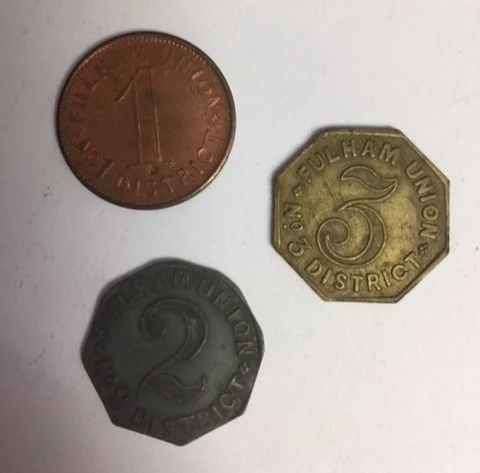
Fulham union, No.1,2, and 3 District, by W.J.Taylor Maker, 70 Red Lion St., Holborn, one loaf ‘1, 2, and 3’ octagonal (30mm).
This is information written on the three coins I’ve chosen to focus on.
These coins are made by W.J.Taylor. Online research suggests that he is William Joseph Taylor, born in Birmingham in 1802. By the 1840s Taylor was established as a medallist and dealer. During his career he produced a considerable number of coins and tokens, mainly for export.
The first thing that came to my attention about these coins were the letters in the middle of the back of the coin ‘ONE LOAF’. This tells us that these coins therefore are food tokens.
‘70 Red Lion Holborn’ written under the coins are place names that still exist today. This is probably the place where the coins were made.
Let’s look at the front side with the number of coins.
Fulham union district no. is written around each number. In 1837s, the parish of Fulham became part of the New Kensington Poor Law Union. Following this, poor people from Fulham were housed in a number of establishments. In 1845, the Kensington poor Law Union was dissolved and Fulham united with Hammersmith parish to form the Fulham Poor Law Union. Finally, in 1848-9, a new Fulham workhouse, for up to 450 inmates, was erected at east side of Fulham Palace Road.
It is assumed that the people who lived in Fulham union at that time used coins by district. Bread and milk tokens were used so families could budget their money and trade them in for fresh bread or milk.
It was interesting experience to look at the society and culture of that time in one coin by looking and touching closely at the coins. Thanks for exploring these wonderful coins with me!
Minchae Cho,
Learning Volunteer
Please send your ideas for Object / Specimen of the Month blogs to rachel.bagnall-bray@fulhampalace.org. If you would like some help, please let us know.
References: https://www.tokencompany.com/mauquoy-token-company-revival-bread-tokens/