
Every month we feature two blogs written by volunteers, one describes an object in the Palace and one a plant from the Garden. It is a great way for us all to learn more about the Palace. If you would like to contribute there is no set format so please do send us your ideas!
Part of the current Restoration Project involved the planting of a new border, known as the Compton Border alongside the Bishop’s Park side of the Walled Garden. The new planting enhances the botanic value of the gardens by emphasising the connection between the Bishops of London and the gardens. It will also be an enchanting extension of the Walled Garden.
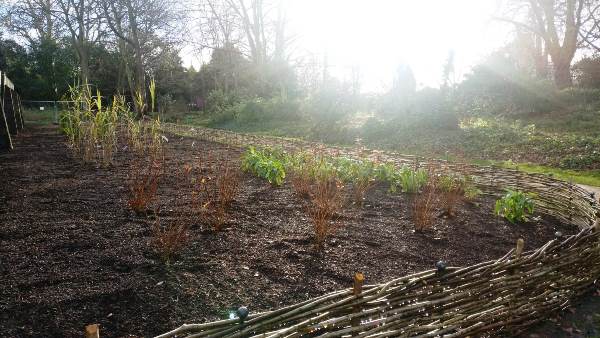
The Compton Border with Volunteer and Staff Made Wattle Fence
So, why Compton?
Bishop Henry Compton was a resident of Fulham Palace from 1675-1713 and was a keen botanist. As Bishop of London, Bishop Compton was also Bishop to the West Indies and Virginia as their remit at that time extended to England's overseas colonies.
Through his contacts in the West indies and Virginia, Compton was able to collect different exotic plants including Lonicera Capifolium (Perfoliate Honeysuckle) and Crataegus Crus-galli (Cockspur Thorn), these have since been planted in the Compton Border near the Walled Garden. Additionally, in 1689 after the death of Duke Albermale, Compton was gifted part of an 800-plant collection to plant at Fulham Palace.
As part of the Restoration Project the palace today is beginning to reintroduce some of the plants that Compton introduced to the Palace including; Lonicera Capifolium (Perfoliate Honeysuckle), Ilex Aquifolium (common Holly), Crataegus Crus-galli (Cockspur Thorn) and Leonotis Leonurus (Lions Tail).
Have a look out for these the next time you’re passing the Walled Garden!
Rebecca McGovern,
Learning Placement Student
Please send your ideas for Object / Specimen of the Month blogs to rachel.bagnall-bray@fulhampalace.org. If you would like some help, please let us know.
References:
Morris, S. (1993) Legacy of a Bishop (Part 2): The Flowers of Fulham Palace Gardens Introduced 1675-1713. Garden History. 21(1) pp.17. DOI: 10.2307/1587051