
On Tuesday 29th January, the Garden Apprentices, Ellie and Alfonso, attended a Rose pruning workshop at the Hurlingham Club. This was given by Richard Stubbs, a rose expert from David Austen Roses, who previously worked as Head Gardener in their show garden in Shropshire.
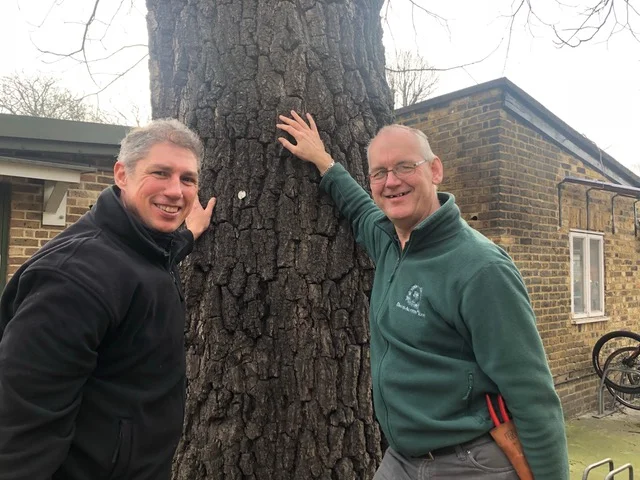
Rose experts Alfonso Moreno, Fulham Palace Apprentice, left, and Richard Stubbs, David Austen Roses, right.
Richard told us how David Austen himself would say ‘I wish I knew how to prune roses’ when he visited the gardens, so there is hope for us all!
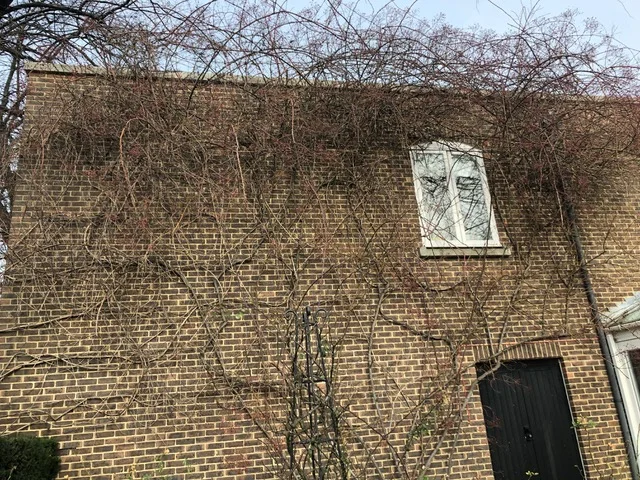
A slightly out of control rambler Rosa, ‘Bobbie James’
Richard focused on shrub roses and explained that, while pruning sounds complex and difficult, there is nothing to be afraid of and ‘You will not kill a rose by pruning it’.
Each plant will be unique, so you need to take into account its position in the garden, border and the growing habit – you can even prune the same rose in different ways for the desired effect. For example, plants towards the back of the border can be left higher.
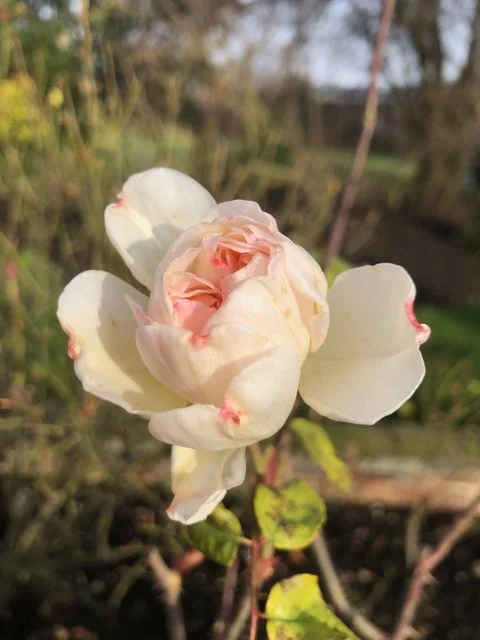
Early flowering growth can be removed
Early Spring is a good time to prune roses, as this encourages strong, healthy stems that will give a good structure to the rose and be vigorous enough to support lots of flowers. The roses can then be fed and mulched in March.
When pruning it is important to remember the ‘three Ds’ – initially removing all dead, damaged, and diseased growth. Then remove crossing stems, suckers, weak, spindly growth thinner than a pencil and any inward growing stems at the base of the plant to aid airflow. The upper part of the shrub rose can be allowed to grow inwards to create a mass of flowers and foliage.
‘If in doubt, take it out’ is a good rule to follow as roses are hardy and will reshoot – if you are feeling initially cautious you can return later and remove more growth. Pruning back to knee height is a good rule of thumb.

Behind the scenes at the Hurlingham Club’s Tool Store - a team not to be messed with!
Stems should be pruned to an outward facing bud, using a sharp, clean pair of secateurs, loppers, or even a small pruning saw for woody growth. The cut is traditionally made diagonally to discourage standing water and rotting. If you cut far away from a bud, the stem above will die back to the bud giving a potential entryway for disease as well as an unsightly look. Richard was not overly concerned about this, as these ‘coat hooks’ will be hidden by the new foliage, but this is a point of debate.
Particularly weak specimens can be ‘spade pruned’ and removed entirely to be replaced by a new plant - older specimens lacking strong growth should be replaced after 15-20 years.
Rose replant disease can build up in the soil, and in badly affected cases, all the soil in a bed must be dug out and replaced before new roses can be replanted successfully. Also when roses have been well fertilised over successive years with a strong mulch like horse compost, certain nutrients can build up in the soil, which can actually have the effect of blocking wanted nutrients from the plant – a soil test can be carried out every 5-10 years to determine if this is the case, if your roses inexplicably lack vigour.
Don’t be afraid to cut off any buds or new shoots while pruning – we found many, and even some flowers due to the recent mild weather; these can be removed as they will be frost damaged, and the plant will make new growth. Finally, a thick pair of gloves and long sleeves are strongly recommended!
Rose recommendations
Very vigorous climber - Rosa ‘ Madame Alfred Carriere’ (white)
Vigorous rambler - Rosa ‘Bobbie James’ (white)
Shrub - Rosa ‘Chianti’ (purple-maroon)
Thanks to Ellie Edmonds, Garden Apprentice, for her fascinating reflections on Rose pruning training at the Hurlingham Club.