
Every month we feature two blogs written by volunteers, one describes an object in the Palace and one a plant from the Garden. It is a great way for us all to learn more about the Palace. If you would like to contribute there is no set format so please do send us your ideas!
During the 2017 Community Dig at Fulham Palace, we had up to four professional archaeologists and around 30 adult volunteers on site, but the most important finds in the first week of the dig were found by members of a Brownies, Guides, Cubs and Scout packs; students from the Moat School and members of the Fulham Palace Young Archaeologists Club (YAC).
In our search for the Palace Dovecot we had started to dig an area in the front of, the main gate to the Tudor courtyard. Instead of the Dovecot we found a thick layer of Tudor brick from parts of the Palace demolished in the mid-1700s. Keen to get the groups of young people digging, we gave them trowels and set them to work on the rubble layer we were working through. What we were not expecting was that between them, they would make highly significant finds that would change our understanding of the history of the Palace.
When they dug into this layer they, of course, found lots of Tudor bricks. This was exciting enough for the budding archaeologists, but what was to emerge were creamy coloured lumps of plasterwork in the shape of leaves, fruit, bunches of grapes and even part of a decorative shield. The pace of digging slowed as we were able to use out trowels to pick out the intricate details on this plasterwork. After being in the ground for nearly 300 the plasterwork had consistency of cheese, so a great deal of care was needed to uncover, and then lift, these remarkable finds. They were later sent away to experts to identify their age and where they might have come from.
They found it difficult to put a precise date on the plasterwork, but the decorative style suggested that it dated from the 1630s. This was because it had some similarities with the ceiling of the Great Dining Room at Ham House which dates to 1636-37. The largest find by the YAC was the huge chunk of cornice with a simple beaded pattern. The care taken to uncover this, preserved the patterns on the back and these showed that it has been attached to brick or stone. This showed that it could have been placed either between the wall and the ceiling above a fireplace, or lower down as part of an elaborate mantlepiece. It could also have been a decorative feature above a door.
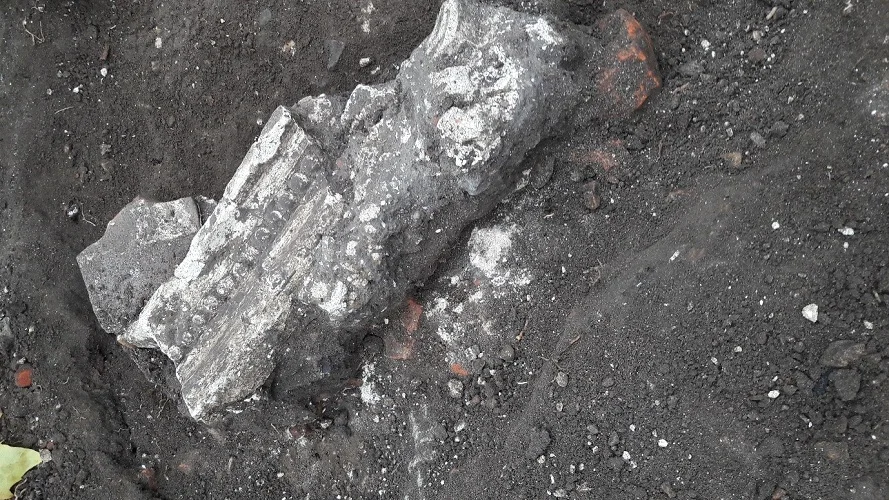
The was found by YAC (the Young Archaeologists Club), and is a huge chunk of cornice with a simple beaded pattern.
The decorative shield (or cartouche) found by the Brownies was undecorated and was similar to one found in the Palace grounds in the 1800s. This was painted with the arms of Bishop Juxon and dated to 1636. This does suggest that some redecoration took place at this time, but there is no record of this. More research is needed.
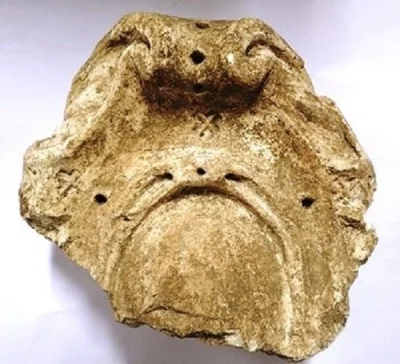
A decorative shield (or cartouche) found by the Brownies the Fulham Palace Community Dig in October 2017
The commitment and the enthusiasm of the young people during the 2017 community dig showed the remarkable power that archaeology has to engage young people in uncovering the past. Their contribution to the Community dig was important. It is likely that some of these finds of ‘great significance’ will eventually be placed in the Fulham Palace Museum and experts have suggested that the images and analysis of these finds should be published. Whatever your age or experience, I would encourage everyone to get involved in activities at Fulham Palace. You never know what you will find!!
David Wellings, Archaeology Volunteer
Please send your ideas for Object / Specimen of the Month blogs to rachel.bagnall-bray@fulhampalace.org. If you would like some help, let us know.