
Every month we feature two blogs written by volunteers, one describes an object in the Palace and one a plant from the Garden. It is a great way for us all to learn more about the Palace. If you would like to contribute there is no set format so please do send us your ideas!
I’m a trustee of Meanwhile Gardens, a small park in North Kensington. Three years ago, when a tiny potted Coast Redwood was given to the Gardens by an anonymous donor, our park gardener duly “bunged it in”, as he put it. Now over 8 feet tall, that little sapling has me wondering about three towering members of the same family - Cupressaceae - represented in the Palace gardens. Will they outlive most of the other trees here? Could they outlive the Palace itself?
Here’s quick rundown of these closely related coniferous trees:
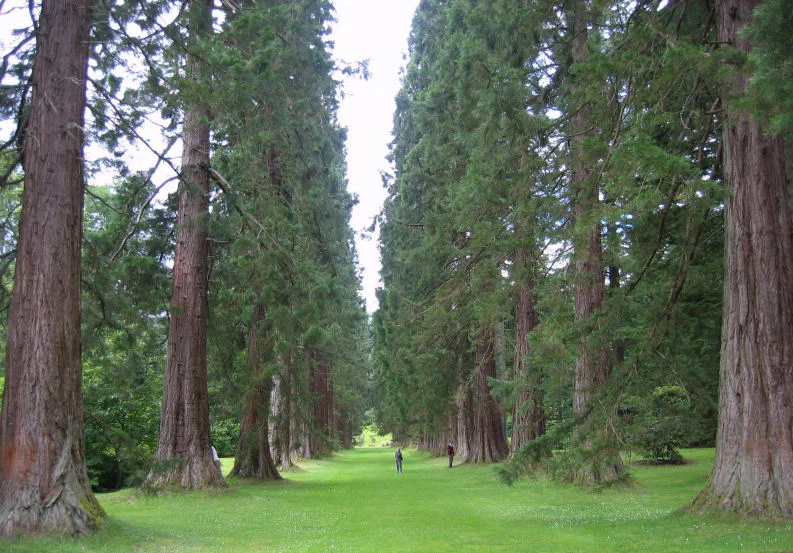
1) Giant Redwood (Sequoiadendron giganteum), located along the eastern boundary next to the yew hedge; evergreen, native to the Californian High Sierra; reddish, spongy bark and aniseed-scented needles.
2) Coast Redwood (Sequoia sempervirens), also located on the eastern boundary, near the Giant Redwood; evergreen, native to the U.S. Pacific coast; reddish, spongy bark and grapefruit-scented needles.
3) Dawn Redwood (Metasequoia glyptostroboides), located just west of the drive near the main entrance gates. Its very different origin – the Far East - may account for the fact that, in contrast to the other two species, it is deciduous, with cracked, peeling grey-brown bark, and needles that don’t smell of anything much but turn a lovely copper pink in autumn.
Most interesting of the three is surely the Metasequoia. This species was first discovered in 1941 as a three million-year-old fossil by a Japanese botanist. Soon afterward, living specimens were found in China, and after WWII were brought to the US and Europe.
Now for a few statistics:
1) Giant Redwoods can live over 3000 years and can grow to 80 m. in height.
2) Coast Redwoods can live over 2000 years and can grow to 100 ft. in height.
3) As Dawn Redwoods are a much more recent discovery, their statistics are less certain – but 50-year-old specimens in Cambridge are already 70 ft. high.
Palace records indicate that the Coast Redwood (Sequoia sempervirens) and Giant Redwood (Sequoiadendron giganteum) were planted in1976, and the Dawn Redwood (Metasequoia glyptostroboides) probably in the 1960’s. Thanks to our head gardener and her measuring wheel and stick, we know the Coast Redwood has grown about 2 ft. each year and is now over 75 ft. tall.
The trees’ botanical names honour a Cherokee chieftain, Sequoiah, who invented the first Native American written alphabet. Travelling throughout the American southwest, he became well known for his efforts to use the language to help reunite the many groups of the Cherokee nation.
When the Coast Redwood (Sequoia sempervirens) first arrived in Britain in 1843, it hardly caused a stir; but soon afterward it was followed by the Giant Redwood (Sequoia giganteum), which created great excitement. This species was dubbed “Wellingtonia” in memory of the Duke of Wellington, who died a year before the tree’s first seedlings arrived in Britain. (When the seedlings appeared on the US East coast, the name “Washingtonia” was proposed, but didn’t stick). Arriving much later in Britain was the Dawn Redwood, whose botanical name) translates as “like a sequoia” and “resembling a swamp cypress”. .
Alas, in the US redwoods have been turned into dance floors, bowling alleys and tunnels big enough to drive through – and there is continued logging for their excellent timber. At the same time, they share the status of a national monument. In 1894 Lincoln signed a bill granting the trees the protection of the State of California “for the benefit of the people” – and soon after that, Teddy Roosevelt’s efforts on behalf of the trees led to the creation of Yosemite and many other national parks and protected wild areas.
Here in Fulham, the Palace’s specimens seem altogether in keeping with Bishop Compton’s enthusiasm for American imports. Despite Peter Wohlleben’s dim view of redwoods grown away from their original habitats (see The Hidden Life of Trees, Ch. 27), our trees seem to be doing well, delighting many visitors - including one Jack Cooke, author of The Tree Climber’s Guide. Referring to his “inner gibbon”, Cooke describes climbing our own Giant Redwood. In view of current efforts to stop little visiting monkeys from climbing trees at the Palace, his account may cause staff and volunteers a wry smile!
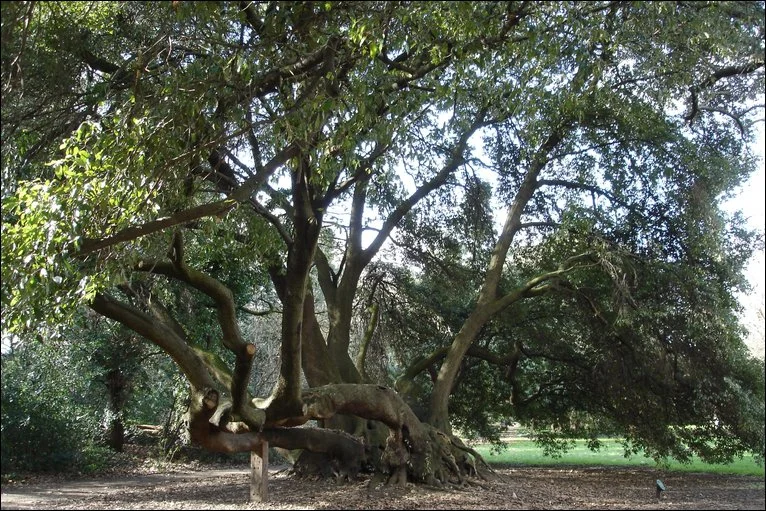
Fulham Palace’s fabulous 500 year old Holm Oak Tree!"
Susie Gretz, Museum Steward Volunteer
Please send your ideas for Object / Specimen of the Month blogs to rachel.bagnall-bray@fulhampalace.org. If you would like some help, let us know.