
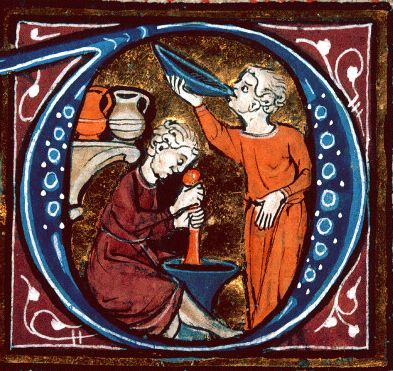
I enjoyed last Thursday evening's talk by Dr Katherine Harvey, as did my guest, who has just started her Diploma Course in the History of Medicine with the Worshipful Society of Apothecaries in Blackfriars. We both found the beautifully-illustrated talk most informative.
Katherine has a PhD from King's College London, and since last year, has been a Wellcome Trust Research Fellow at Birkbeck College. Her project is Medicine and the Bishop in Medieval England, c.1100-c.1400, and when speaking to us at Fulham Palace (a home of the Bishop of London for at least 800 years) she aptly focused on the Bishop as patient. I was expecting to hear that there were tensions between medical and Christian religious understandings of health and well-being in late medieval England. But, instead we learnt that the Bishop embraced medical ideas based on the ancient Greek system of the four humours, originally devised by Hippocrates and Galen. A patient's four humours had to be kept in balance. Accordingly, Bishop readily employed the 'art' of the Barber Surgeons to be bled at the right season and time of, for example, the lunar cycle.
Medieval medicine was as much about prevention as cure, and it was thought that an individual's health was greatly influenced by six 'non-natural' factors, which included air, travel and emotions. Bishops were aware of the dangers of travel, which would be required of them as members of the educated elite who were often also Lord Chancellors or Ambassadors of State. The stress of being a Bishop would need to be reduced by a relaxing regimen...
Life in the Middle Ages - at least for senior cleric - was not as unhygienic as we might have imagined! However, we also learn that some Bishops feared being poisoned, and we saw a picture of an exquisite table ornament used by Bishop Robert de Sigillo to counter this danger. It was a so-called 'serpents' tongue tree', in fact made of polished sharks' teeth. This intrigued me and other Fulham Palace Guides, who well know that the ornamental did not prevent Bishop de Sigillo being arrested in 1141 at Fulham Palace, and held for ransom!
Thanks are due to Dr Harvey for a fascinating talk.
Jane Bowden-Dan
Volunteer Museum Steward and Historical Tour Guide
Next talk will be today Wednesday, 23 September at 7pm. The Great Encourager: Bishop Compton and his Garden at Fulham Palace. Click here to book.