
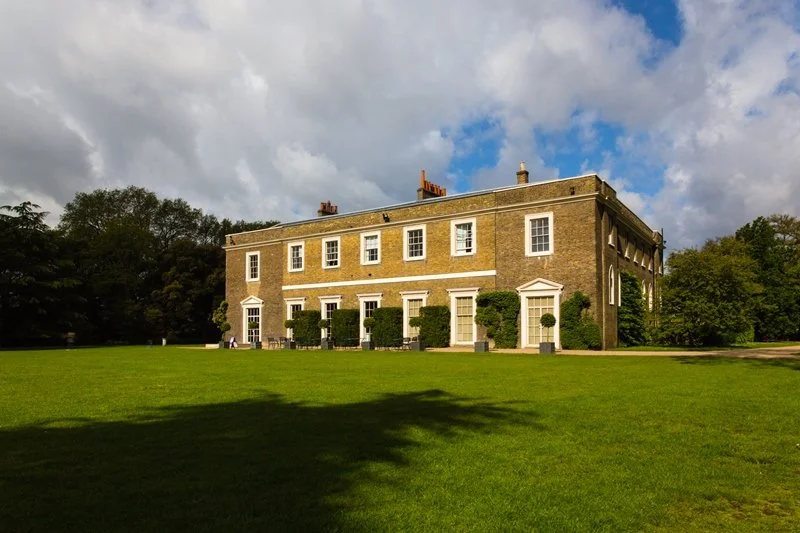
Becoming a trained member of the Thames Discovery Programme has given me and many other non-academically trained volunteers the opportunity to observe, monitor and record a much overlooked area of great archaeological importance – The Thames Foreshore.
The Timbers
Having first come across a couple of parallel recumbent timbers on the Fulham Palace Foreshore in July 2010, the Fulham Foreshore Recording and Observation Group (FROG) have kept a record of their visibility and progress of erosion. Situated just upstream of Putney Bridge, they were sited in an E/W direction following the line of the shore on a long raised bank and visible at medium to low tides. The first one that became apparent was 15cm wide and the second one 28cm wide and placed 2.70 metres apart. They were then flush with the foreshore surface with just their ends visible. Although there was quite a difference in size, the fact they were parallel made me curious.

Site of Timbers looking towards the East. Timber 2# in foreground. Timber I# is mid left of picture.
In November 2014, a third parallel timber (timber 3#) was located towards the east with interesting chop-marks on it, and two plainer ones running immediately south of it which appeared to be part of the same structure. On showing a photo of this to ancient wood expert Damian Goodburn (MOLA) at the Foreshore Forum that year he suggested it was of suitable size for dating. (11cm x3.5cm depth).
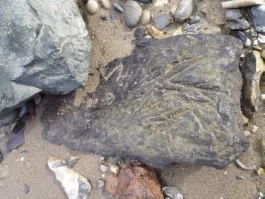
Timber #3
So in January 2015 a sample was taken of the chop-marked timber and thus revealed an underlying timber which had a wooden peg that had been hammered through it. Maybe this plank was intended to remain flat on the shore. A bonus find! The intriguing chop-marks however suggest to me that the associated timbers could have been cut and formed in-situ. It has been suggested that this site could have been a mooring feature for boats or maybe it is part of a revetment.
April 2015 was the last time timbers 1# and 2# were visible but the remainder of 3# 4# and 5# are still intact, although submerged.
Results for Timber 3# AD608 +/- 27 years
The radiocarbon dating of the sample from Timber 3# places this structure in the early/mid Saxon period. This predates the earliest documentary reference to Fulham which dates from AD 704 when the manor or land at ‘Fulanham’ was granted from Tyrtilus, Bishop of Hereford to Wealdhere, Bishop of London.
Across the river at Putney an early Saxon fish trap was identified in the early 1970’s by the Wandsworth Historical Society (dated 5th-7th Century in the 1990’s) and also one at Hammersmith and Barn Elms.
The Wattle
On a FROG Monitoring event in August 2011 we were observing the vicinity of the aforementioned parallel timbers when our Project Director and Head of Community Archaeology, Natalie Cohen pointed out a fair amount of shell incorporated in the gravel. Scraping just below the surface she revealed some wattle.
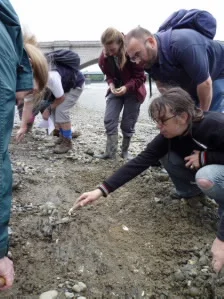
Uncovering the Wattle
Situated just South of the site of the parallel timbers, aligned E/W, parallel yet on a lower level, it was suggested that the wattle was not probably not related.
It had remained covered until September 2013 when members of the FROG recorded it.
With tight time restraints as there was a lot to draw before the tide came in, we revealed it to be 7.50 metres x 70cm wide. A large pinkish boulder seemed to mark its eastern end. We covered the area as best we could to prevent further erosion.
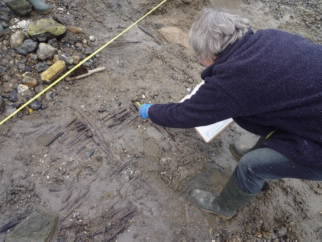
Recording the Wattle
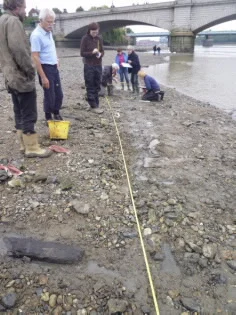
The length of the site. Timber 1# on left
The shell layer has now eroded out but the wattle is still sometimes visible in parts only at lower tides. The whole area is becoming less accessible at medium tides as the foreshore is flattening out a lot behind it.
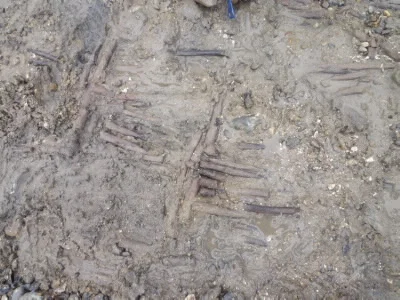
Remains of Wattle
Results for the Wattle AD 951 +/-26 years
The wattle is likely to be a hurdle from a fish trap which was created in the Late Saxon period.
Finding intact wattle on the foreshore is very rare. Getting results from the sample was a great surprise for us as it is normally difficult to get a reading from a sample due to its size and structure. The results confirm that they are not contemporary with the timber structure but give us a chance to view two different horizons in a close area.
Thanks to the Thames Discovery Programme and FROG Volunteers, we have been able to give Fulham another couple of stories to add to its timeline.
And as erosion progresses, more will follow.