
Presentation title and credit to Eleanor Hex for her time and effort :).
Several weeks ago, I had the opportunity to attend the talk ‘The Church and the plantations’ given by Eleanor Hex. The talk focused on Eleanor’s research on the Bishops of London involvement in tobacco plantations in the colony of Virginia - primarily discussing the bishop’s role in the slave trade. Eleanor also discussed the treatment of enslaved people living and working on these plantations at the time.
The lasting impact of slavery is still something that is being studied. As an American I have been taught how the mistreatment of people of colour in the U.S. has largely shaped U.S. history, and continues to inform our current conversations on race and equality. However, all of my learning has been based on what has happened in America. Unfortunately, the slave trade was a global epidemic. Therefore, the repercussions of slavery are not only endemic to North America, but to the entire world. Learning about how the different bishops had been involved in the slave trade or in the owning of plantations was very eye-opening. It was particularly insightful to learn that the ownership of a plantation was not seen as a moral failing, even for a religious figure. Instead, it was viewed as capital, which allowed the bishops their daily comforts. It is interesting to think how money brought in from the work of enslaved people was probably used to shape the home of Fulham Palace.
As I previously mentioned, Eleanor talked about the conditions enslaved people lived in. In this conversation I learned new things about the role of religion in slavery – a particularly poignant conversation to have in the historic home of the Bishops of London. Eleanor discussed how enslaved people were often forced to reject their own gods and personal beliefs and forced to practice Christianity. Eleanor also showed a picture of the Slave Bible from 1807. In the Slave Bible the entire book of Exodus had been removed, as had many other books and chapters of scripture. The Bible was centred on the ten commandments, meant to help instil rules on enslaved people. It is interesting to think about how in the lives of enslaved people even the act of reading the scriptures was a form of mistreatment.
I am grateful that Eleanor shared her research with us, and that I was able to present for the conversation. I hope in the future I can be a better global citizen and be more conscious of how slavery has, and continues to, impact lives across the globe.
If anyone would like to watch the talk first-hand, I will include a link!
Link to the talk: The Church & the Plantations
Here are some links to other events happening at the Palace, if you would like to get involved or learn more:
The Bishops of London, Colonialism, and Transatlantic Slavery: Resistance:
https://www.fulhampalace.org/resistance/
Fulham Palace & seeds of sedition: talk with Akosua Paries-Osei:
An African abolitionist at Fulham Palace: talk by Dr Joseph Yannielli:
https://www.fulhampalace.org/whats-on/events/an-african-abolitionist-talk-by-joseph-yannielli/
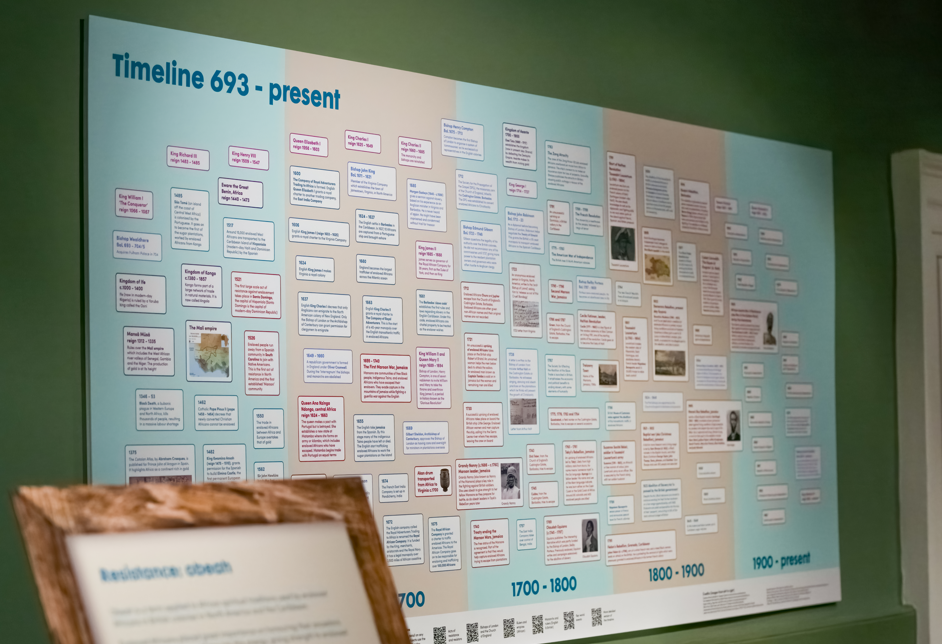
Image of the timeline that is part of the museum exhibition, ‘The Bishops of London, Colonialism, and Transatlantic Slavery: Resistance’.