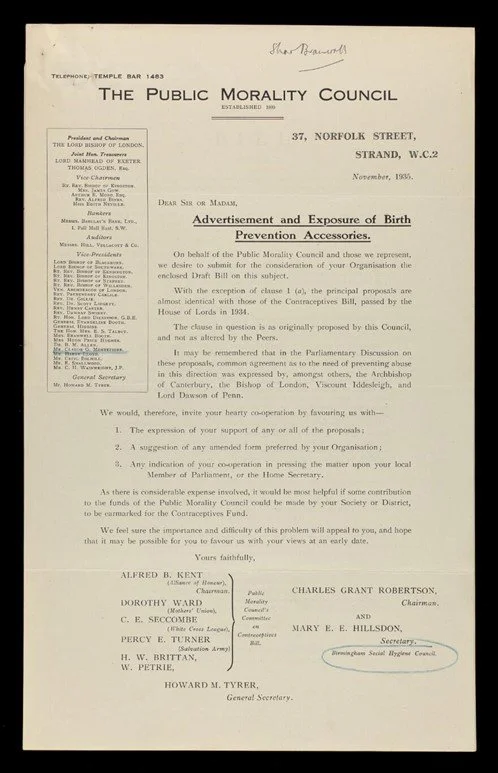
Anne Connaughton, front of house volunteer, introduces us to the first of her series of blogs on the public morality council during World War Two- including its connections to the Bishops and Fulham Palace.
Readers will know that Bishops of London presided over the proceedings of the Public Morality Council (PMC) from its inception in 1899, to its closure in 1968. By World War Two, during Bishop Fisher’s tenure, the remit of its morality patrols had extended to most areas of public life, as London became particularly fruitful territory. In a series of blogs, we will follow in the footsteps of a morality patrol in war-time London, via material held at the London Metropolitan Archive (LMA).
The PMC, which worked through a network of committees, formed a special War Time Committee. Some meetings were held at Fulham Palace, including in February 1940, when the Committee decided that the work of the patrols be based on observation of, and reports on public outlets, including parks and open spaces; public houses, cafes and clubs; suspected brothels; the myriad influences of theatre, films and literature and gaming and betting activities. Written reports would be submitted to the General Secretary of the PMC. The enthusiasm of the patrols and the prospect of moral panic inspired the PMC’s quest for “a higher standard of moral life”.
Activists espoused “keen vigilance on the part of the police “ given “how many questionable individuals loiter in the vicinity of populous railway stations “. Unrivalled potential for uncovering “indecorous behaviour” brings our patrol to a chemist’s shop in the booking hall at Euston station. In correspondence dating from 1942, a patrolling officer describes how customers were not served inside the shop, but from a hatch. The shop appeared to be a well-stocked outlet, selling “cosmetics; beauty preparations and shaving requisites”. Contraceptive material was not specifically advertised, although two cards “6 “ square “ announced “Prentif’s Contraception Products “ and “Rendall’s Feminine Hygiene Products “*. The patrolling officer notes the number of customers wearing military uniform, while concluding that “whilst obvious that contraceptives are sold, it seemed to be normal in these establishments”. Rendell’s products were widely advertised in sections of the press.
More widely, contraception had long been a political issue. One clergyman informed his congregation that married couples “who shrink from parenthood are leading Britain to racial suicide”**. The Baptist Union Assembly was told that birth control resulted in “barnyard morals”, as the use of contraceptives and “marriage responsibilities, indefinitely postponed”, constituted “disruptive influences now threatening the unity of the home”.*** This aggressive ideology accorded perfectly with the PMC’s militancy over moral conduct and the decline in the birth rate in Britain.
Useful Sources, including italicised extracts:
Files of Patrolling Officers’ Reports 1938-1942; 1941-1945; 1942-1947 LMA
File of Reports for the War Time Committee 1940 LMA
Wellcome Collection
*”Rendell’s For Feminine Hygiene Products”; p.7, Reveille, Saturday 15th March, 1941 (BNA)
**“Wives who bar children imperil race”; p.2, Daily Mirror, 22nd November, 1937 (BNA)
***”Birth control is causing farmyard morals”; p.2, Daily Mirror, Wednesday, 5th May, 1943 (BNA)
Next Time: “A common drinking den.......the accosting of women” : The Perils of Alcohol.