
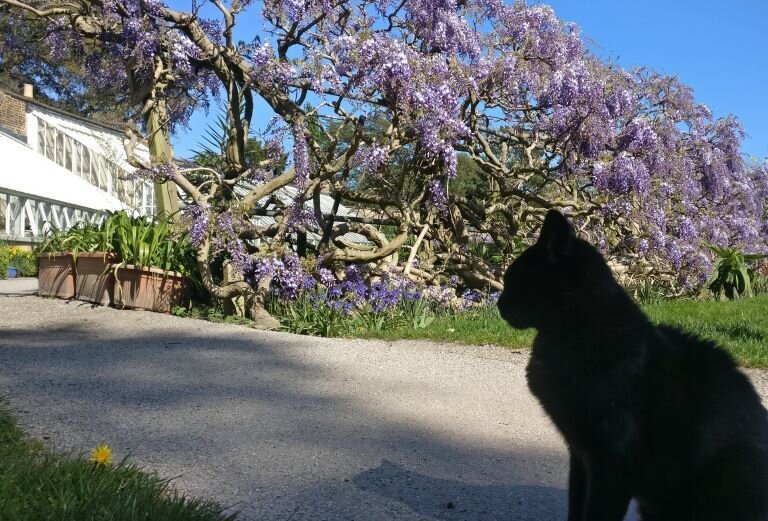
This blog was kindly written for us by placement student Nica Olivendal - to find out more about the Wisteria Campaign, click here
As you may or may not know, Fulham Palace is currently holding a Wisteria arch appeal, to fundraise enough money to install a new support structure for the wisteria in the Palace’s walled garden. The existing supports were installed in the 2000s and have since begun to rot, causing damage to the wisteria and the surrounding plants. The goal is to raise £20,000 in order to restore the wisteria to its former glory and ensure that generations to come can enjoy its wonder!
Being a Cultural Entrepreneurship student from Uppsala University, Sweden, I have spent 4 months doing my internship at Fulham Palace. Altogether it has been a fantastic experience and I have learnt so much about this magnificent Palace and surrounding garden.
I was excited about getting involved in the wisteria campaign, as it was one of the first things mentioned to me – how wonderful the wisteria is in the springtime. Having spoken to visitors in the garden I have also learnt that the wisteria is a popular attraction and a bit of a “talk of the town” in Fulham, but at this point I had not myself seen it in bloom, and I was not quite sure if the wisteria was really worth the fuss. Since then, spring has arrived at the Palace and the wisteria has truly started to blossom, with vibrant coloured flowers and a scent that is out of this world. Having seen the wisteria in action, I can now fully understand what all the talk was really about.
So here are 10 reasons why the Fulham Palace wisteria is so special and why the Palace needs help to secure the future of our much-beloved specimen.
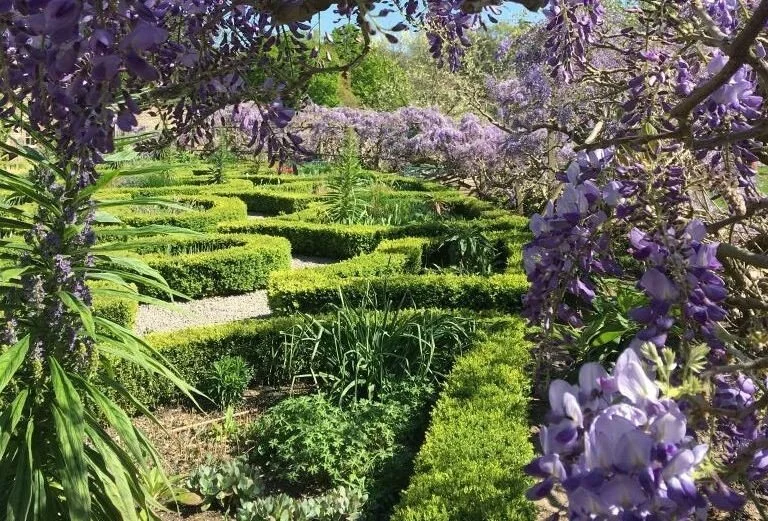
Close-up of the wisteria in the walled garden, with beautiful blue and purple flowers. (https://www.fulhampalace.org/news/wisteria-hysteria/ Wisteria Hysteria)
The Fulham Palace wisteria is one of the oldest specimens in London
The wisteria was first brought over to Europe from Asia in the early 1800s. Fuller’s Brewery in Chiswick is speculated to have one of the very first specimens imported from China in the 1820s. From here, one theory is that Bishop Blomfield, who had a keen interest in horticulture, asked for a cutting which was then planted in the walled garden. This would date the wisteria to the 1830s, making it almost 200 years of age and one of the oldest in London!
Chinese origins
The Palace wisteria is of Chinese origin, a Wisteria sinensis. The species has slightly smaller flower racemes than its Japanese cousin Wisteria floribunda, but a superior scent.
A blooming long wait
Wisterias take a long time to bloom and produce flowers. From seed it takes about 12 years for the plant to flower, but it is worth the wait!
Spectacular in size
The Fulham Palace wisteria measures the spectacular size of 17 meters. All species are strong-growing and can reach a height of around 10 meters or spread up to 20 meters, or more, against a wall.
Curvy
The Palace wisteria climbs in an arch like shape, that mirrors the curve of the south wall behind it and creates a natural barrier between the knot garden and the rest of the walled garden.
The original design
In this lovely photograph depicting the walled garden dated to 1901, the wisteria is seen in the background, supported by arched, metal hoops. Some of the remains can still be seen poking up from the ground. For the wisteria project, the plan is to recreate a similar support structure of double steel, ornate hoops to symbolise the original design.
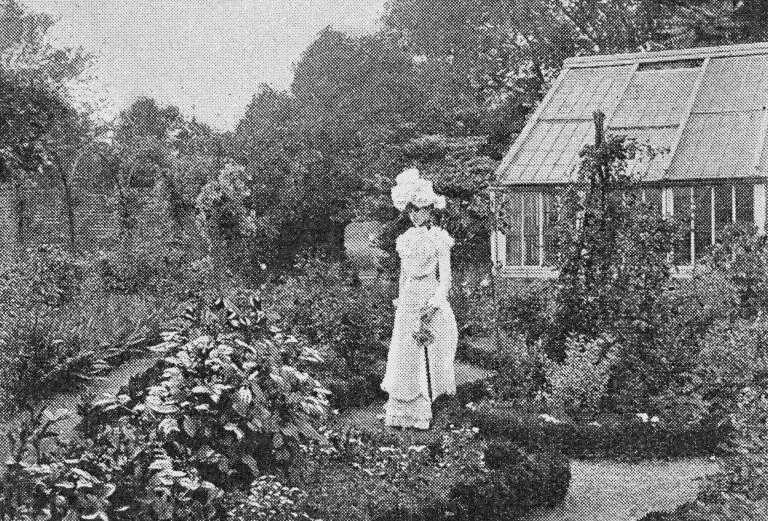
Photograph from 1901 with wisteria and ornate hoops visible in the background.
(https://www.fulhampalace.org/support-us/current-campaigns/wisteria-arch-appeal/ Wisteria Arch Appeal)
Sweet smell, sour taste
The wisteria is part of the Fabaceae, or Pea Family of plants. It is the 3rd largest family of plants and has about 19.000 known species. Whereas many of these are edible, the wisteria is not, and instead highly toxic. Therefore, it is suitable to watch and smell, but not to touch, and always make sure to wash your hands if you do.
Creates a buzz
Bees are very fond of the Palace wisteria. Unlike, for example the lupin, whose flowers grow upright and hence provides a space for the bee to land, the wisteria flowers grow “upside-down”. To make it easier for bees to pollinate the flowers, the wisteria very cleverly turns its petals 180 degrees so the bee can sit on it and reach the nectar.
It certainly keeps the garden team busy
In the wild, a wisteria can become invasive to other plants with its vigorous growth. To keep the growth under control, and to ensure a healthy and florid plant, it is important to prune it. At Fulham Palace, this takes place in the winter, between January and February, and it takes the whole garden team around a week to complete. Amazing work!
Fabulous spot for selfies
The wisteria is a crowd-pleaser, (and a great selfie-spot), and every year it attracts locals as well as visitors from faraway places. As we all know, last year the Palace and walled garden was closed to the public and, sadly, many missed out on the spectacular views of the wisteria. However, this year the walled garden is open and welcomes all visitors to enjoy (socially distanced) the great wonder that is the Palace wisteria.
Want to get involved?
If you want to get involved and support the wisteria appeal, you can help out by volunteering at the welcome desk at the walled garden gate. It is a fantastic opportunity to welcome, engage and support members of the public, to inform people about the project and to answer any questions they might have.
You can of course donate to wisteria appeal, it can be done through PayPal, cheque, bank transfer or at the walled garden desk. You can donate as much or little as you want – every penny counts and will go to securing the wisteria’s future for many generations to come.