
#AskAnArchaeologist
From 11-19 July, the Council for British Archaeology ran its 29th Festival of Archaeology. This year, due to COVID-19, it was a rather digital affair! We got involved with #AskAnArchaeologist day on Twitter and our very own community archaeologist Alexis Haslam answered your archaeological questions.
Here is the Q&A session:
Julie via Twitter: Alexis, my favourite exhibits in the museum are the Tudor pins - but how on earth do you find something so small when you’re digging?
Alexis: Great question! We use a metal detector. At Fulham Palace, we have to have a license to do this as it is a Scheduled Ancient Monument. Keen eyes work, too. The pins are copper so they appear green in the ground. The Young Archaeologists (YAC) are very good at spotting the smallest items!
Jamie via email: What's the oldest thing found at Fulham Palace?
Alexis: Definitely the Late Mesolithic to Early Neolithic struck flint. This dates to around 4,000 BC (or BCE as they say now). We have recovered nearly 2,000 prehistoric flints from Fulham Palace, which makes it one of the largest assemblages from the London region. It was clearly a very significant place at this time!
Jamie via email: What's the most unusual thing found at Fulham Palace?
Alexis: I have to say it is a fragment of a human skull found in a 19th century cesspit in the area where the external toilet block is now. Human bones are fairly common in the archaeological record, but this is the only one found in the Palace grounds - burials took place at All Saints, of course. Why this piece of skull ended up here is odd! Perhaps it was a curio or a fragment that got collected from the All Saints cemetery? It certainly proves that 19th century churchyards were messy affairs!
Jamie via email: What is the most amusing thing found at Fulham Palace?
Alexis: It has to be the condom tin recovered from beneath the floorboards in the main building! A very odd find from a Bishop's Palace! Actually, thinking about it, who did the tin belong to? Was it one of the soldiers when the Palace was used as a hospital? That has sent me down a rabbit hole and the history of condoms (and probably done some terrible things to my search history / cookies).
Alison via Facebook: Has anyone ever attempted to excavate the possible Roman remains near the walled garden? Are there any plans to do so?
Alexis: That's a good 'un! Unfortunately, because it’s a Scheduled Ancient Monument we have to have permission from Historic England before we dig and preservation in situ - or leaving it alone - is usually the preferred option. Plus archaeology costs money! We have excavated at this end of the site, and the pottery, coins and building materials recovered definitely indicate a very late Roman domestic settlement (350-400 AD). Maybe a villa. I personally think it’s in the All Saints grounds. We have found Roman ditches and pits, which probably relate to field systems. I find the late Roman period really interesting and Fulham Palace fits in with numerous theories about what was going on in Britain at the time.
Barbara via Twitter: what is your favourite archaeological find?
Alexis: That's a really good one. I've worked on some great excavations. The “Prittlewell Prince” in Essex was a once in a lifetime discovery and amazing to work on. I worked at Shadwell too when PCA found the Roman bathhouse which was an amazing thing to find. At Fulham Palace, I have to say I love the teetotum that Simon Butt found in the dovecote dig, especially as the term 'Fullams' relates to playing with loaded dice!
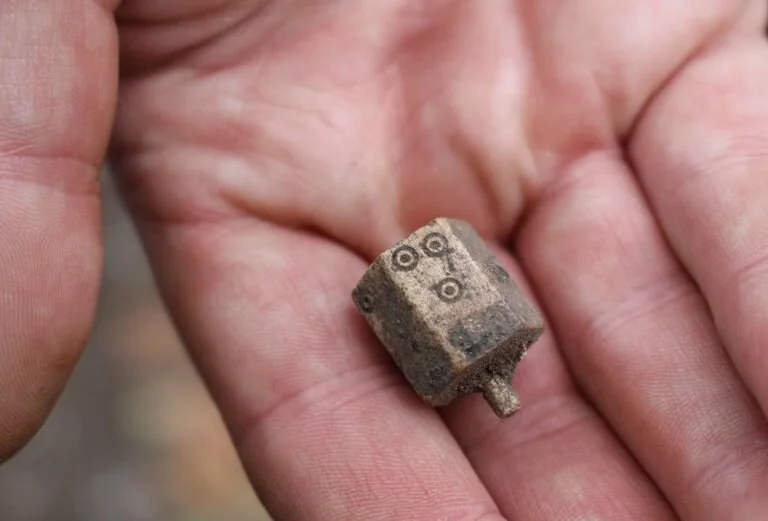
A six-sided Tudor teetotum made from antler between 1480 and 1550. Teetotums were spinning tops used in gambling games. Discovered by volunteer archaeologist Simon Butt during our Dovecot Dig in 2017.
Kelli via Twitter: How can kids get involved in archaeology?
Alexis: The first port of call would be to look at joining a Young Archaeologists Club (YAC) - run by the Council for British Archaeology. Getting kids interested in the past is really important. Through YAC more opportunities will become apparent as the CBA run occasional courses aimed at younger individuals. Getting kids involved in excavations can be tough due to health and safety issues, but there are opportunities and whenever we run a dig at Fulham Palace, YAC always play an important role.
See Becky's blog that she did for us on YAC!
Adreanna via Twitter: We know archaeologists take part in digs, but what else do you do as part of your job?
Alexis: Excavation is only one part of revealing the story of a site. There's research that goes on before excavation - writing Desk Based Assessments for example, and then an awful lot of research afterwards as the site has to be published and placed into context. So lots of reading, writing and data entry. Plus there are lots of specialists who have to look at the material recovered from an excavation in order to identify all the pottery, bones, flint, glass and clay pipes. We take soil samples so specialists can tell us about what the landscape was like and of course all those finds have to be washed, marked and archived. There's an awful lot of work that goes into a dig both before, during and after and on big projects it can take decades until they are published!
Adreanna via Twitter: What are parch marks and why are they important?
Alexis: These marks are caused when underlying structures inhibit the growth of grass, especially in hot weather. So the lines that appear on the north lawn are actually the footings of our 13th century chapel which was demolished in 1764. We know the chapel had a cellar, so the remains of the building are still down there. That's why we have to protect this area of the lawn so that the building, or what's left of it, isn't damaged. We don't have any drawings of the chapel so we don't know what it looks like. I'd love to excavate it one day.
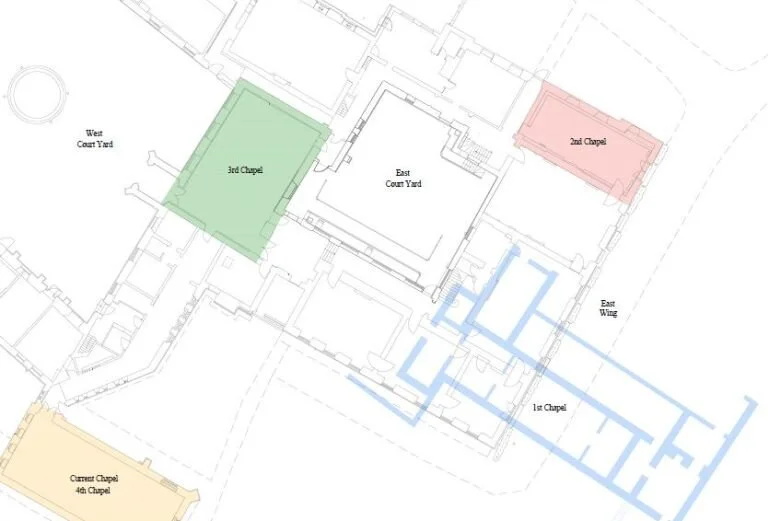
A map of the former chapels of Fulham Palace – you can see where the first chapel is located directly under the café on the main lawn, where the parchmarks appear during dry summers!
Suzanne via Twitter: If you could excavate the Medieval chapel, what sorts of artefacts would you hope to find?
Alexis: The main thing I'd hope to find is some evidence of what it may have looked like and what it was built from- any elaborate stonework etc. Any other finds would be a bonus! It used to have a still room beneath it for making medicines. Any evidence for that would be fantastic!
Adreanna via Twitter: What is the most interesting part of Fulham Palace from an archaeologist perspective that the public doesn't get to see normally?
Alexis: I'd have to say the roof space. The Tudor timberwork is amazing and makes you realise how old the building truly is. Plus the daub walls give a real sense of what the inside of the building was once like. Great place to hide too!
You can watch Alexis explore the Tudor roof space here.
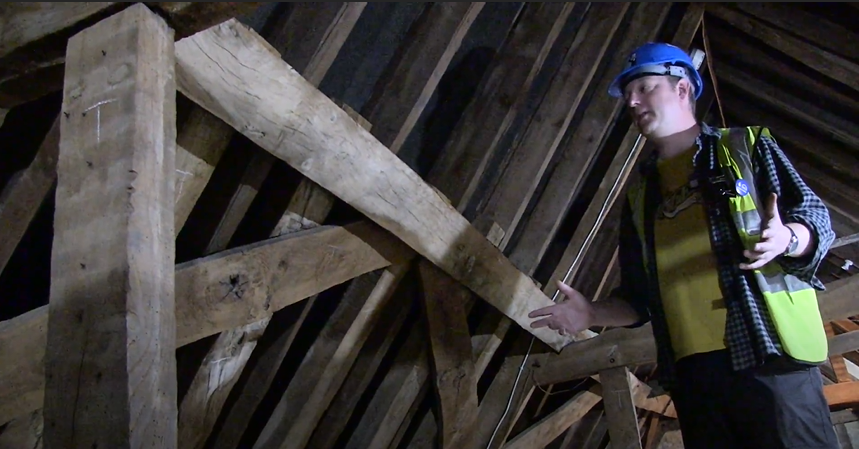
Alexis in the Tudor roof space above the Great Hall.
Adreanna via Twitter: How do you know if something is pottery, bone, or a rock?
Alexis: Umm, well if you're on site and you don't know what the object is a lot of archaeologists hit it with a trowel! That's the naughty answer (especially if it turns out to be an incendiary bomb!) Bone often looks kind of spongy on the inside, pottery you can usually tell by the surface / if there is a rim. There's a knack to identifying struck flint, but the most obvious struck flints are very clear.
Adreanna via Twitter: What is the youngest object you've found? Is there a point where it stops being archaeology and becomes just finding modern-day rubbish?
Alexis: That's an interesting question! There has been a lot of differing opinion on this, but I don't see why there has to be an end date. Archaeology involves the study of society and how it develops. There has certainly been reporting undertaken on defunct homeless shelters for instance as well as recording industrial structures and buildings. At Fulham Palace, we collected crisp packets which were dumped in the mid-1970s as the site was used for refuse disposal. This reflects a period of decline on the site and is just as relevant historically as the Palace's grand elements!
Here is a little video of Elowyn enthusing over our crisp packets in the museum.
Adreanna via Twitter: Was there anything that disappointed you about becoming an archaeologist that you didn't expect? i.e. expectation vs. reality?
Alexis: To that, I'd say there's a lot of issues in archaeology that have never truly been tackled. Poor pay, poor conditions and short term contracts are still massive problems and it is disappointing that this is very much so still the case. There has been very little advancement in this in the 20 years I have spent in the field. It takes a huge degree of passion to be an archaeologist, but there is only so much that people can take. I've seen an awful lot of highly talented archaeologists walk away from the job for this very reason. If it carries on like this there won't be any archaeologists left to excavate the sites as wages vs the cost of living become even more divergent. I'd like to see the powers that be in archaeology actually try and make a difference here.
A lot of other archaeologists also loved this question and answered similarly. A common theme was the low wages, lack of job security, and the intensely competitive nature of academia.
Oxfordshire Museums Resource Centre @OxonMRC replied: It wasn't a disappointment but expectation vs. reality... as a kid I thought all archaeologists excavated, in reality, there are so many specialisms within archaeology that even if you don't hold a trowel you are an archaeologist.
There you have it, plenty of food for thought there! For more information about #AskAnArchaeologist day, head to the links below:
If your archaeological appetite has been whetted, Alexis also recorded a tour of the Palace and garden as seen through an archaeological lens. Here's your chance to take a virtual tour of the interiors whilst our site remains closed, and learn about what years of excavations at Fulham Palace have revealed - and what remains a mystery!