
Tree Tag No. 5351
July’s Object of the Month is kindly written by Esther Dean, tour guide, tree survey volunteer, costume assistant and sewing bee volunteer.
Each month we feature two blogs by volunteers, one on an object in the Palace and another on a plant from the garden. There is no set format so please feel free to send in your ideas if you would like to contribute. It is an excellent way to learn more about the Palace and share what interests you with others!
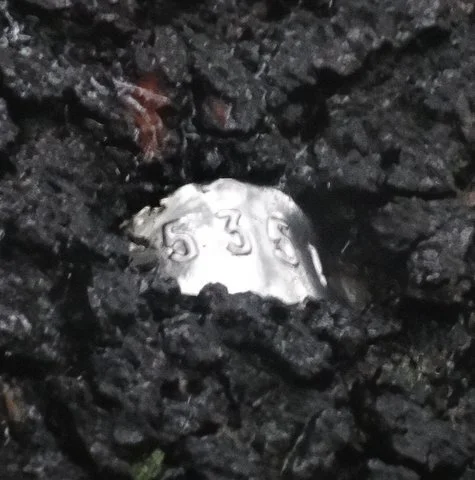
A close-up of the tag
This object must be one of the smallest, most insignificant looking ever chosen. It is a small metal tag, barely a centimetre across, impressed with a number and embedded in the trunk of a tree. But it leads us to one of the oldest and most magnificent things at the Palace and its gardens. The number is 5351 and if you check this with the Palace tree survey you will find it listed as a Holm Oak, and that it is “a significant veteran tree, the oldest holm oak in the country”. It is now one of the Great Trees of London and surely the most beloved, grandest and most venerable tree in the garden.
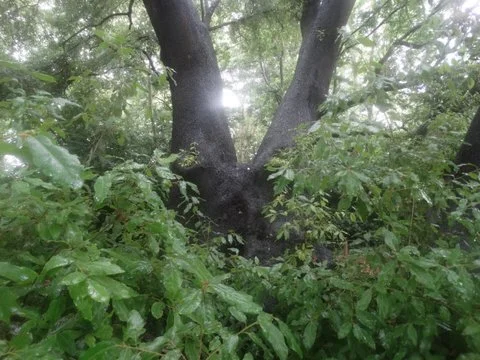
The Holm Oak, taken through the rain last Thursday
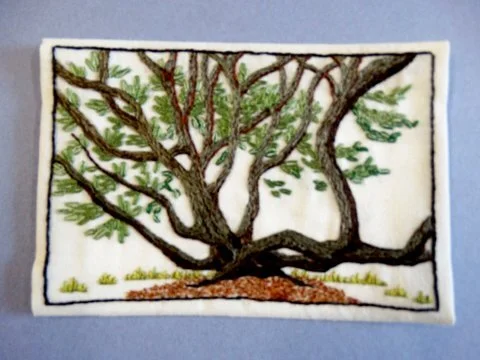
My embroidered impression of the Holm Oak
If you look carefully, you will find a numbered metal tag on every tree in the garden. There are getting on for a thousand listed in the 2016 tree survey. Every tree has been assigned a number, description, type, age and condition. However, the list is not static. Over the years, some trees have been lost. During the lockdown, No. 5119 -yellow wood, Cladrastis Lutea, found behind the cedar on the lawn - unfortunately fell over. It had been diseased for some time and there had been discussion about its future, but it chose its own time to leave us. Another that has left us is No. 5023 - gum cider, Eucalyptus Gunnii, found near the car park entrance. It too had been diseased and not looking very happy for some years. Over the past few years, a number of the self-sown sycamores in the beds running alongside Bishops Park have been removed to open up the views of the Palace from the park. Their trunks and branches have been used to create a wild play area for our young visitors.
However, all is not lost. There are now many exciting new plantings awaiting their tags. Notably, the Magnolia Virginians, which is now thriving and flowering in the newly created Compton Bed outside the walled garden; A fitting remembrance of our plant-loving Bishop. On the lawn by the children’s nursery site, you will find a recently planted young elm, Ulmus ‘New Horizon’. It is hoped that this newly developed strain of elm will be immune to the ravages of Dutch Elm Disease. It is a reminder that, in the past, the elm was the most abundant tree in the area. A few still remain in the wilderness between the allotments and the entrance to All Saints Church. There are many more new plantings of different trees all over the grounds.
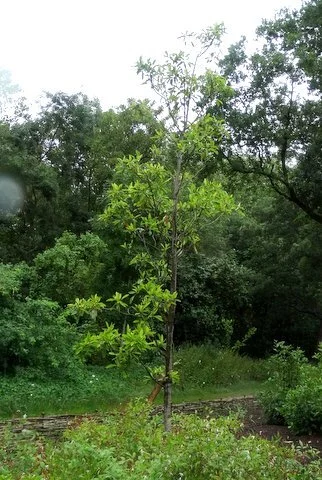
The newly planted Magnolia Virginiana
Should you have ventured to the outermost reaches of the gardens over the past few years, you may have come across a bedraggled trio emerging from the undergrowth, carrying clipboards, charts, binoculars and sticks. They are the intrepid volunteer tree surveying team of Fulham Palace, out in all weathers, to inspect and evaluate the condition of every tree in the Gardens. I can call them intrepid as I am one of them. We have been trained how to look at a tree from both far and near, from its base to its crown. Does it lean? Has it righted itself? Does it have any fungal growth? Are there any branches that look as if they might fall? Often we have to fight our way through brambles, nettles and undergrowth to get to the trees and then attempt to find the number tag. Trees are living, growing things and they have a habit of letting their bark grow over and eat up the tag. We record all this and then refer our findings back to Lucy. It is particularly important in the areas where children play that any dangers are evaluated. We were due to restart our surveying this spring but coronavirus has interrupted our labours. Let us hope that it will not be too long before we can restart our tag hunting again.
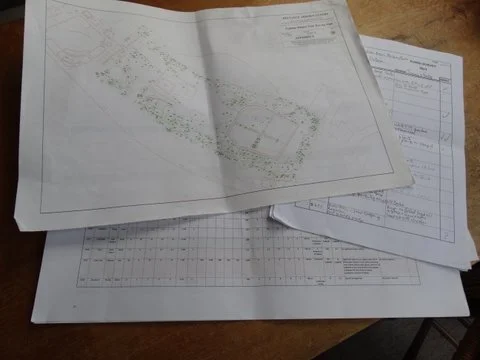
A collection of some of the tree surveyors charts
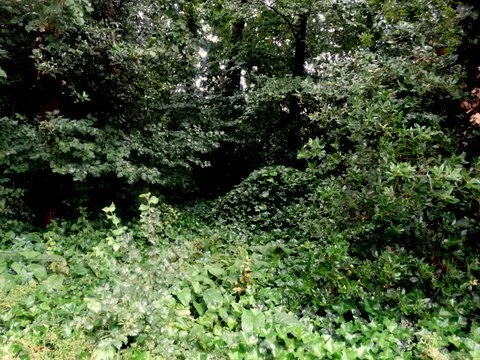
The undergrowth through which the tree surveyors have to make their way