
The Bishop’s Cope, 1910
Written by Naomi Jennings - O’Toole, learning admin volunteer.
Each month we feature two blogs by volunteers, one on an object in the Palace and another on a plant from the garden. There is no set format so please feel free to send in your ideas if you would like to contribute. It is an excellent way to learn more about the Palace and share what interests you!
In the first room at the Palace exhibition, the glittering cope is always the first thing to catch my eye. I could spend hours pouring over the tiny elements and miniature flowers that make up this cope. It is a beautiful and elegant reminder of the role of the Palace as the home of the Bishops of London - a role that kept the site grounded through its fluctuating history. The Palace witnessed the English Civil War, hosted Catherine of Aragon and transformed into a hospital in 1917, and now it has stood through the international pandemic. The cope at its minimum is just an object, but it is one that encapsulated the Bishop’s role as a guide to the public.
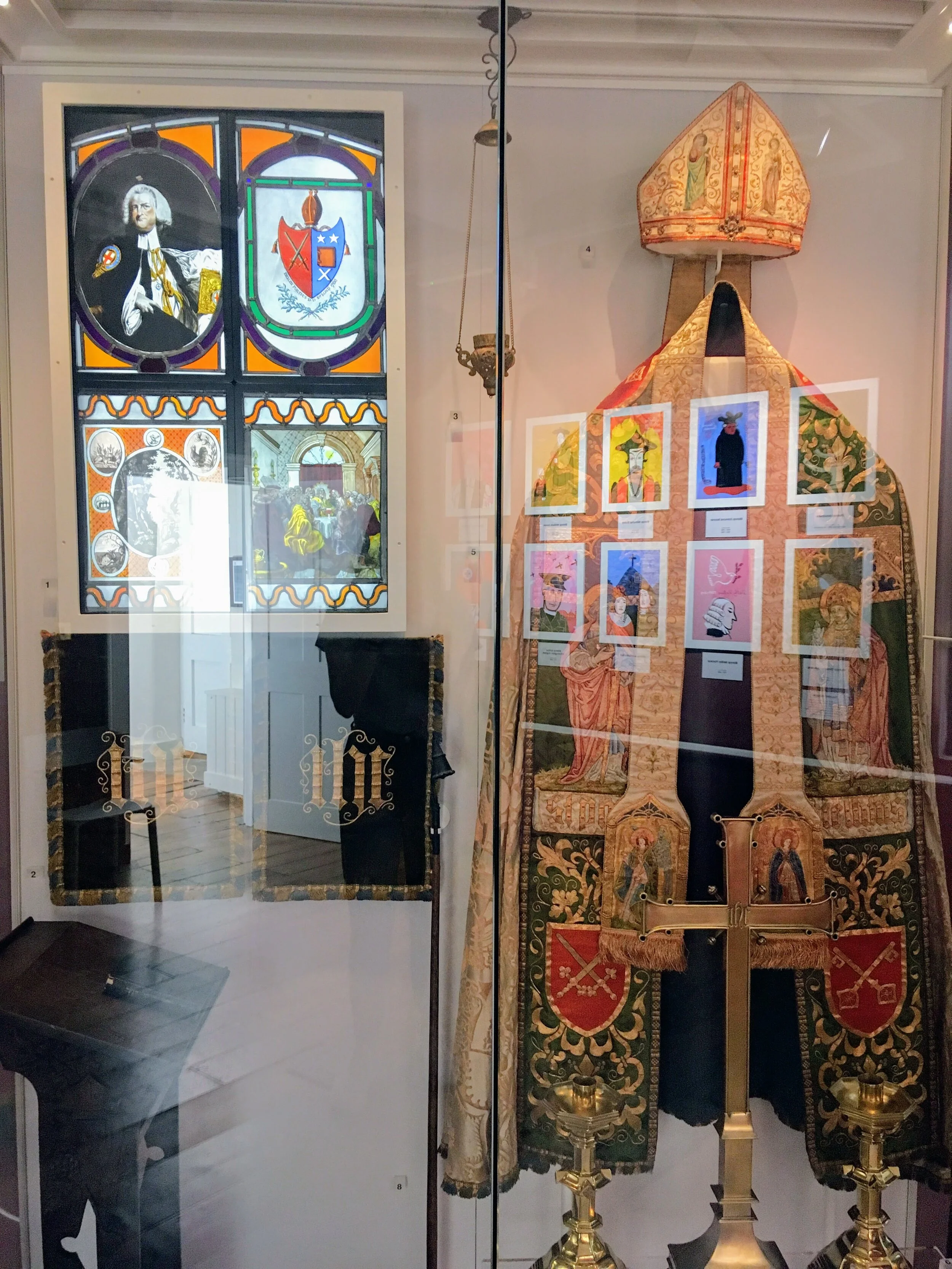
The cope on display with the mitre and crosier, alongside other objects associated with liturgical practice.
How the makers achieved its shimmering effect with embroidery is extraordinary. It certainly imbues the cope with a mysterious aura. Fittingly, since copes have always carried a strong symbolic significance. Items of clothing that stand as metaphors are plenty in liturgical contexts. For example, a pallium (a strip of white woollen cloth that is worn on the shoulders) represents the sheep worn around the neck when a shepherd carries them.
A cope identifies the Bishop as the representative of God on earth - a key tenet of Christian theology. The garment must function simultaneously as a marker of identification for the congregation and to grant respect to its wearer. The quality and expense of the materials are the most immediate status marker. The status of Christian figures were, of course, primarily a spiritual excellency but material value expressed this in earthly terms. Liturgical clothing derived from the clothing worn by Greek and Roman dignitaries who belonged to the wealthiest classes. The precious gems and refined embroidery, therefore, also speaks to the history of copes more generally.
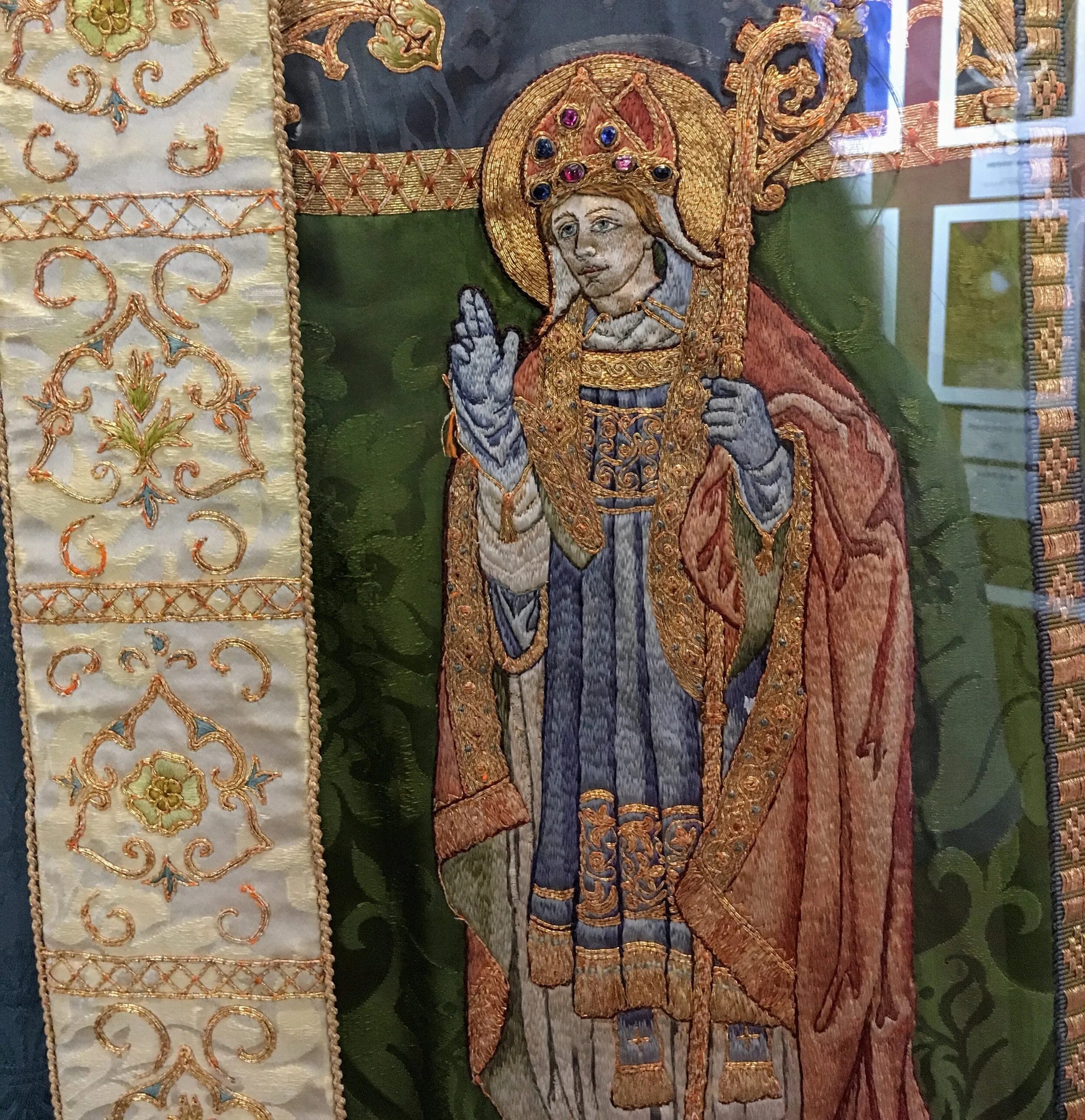
Detail of the cope
This figure exemplifies how refined and delicate the cope’s detailing is. Tiny gems are attached to the mitre. The face is described with extremely thin thread, to the extent of shadowing around the chin and nose, and extra lines to show the folds in the eyelids. The white band on the left features fine needlework; symmetrical in design, with different coloured material to distinguish minute elements (note the two tones of yellow for the layers of petals in the central flowers).
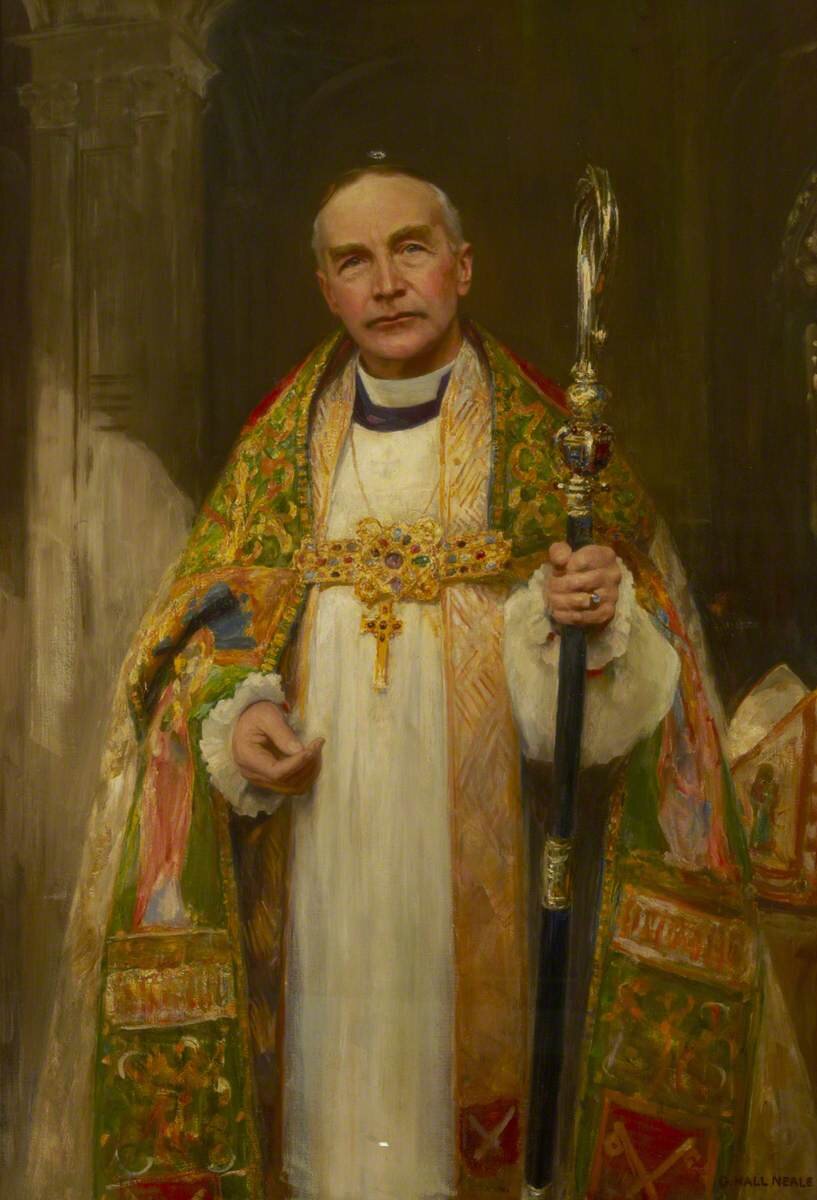
A painting of Bishop Arthur Foley Winnington-Ingram (1858-1946) wearing the cope.
George Hall Neale (1863-1946), 1916, oil on canvas, 170.7 x 122 cm, held at Fulham Palace.
This painting of Bishop Winnington-Ingram spectacularly adorned in the cope, gripping his crosier and bejewelled with a ring and crucifix necklace gives an impression of what the cope would have looked like when worn. Bands of detailing are differentiated with colour and pattern, which build upon each other in a layering effect, accomplishing a framing device. The red patches on his shoulders contrast with the green background which draws the eye upwards towards the Bishop’s face. Winnington-Ingram is picturesque and idealised. The artist continues this characterisation with a classical architectural setting, a deep and shadowy space, while the figure steps into a ray of light (a slight take on chiaroscuro). His gaze softly drifts to a point slightly above the viewer’s head. We are not permitted to make eye contact with him. Instead, he seems to be lost in thought, and we are led to wonder if he is contemplating complex Christological issues (or other Bishop-like matters). In this painting, we see how costume was one of the many methods artists used to characterise and idealise their sitters.
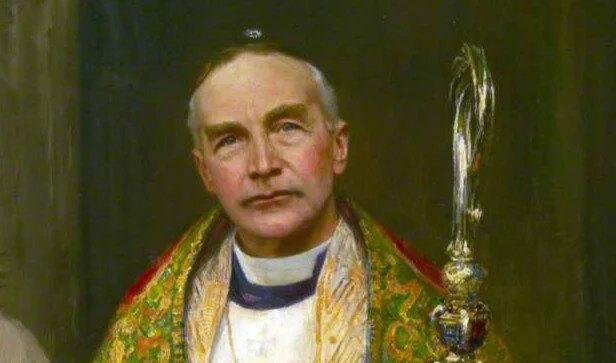
Detail - the Bishop’s thoughful gaze.
The form of the cope is both broad and flowing. We cannot see the shape and substance of the body clothed within. This reveals another function of the cope; to symbolise detachment from everyday life and the earthly body. Formless, almost ethereal, the body of the Bishop is brought more closely to spirit.
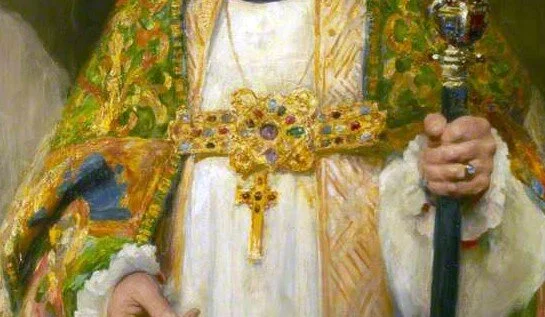
Detail - the morse (clasp) fastens the cope together. These are often highly ornamented and adorned with precious gems.
However, the painting doesn’t provide much of an insight into how it would actually feel to wear a cope. The garment opens to a semi-circle shape and reaches all the way down to the feet. It is altogether a very heavy object. The vivid colours and reflective threads would have captured the attention of the congregation from a distance and allow its wearer to be instantly recognisable. Yet the decoration would have been most appreciated by the Bishop. The intimacy of wearing the cope, the feeling of the fabric and weight, the awareness of the wealth amassed in its foundation, combine their effects and multiply each other. The cope was tactile and sensory. There is no doubt that it would have been inspiring to wear.
Moreover, the act of dressing in clothes was an important ritual for Bishops. It was considered a process of de-personalising and reaching to become as alike to Christ as possible.
Dressing (as with almost everything we do nowadays) always begins with washing the hands. This ablution is accompanied by a prayer:
Da, Domine, virtutem manibus meis ad abstergendam omnem maculam; ut sine pollutione mentis et corporis valeam tibi servire. (Give, Oh Lord, to my hands, the virtue that will erase all stains: so that I may serve you without a stain on my soul and body).
Following this, the amice is put on, then the stole and the chasuble. Stoles are generally understood to symbolise the bonds of Jesus during the Passion, or the duty to spread the word of God. Its colour is typically dictated by the liturgical season or nature of the service.
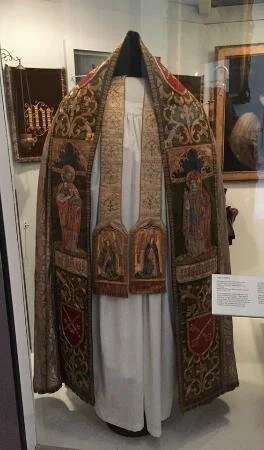
The cope in Fulham Palace’s older display with the stole visible.
©️ TripAdvisor, user Tp19862011 (April, 2015) https://media-cdn.tripadvisor.com/media/photo-s/07/af/6d/0a/fulham-palace-museum.jpg
The stole paired with Bishop Winnington-Ingram’s cope is gold throughout, adorned with a darker golden thread that swirls within differentiated squares. The stole ends with an amazingly intricate angel who stands inside a pointed arch.
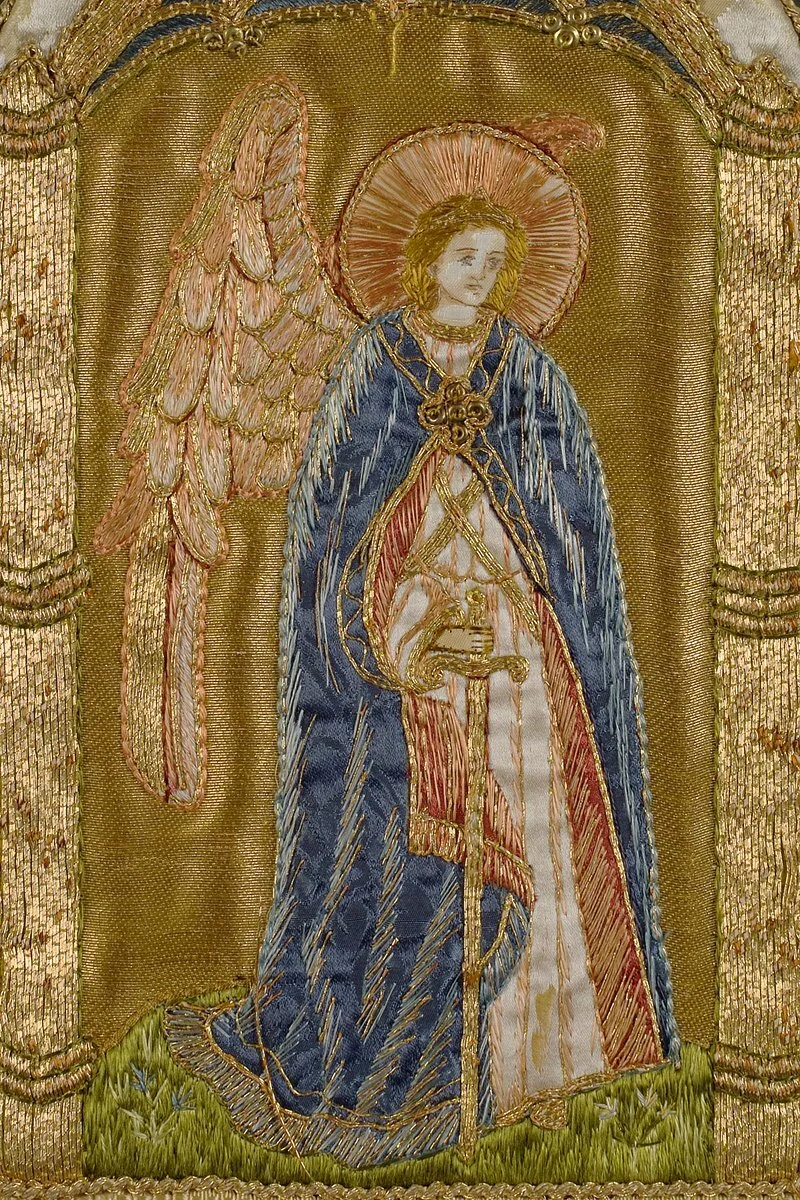
Detail - an angel on the stole, gripping a sword and stood on grass with minute flowers.
The angel’s clothing here imitates the Bishop’s own clothing. Perhaps he would have associated wearing the garment with this ideological representation of a Christian guide.
The figures on the stole moreover mirror those on the cope, emphasising the layering effect that liturgical clothing was designed for. Our gaze is led from one figure to another across the horizontal plane they create. Saint Paul is featured, symbolised by his book and sword. The book represents his epistles in the New Testament while the sword is a reminder of the means of his martyrdom (he was beheaded in Rome in 67 AD). These tiny characters may have worked in a twofold way; to a viewer standing before the Bishop, their attributes would have manifested onto him, while the Bishop himself may have felt inspired and guided by their examples.
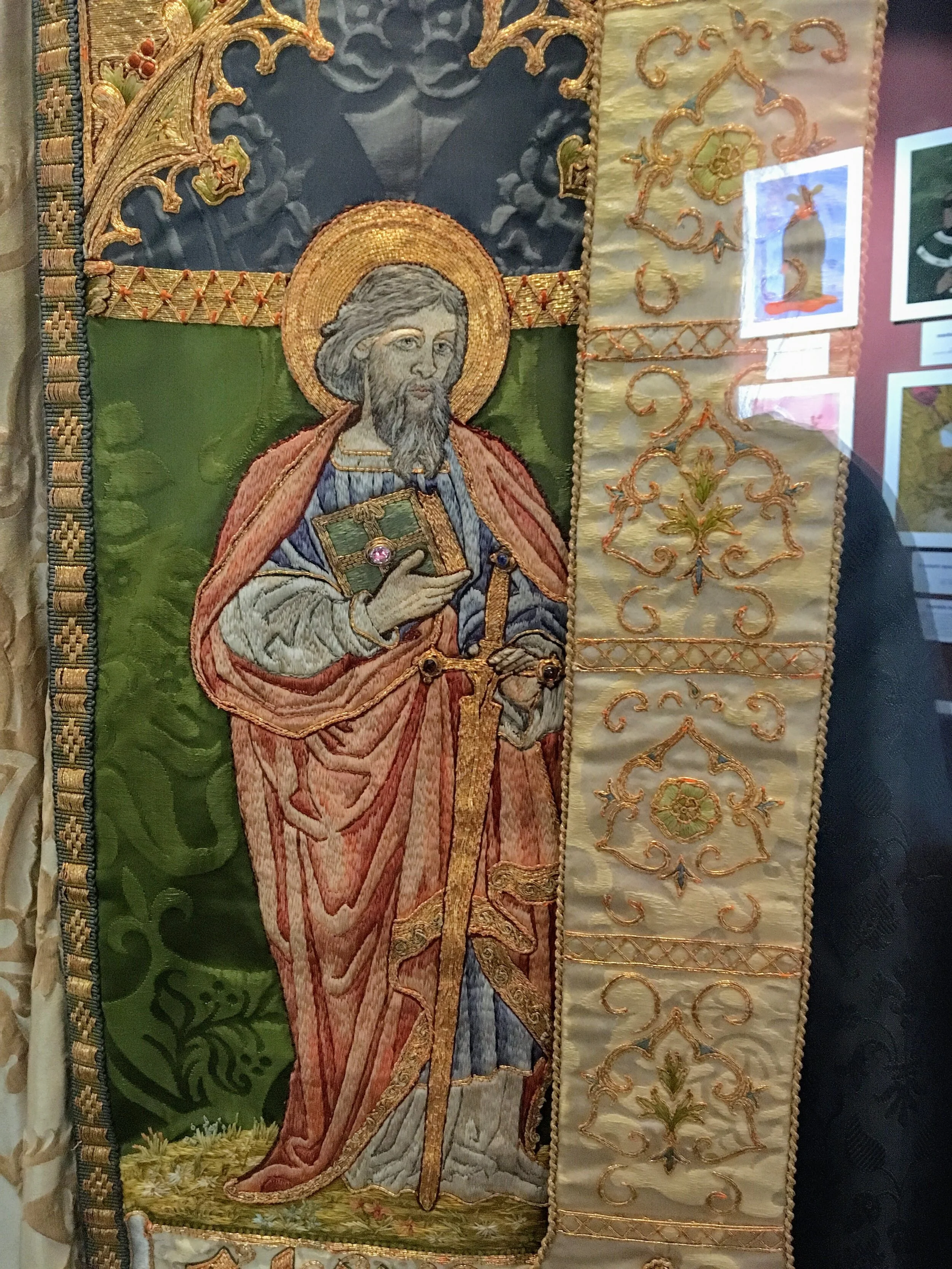
Detail - Saint Paul on the cope. The layers in his robe are described with gradients of tone, unlike the stiff cut of the cope itself.
The cope is as complex in its symbology as in its execution. It guides us through all the intertwining threads, knots and gems piece by piece, as it stands in its current display case. But it is important to reflect on how it was used, how it evoked awe in those that saw it and the fundamental part it played in Bishop Winnington-Ingram’s role.
To illustrate my point, compare the cope to the military costume the Bishop wore during WW1. Winnington-Ingram earned himself a reputation as “the most successful recruiting officer in the country.” The contrast in characterisation between Neale’s painting and the photograph of the Bishop reveals just how powerful clothing and costume can be in prescribing identity and consequently how we remember Winnington-Ingram today.
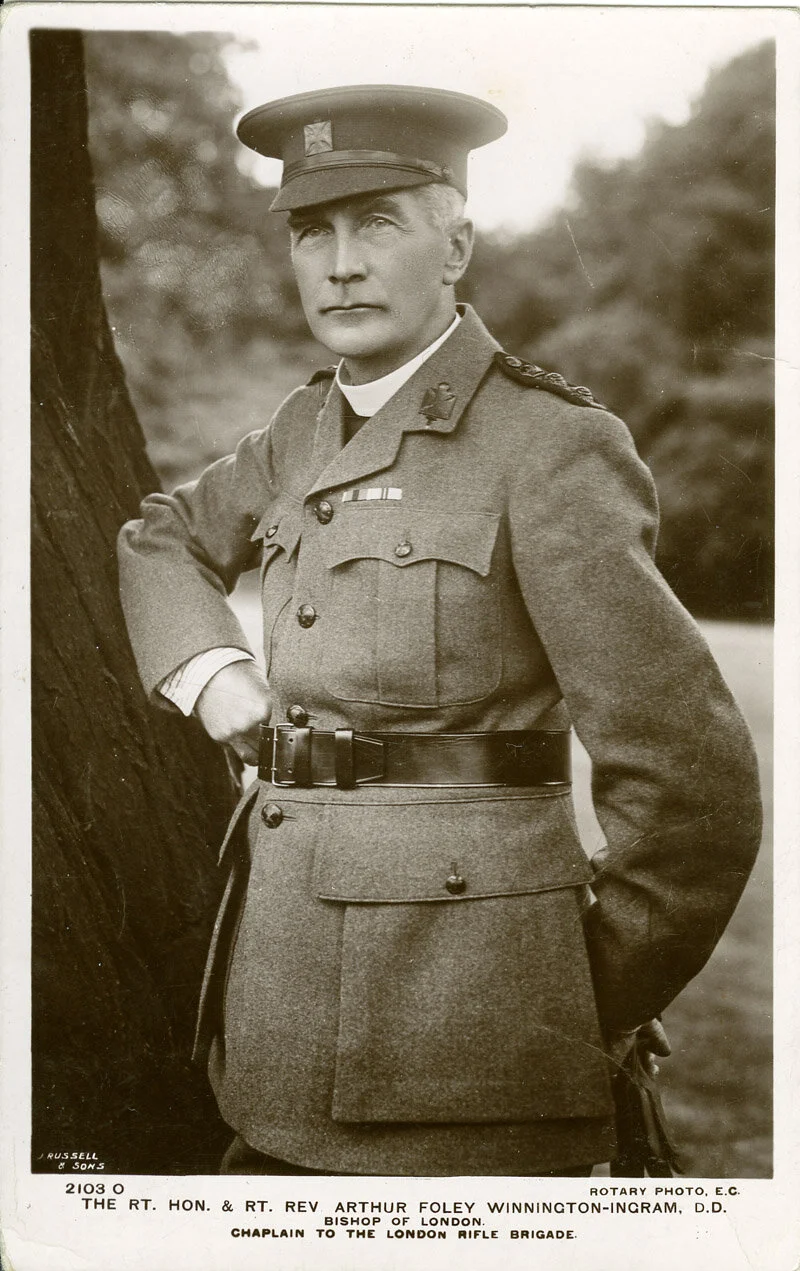
Bishop Winnington-Ingram looking very different than in his cope, remembered as a Chaplain to the London Rifle Brigade.