
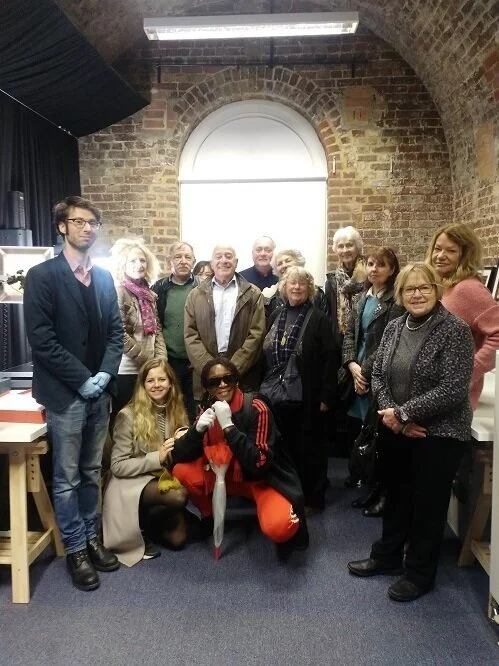
One half of our merry band of volunteers in the photographic library at the Courtauld Institute of Art
In late November, a group of 17 volunteers visited the Courtauld Institute of Art to learn all about their Photographic Library and to try their hand at helping with the Institute’s extensive digitisation project. The digitisation work forms part of the larger National Lottery Heritage Fund five year project: ‘Courtauld Connects’.
An air of mystery pervaded the visit as we were taken deep down into the underground vaults that housed the two main extensive collections - the Witt and the Conway Libraries. We were given a brief and interesting history of the main collections by the Head of the Project: the Conway, established in 1932 and consisting of more than one million photographs on all aspects of architecture and related topics and the Witt, consisting of over two million photographs of western art by 70,00 artists, both famous and those less so. Everything here was on a big scale. The Courtauld also holds the Photographic Survey, a major study of private art collections in England, Wales and Ireland. This is made available for study in many galleries and universities across Europe and the United States, offering a world-class resource for both students and scholars of art history.
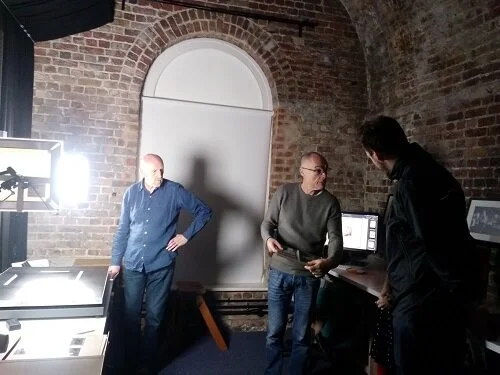
The photography studio inside the Courtauld Institute’s photographic library
The Photographic Library’s Paper Conservationist, Mark, spoke with us about the degradation of photographic materials, and he had kindly dug out images from the Courtauld archive of Fulham Palace from the 1970s. You can see an overview of these photographs on the image gallery on the portal.
After the overview, we were introduced to the digitisation project in which we were going to briefly participate. The project objective is to preserve the contents of the Conway and Witt collections (some of them in poor condition), so as to ensure their availability for the future. Digitising the two collections was undertaken using very different methods, Conway was to be a community project while the Witt collection was sent off to a professional digitisation studio. The latter had transformed a container-load of materials into a quantity that would (more or less) fit into a suitcase – the wonders of technology! As with all physical collections, having sufficient storage space is always a challenge; the project will resolve this for the foreseeable future.
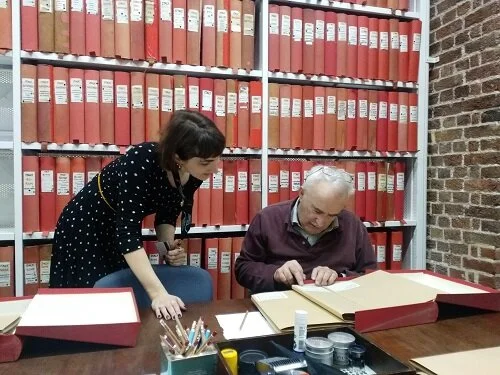
Photographic Library Volunteer Manager Francesca with Fulham Palace volunteer Eddie hard at work cataloguing the photographs ready for digitisation.
There were two stages to digitising the Conway collection, the first was the sorting and cataloguing of each image contained within hard copy folders of the original photographs. It was a detailed and thorough process, made interesting by the fascinating content of the photographs which you were able to study.
The second stage was the photography of the original material. The hi-tech camera, in a fixed position over the flat-bed platen, was a marvel – each frame taken is in impeccable quality and the image is perfectly positioned on the horizontal/vertical axis, provided the original is placed within a clear border (thus, only human error could produce a poor result). We took it in turns to place each photograph on the platen, making sure we did not mark or damage it; to take the picture - a satisfyingly complex click; then to place the original back into the file from which it had been taken. The next stage was to review the result on a huge monitor to ensure it was acceptable and to give it a sequential numeric ID. Starting gingerly at first - you do not want to damage history or break a very expensive camera – with some practice, we become increasingly confident.
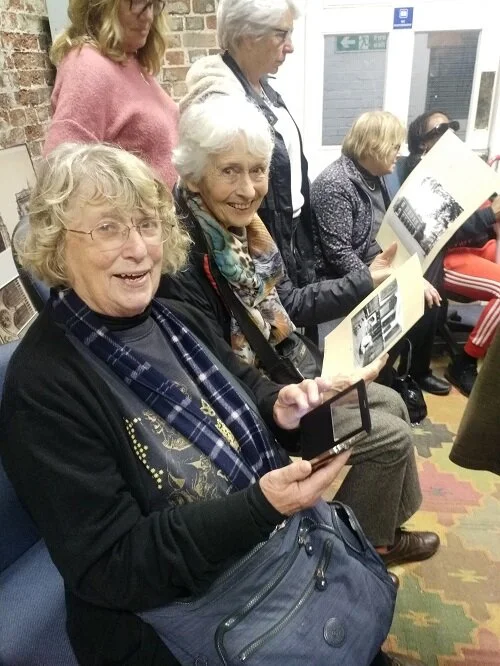
Our activities were interrupted by a fire alarm. We had to evacuate the building, chatting outside until the problem was resolved, then we trooped back, eager to continue this fascinating process. By the end of our visit, it would be fair to say that we had had an excellent insight into an important and impressive organisation and that we had enjoyed ourselves; thank you, Fulham Palace.
Incidentally, the digitisation projected is run mainly by volunteers – 500 of them – where would the world be without us?
Ronny Nicholas, Garden volunteer
7 December 2019
Huge thanks to Ronny for this great blog about our recent trip. If you’d like to join us on our next outing then please keep an eye on the calendar page of the portal, and on the monthly Volunteers’ Newsletter which makes its way to your email inbox on the third week of the month.