
Roughly 4 miles south west of the Essex town of Colchester is the ancient manor of Copford. The land was given by the later Saxon Kings to the Bishops of London beginning with Bishop AElfstan in 995 AD. The present Copford Hall dates from the 18th century and occupies the site of the earlier medieval manor house. Next to the house is the Norman church of St Michael and All Angels and its importance, both architecturally and decoratively, combined with its proximity to the manor house suggests this was the Chapel of the Bishops of London.
The east end of the chapel is formed into an apse, which is rare in this country. The fabric of the church includes robbed Roman bricks. These were readily available from nearby Colchester (Camulodunum) where many buildings had survived to the medieval period, including some with apsidal features. The inside of the chapel is swathed in wall paintings and frescos in Romanesque style. The apse fresco is a magnificent Christ in Majesty which embraces the altar. Byzantine influence dominates throughout and evokes the more familiar interiors of Italian churches.
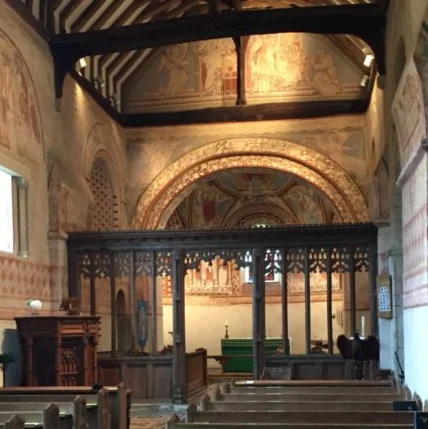
Copford Church apse interior
Edmund Bonner was said to be very fond of Copford and willed that he be buried there. Perhaps the Catholic Bishop Bonner witnessed the lime washing of the wall paintings carried out at the succession of Edward VI, an event that marked the start of the ensuing Protestant restraint. The paintings remained covered and safe from the destructive activities of the iconoclasts until the 19th century when they were revealed.
In 1559 this beautiful chapel and its manor was lost to the Bishops of London when Bonner refused to subscribe to the Acts of Supremacy and Uniformity of the Protestant Elizabeth I. The Queen took back the manor and it was sold to a private family. Bonner was committed to Marshalsea prison for the second, and last time. St Michaels and All Angels remained the parish church of Copford.
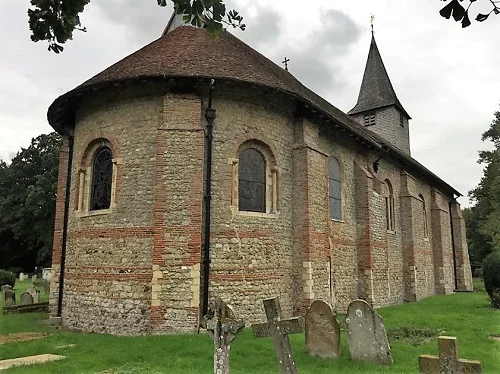
The exterior of the Comfprd Church Apse
During excavation by the side of the altar for the burial of the vicar, John Kelly, in 1809, the workmen uncovered a coffin bearing the name of Edmund Bonner. Perhaps, St George’s churchyard close to Marshalsea prison wasn’t the bishop’s last resting place after all.
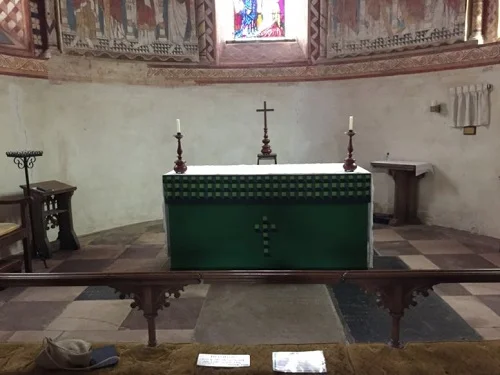
The altar in the Comford Church, where we can speculate that Bishop Bonner himself could be buried.
Sarah Lamden, Archaeology volunteer