
Every month we feature two blogs written by volunteers, one describes an object in the Palace and one a plant from the Garden. It is a great way for us all to learn more about the Palace, if you would like to contribute there is no set format so please do send us your ideas!
It was late June 2017 when I first heard that Fulham Palace were looking for archaeological volunteers to find the remains of the Tudor dovecote and possibly parts of the original medieval manor of the Bishops of London. I couldn’t believe my luck when I was asked to go and meet Alexis Haslam (Community Archaeologist) and was accepted as one of the 30 volunteers to work on the excavation. Specialist training days followed and finally in October, I found myself standing on the edge of one of the two main trenches, waiting for instructions and feeling both excited and nervous. Excited because previous digs at Fulham Palace had already found Roman coins, flints from the Mesolithic to Neolithic eras, and fragments of early Saxon and Roman pottery; nervous because we were using pick axes and mattocks as well as trowels, and I didn’t want to be the one that damaged a precious find, if we were lucky enough to find one.
Alexis got us working in twos, and I was paired with another volunteer - Valerie. We were asked to dig a section, in an area thought to have been dug previously and then filled in. My nervous perspiration was soon replaced by real perspiration, as Valerie and I took it in turns to dig, fill buckets, load the wheelbarrow and then move barrow loads of waste uphill onto the spoil heap.
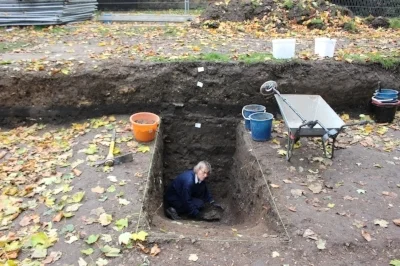
The hard work was rewarded as very soon we started to find evidence of the early inhabitants of the site. We were digging in what must have been a midden. Virtually every layer had artefacts such as pieces of what looked like Tudor brick and tile, nails, sherds of pottery, pieces of glass, charcoal, parts of clay tobacco pipes and animal bones of all shapes and sizes. Some of these bones had butchers’ cut marks possibly indicating that we were digging up food waste from the Bishops’ kitchens. The deeper we went, the more we found and every day we had a collection of finds to document against each layer before we went home. Other excavations around us had similar finds, but in addition, other volunteers had found items such as the skeleton of a large dog, jettons, an Elizabethan coin, a gambling top (Teetotom) and some stunning pieces of architectural masonry including two faces. Although many of our finds when examined by an expert would later reveal a lot of exciting facts about the site, both Valerie and I were hoping for something special….!
On 23rd October, just two layers away from the river gravels which would mark the end of our dig, it was my turn down our small trench. Both Valerie and I had been using a mattock but for some reason I took up my trowel and I started scraping instead. Suddenly, I found what looked like the top of a rounded yellowish pebble, so I scraped some more and found I had something made of pottery – a largish piece of pottery. By now Valerie was leaning over the pit and encouraging me to trowel faster. Very soon I revealed the side of what looked like a jug with a handle. More trowel work and it appeared that we didn’t just have a sherd, but maybe most of the pot. Proceeding with care, we finally managed to ease an almost complete drinking pot out of the soil.
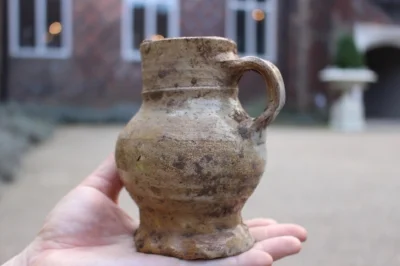
The bottom of the pot had a kind of pie crust edge and it was complete except for a small hole around the back, which was why it had been thrown away. It was full of soil which must have protected it. Valerie and I were quite restrained – no little dances -but large grins cracked our faces. It was ‘our pot’.
Alexis told us that he thought it was a drinking jug of Raeren stoneware made 1480-1610 and this was later confirmed by experts. This stoneware was imported from the Rhinelands and would have been more expensive than local pottery. This stoneware is not rare, but could our jug have been used by one of the Bishops or someone in his household to drink the ale made at the palace? We will never know, but as this was the first major piece of pottery uncovered by my trowel at Fulham Palace, working closely with others, it is very special to me.
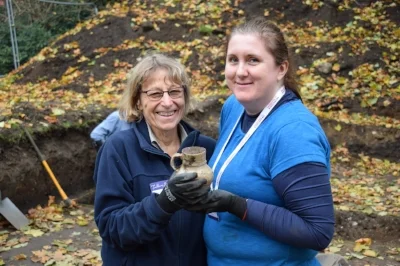
Ann Russell, Archaeology Volunteer
Please send your ideas for Object / Specimen of the Month blogs to rachel.bray@fulhampalace.org. If you would like some help, let us know.