
Every month we are going to feature two blogs written by volunteers, one will describe an object in the Palace and one a plant from the Garden. It is great way for us all to learn more about the Palace, if you would like to contribute there is no set format so send us your ideas!
April's Favourite Object by Kathy Stevenson
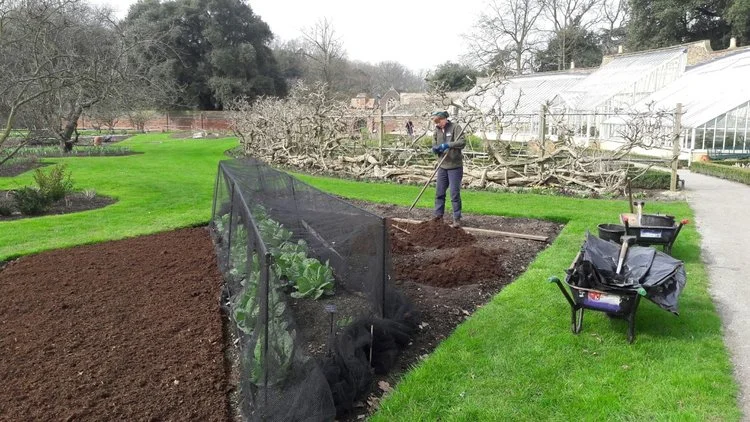
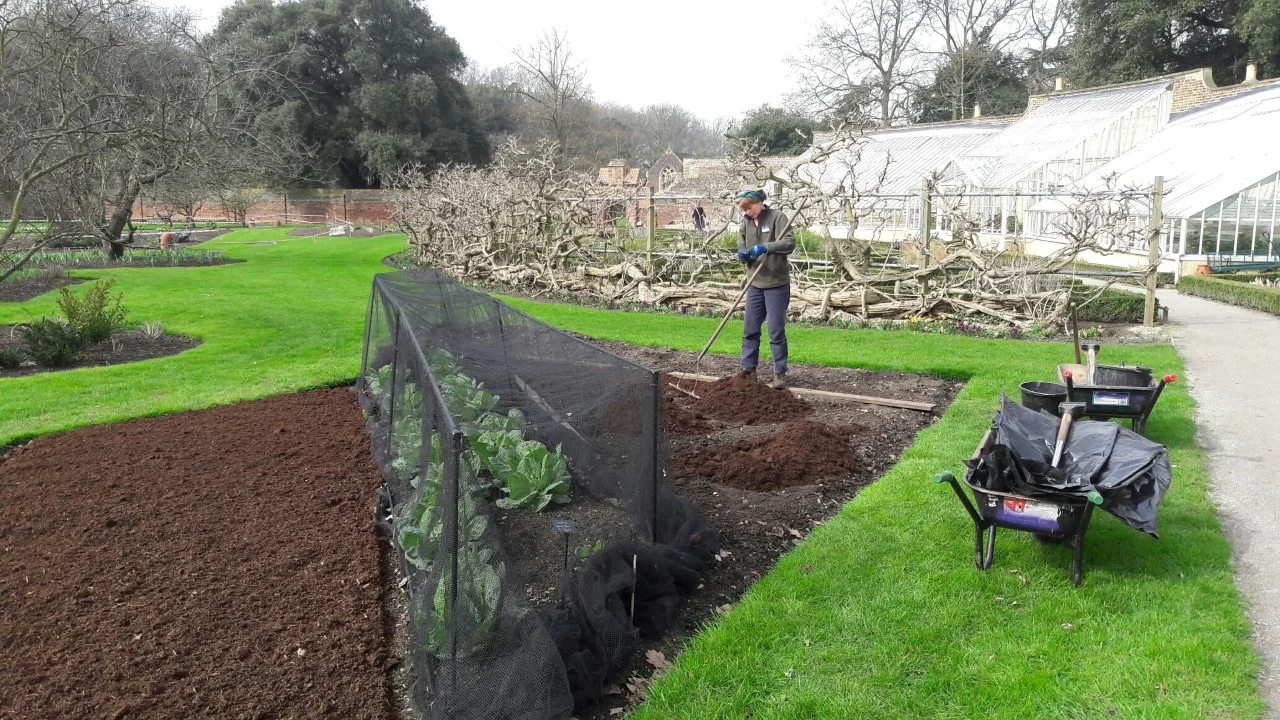
Hi, I'm Kathy, one of the garden volunteers. For the 'Choose a Favourite Object' theme for April I had the vague idea of 'A Flowering Tree' as my subject. Two days later I was spreading manure over our future vegetable beds and suddenly the soil beneath my feet became much more interesting. I already knew we produced our own mulch and compost from weeding the beds, raking leaves and emptying our bothies' kitchen compost bin, and I thought this converted into vitamins and minerals that would feed our potatoes. That's enough, right? But there I was, introducing something that came from a horse's digestive tract and that made me wonder, just what was really going on here? I did a little digging, and unearthed a mountain of information on the subject.
Let us begin with the quality of the soil we have already. Fulham Palace has a wide distribution of well draining, alkaline soil, derived from a combination of chalk, limestone and sand. This is good for growing vegetables, although the sand content doesn't help with water retention and we need to add something to prevent moisture loss in the gardens.
The good news at Fulham Palace is that most of our soil improvers are right here on site. Thanks to the sales of our produce and a hefty contribution from the lottery fund, we were able to create proper composting bays and buy a tractor to work them. Grass clippings, a rich source of nitrogen (which feeds the bacteria that help vegetable roots grow well), are layered in with the compost. Chris A. turns the whole mixture weekly and in time, our Black Gold is ready to be worked into the weeded beds. We also turn leaves in to mulch and soil improver. Leaves take a long time to decompose, so there are separate bays where they are allowed to rot down undisturbed. The end result is called leaf mould.
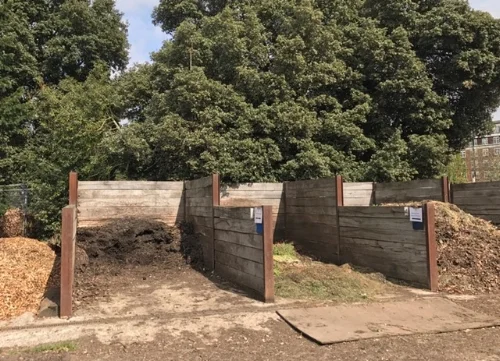
The garden ready compost is on the left, with garden waste next along
Then there is the rotation of crops every year to ensure that no pest or disease has time to set up home in the soil. If roots are planted one year, they are followed the next year by potatoes, then onions the third year, legumes the fourth, brassicas the fifth and back to roots the sixth.
And that horse manure? It was actually mushroom compost, which is made by mushroom growers using organic materials such as straw, corn cobs and hulls, and poultry and horse manure. The manures are high in nitrogen, activating the compost. The straw adds carbon and gives the mass structure and aeration.
Here’s what the RHS say about spent mushroom compost:
"Mushroom compost is excellent on the vegetable garden, as vegetable crops usually grow best when the soil is not acid and where the soil is alkaline, brassicas (cabbage, broccoli, cauliflower, kohlrabi, Brussels sprouts and kale) are less likely to be infected by clubroot disease."
So you see, the dirt beneath your feet is not an inert growing medium. It lives and breathes. And our vegetables love it. See you at the barrow!
Kathy Stevenson
Please send your ideas for blogs to commsvolunteer@fulhampalace.org If you would like some help, let us know.