
Every month we are going to feature two blogs written by volunteers, one will describe an object in the Palace and one a plant from the Garden. It is great way for us all to learn more about the Palace, if you would like to contribute there is no set format so send us your ideas!
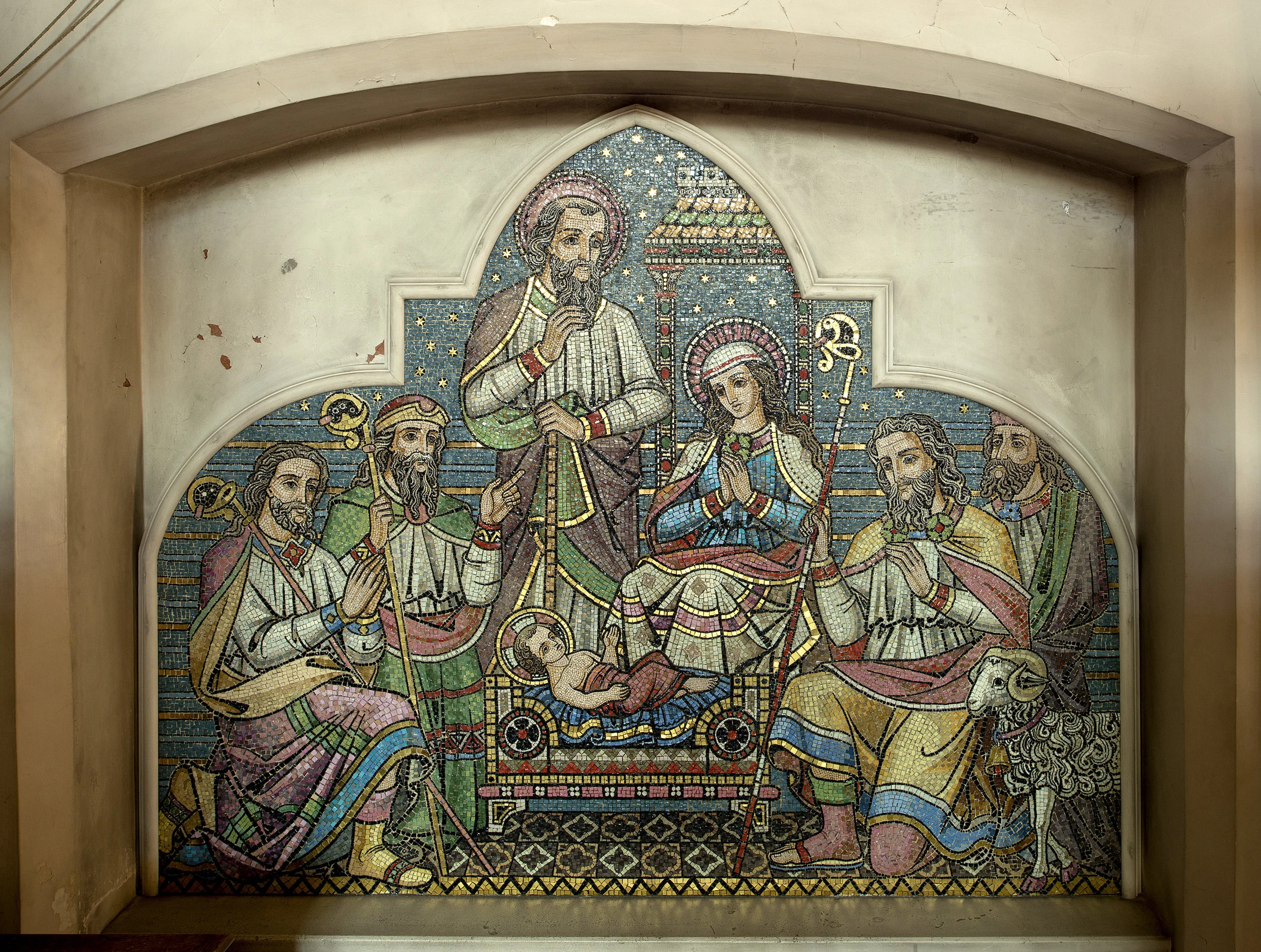
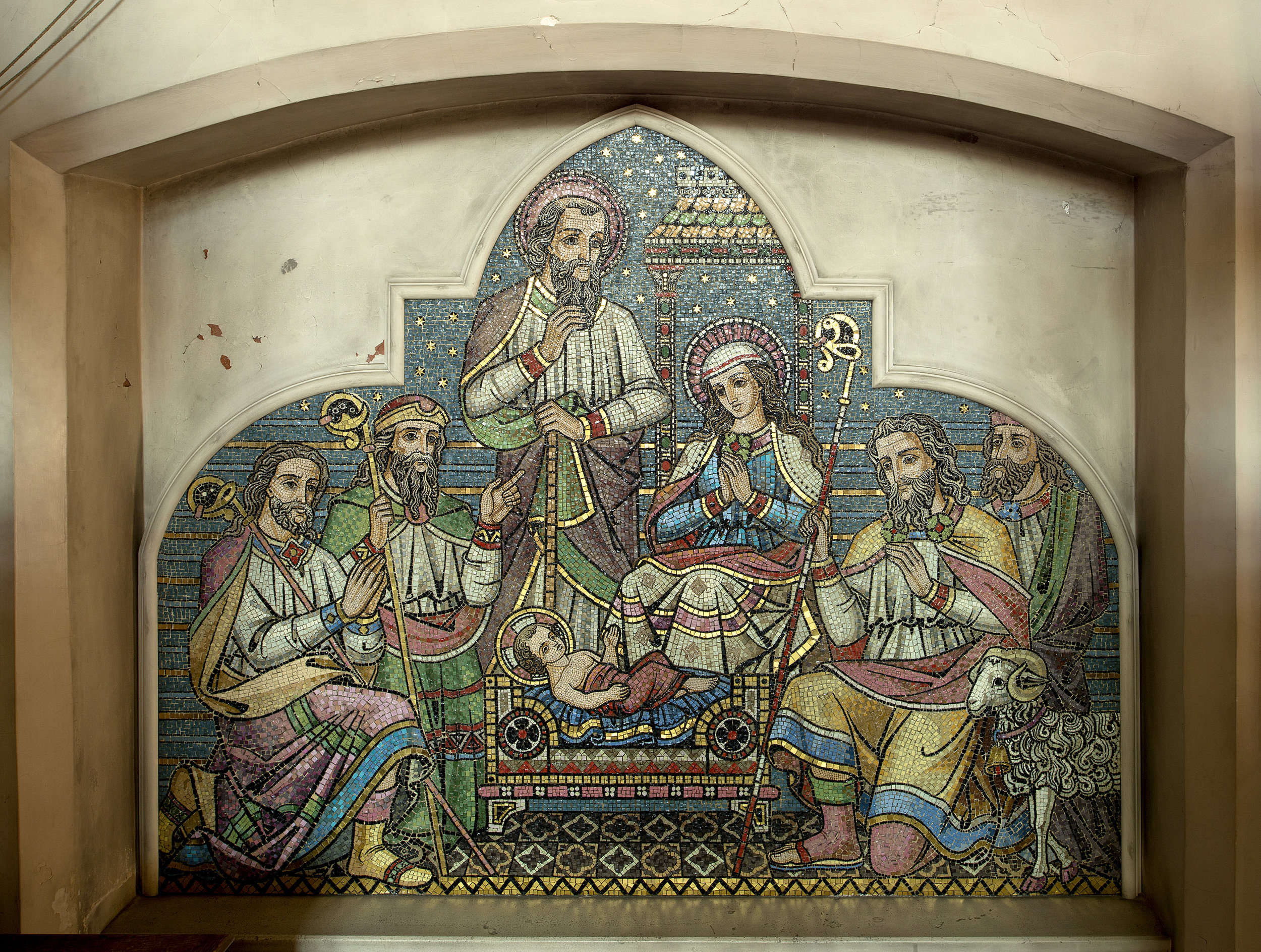
The Nativity with the Shepherds designed by William Butterfield exectued by the Salviati Company from cartoons by Alexander Gibbs.
In 1866 Bishop Tait commissioned William Butterfield to design the new Chapel. The mosaic was originally positioned on the east wall of the Chapel as a reredos depicting the Nativity with the Shepherds. It was also designed by Butterfield and made with glass mosaic pieces by the Salviati company from cartoons by Alexander Gibbs. It was moved to the west wall by Bishop Wand after the Chapel was damaged by a bomb during World War II.
It now seems rather sadly marooned but it was originally the centrepiece of Butterfield’s design as we can see in the 1879 photograph, though sadly not in colour. The shape of the reredos echoes the shape of the east window above and forms a focal point within the patterns of the brickwork and the tiles along the walls and floor. The elaborate patterning of the crib, the floor and roof tiles and the stripy walls echo the surrounding chapel rather than representing a humble stable and manger. The figures and the twirly-coated sheep are stylized and geometric design takes precedence over narrative.
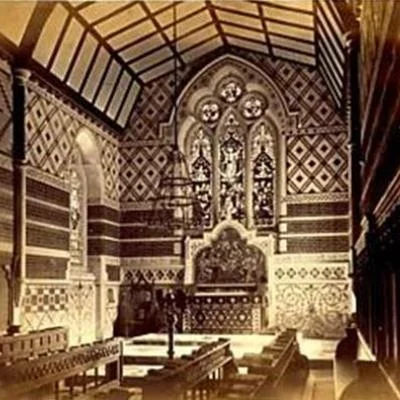
The Chapel in 1879 showing the Salviati mosaic in its intended location above the Altar.
Butterfield felt that a church should be the vision of a single person and liked to control every aspect of the design. Any figurative work had to follow the scriptures closely without distracting emotional appeal. This was shown subsequently when there was a huge row about Keble College Chapel where the Warden had the temerity to ask Butterfield to adapt his design to accommodate Holman Hunt’s The Light of the World. Butterfield regarded it as ‘a sentimental picture’ more suited to ‘some other room such as the Library’ and, needless to say, the painting went to the Library.
Butterfield did not do the design drawings himself but relied on others to interpret his ideas. For the mosaic panel, he employed Alexander Gibbs, who also worked with him on All Saints, Margaret Street, and Keble College Chapel. He quarrelled with almost all his more inspired collaborators but Gibbs understood what he wanted and did not try to bring in his own ideas.
Salviati had begun his company in Venice and was an entrepreneur with an eye for a good opportunity. With his collaborators, he revitalized the moribund Venetian glass industry by inventing a new technique to make ‘smalti’, the glass used for mosaic, in gold and silver and a large range of different colours. They also thought of a new way to make it easier and cheaper to transport the mosaics from Venice around the world. They transferred the designs onto heavy paper, added the glass pieces upside-down and then covered them with a thin layer of cement. The sections could be fitted together on arrival like a jigsaw puzzle and the paper removed, so there was no need for a craftsman to set the individual mosaic pieces in situ.
Capitalizing on the British love of Venice, Salviati exhibited to great acclaim at the 1862 Exhibition in London. He profited greatly from the death of Prince Albert and was commissioned by Queen Victoria to make the mosaics on the Royal Mausoleum at Frogmore, the Albert Memorial Chapel at Windsor and the Albert Memorial. Many other high profile commissions followed, including the Last Supper behind the altar at Westminster Abbey, the spandrels under the dome of St Paul’s Cathedral, and decorative panels in the South Kensington Museum (now the V & A) and the Houses of Parliament, as well as many churches, castles and private homes
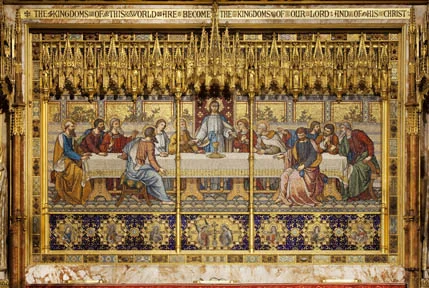
The Last Supper from behind the Altar at Westminster Abbey to a design by Clayton and Bell.
By 1897 when Mandell Creighton became Bishop, tastes had changed and mosaic mania had subsided. His wife Louise commented, ‘Nothing can make that Chapel beautiful’. They had come from Peterborough and loved its magnificent soaring cathedral. The mosaic was hidden behind a thick curtain and replaced with the wooden altarpiece with a relief of the Crucifixion which they had brought with them.
salviatimosaics.blogspot.co.uk/2013/06/tait-chapel
Camilla Adeane
Please send your ideas for blogs to rachel.bray@fulhampalace.org If you would like some help, let us know.