
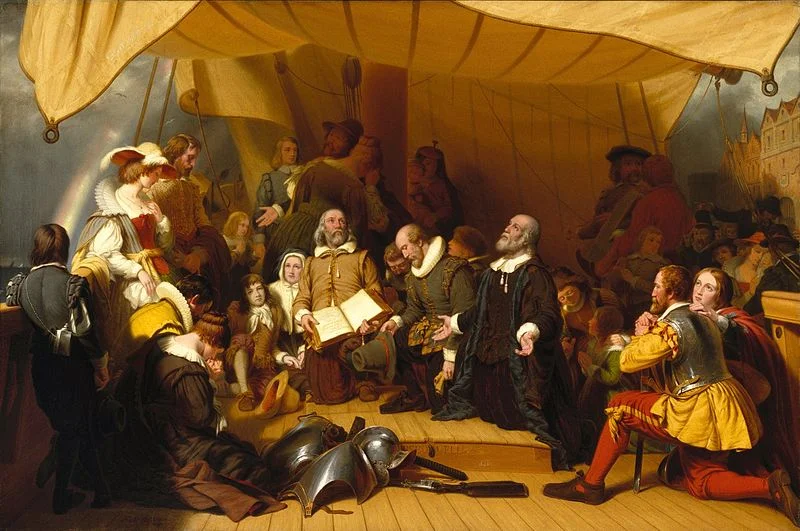
Recently, I was pleasantly surprised to learn about Fulham Palace’s links to America. I’d heard that before the Revolutionary War, the Bishop of London oversaw the spiritual welfare of British colonists in North America but was unaware of the palace’s lesser-known connection to Pilgrim William Bradford. In the mid-nineteenth century a lost manuscript of Bradford’s ‘Of Plimoth Plantation’ mysteriously turned up in the Fulham Palace library. A signatory of the Mayflower Compact and five-time governor of Plymouth (alternately spelled Plimoth) Colony, Bradford is a significant figure in early American history. Likewise, ‘Of Plimoth Plantation,’ referred to as ‘The Log of the Mayflower' by the British, is a near priceless artifact in early American history.
Plymouth Colony was the second permanent English settlement in North America. Bradford’s text is a recounting of the Pilgrim Fathers’ voyage to the ‘New World,’ and the most complete, authoritative record of the colony’s first years. Never intended for publication, after Bradford’s death the manuscript was passed-down through generations until it was acquired by Reverend Thomas Prince. He published a selection of excerpts and kept the document in his library at the Old South Church in Boston, Massachusetts. However, sometime during America’s Revolutionary War, Bradford’s manuscript of ‘Of Plimoth Plantation’ vanished. It unexpectedly reappeared in 1856, shelved in the Fulham Palace library.
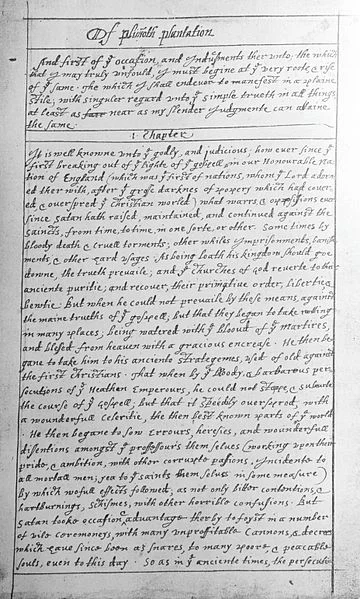
Though it’s unknown exactly how or why the book traveled from Boston, Massachusetts to London, England, there are conjectures. Two popular explanations are that it was pilfered by a British soldier or taken for safe-keeping when loyalist Governor Thomas Hutchinson fled the colony. After its discovery, the current bishop (either Charles Blomfield or Archibald Tait) granted permission for the manuscript to be copied. It was published in Boston early the following year. Finally, after years of diplomatic wrangling, the original was returned to the United States on 29 April 1897. Its celebrated return can be attributed to Bishop Creighton who, himself a historian, thought a document as significant as Bradford’s belonged in America. Today, it is treasured as an invaluable piece of early American history and has a place of prominence in the Massachusetts State House. If you’re too busy to make the transatlantic journey, a reproduction page from the manuscript can be seen on the large map panel at the Museum. To read more, check-out ‘Saints & Strangers: Lives of the Pilgrim Fathers and Their Families’ by George F. Willison and Samuel Eliot Morison’s edition of ‘Of Plymouth Plantation, 1620-1647’ by William Bradford.