
The Wheelbarrow
August’s object in focus was kindly chosen and written about by garden volunteer and head gardener’s admin assistant Jamie Atwell.
Every month, volunteers post an Object and Specimen of the Month. They are an excellent way to research something about the Palace that has always interested you - and share it with others! There is no set format for these posts, and can even be creative writing pieces, so please do get in touch if you are interested in submitting a blog piece.
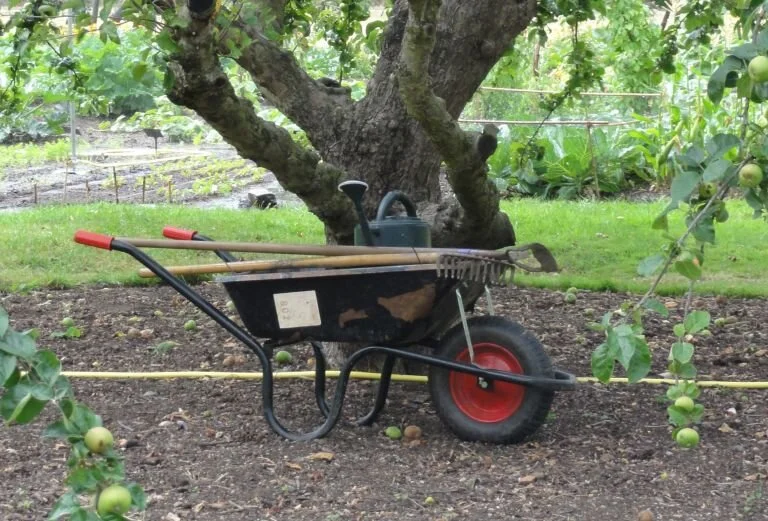
The Wheelbarrow under the apple trees.
The re-opening of the garden at Fulham Palace (hurrah!) means that, once again, we can all enjoy this magical place. For us garden volunteers, we can now get back to doing what we love – playing a small part in helping to tend and care for the second oldest botanical garden in London. During lockdown, Head Gardener Lucy Hart and her full-time professional team worked incredibly hard to keep everything on an even keel during one of the busiest periods in the horticultural year. It is to their great credit that the garden looks as impressive as it does (though there are plenty of tasks for us volunteers to get on with!)
During the period of lockdown, and whilst pining for the garden at Fulham Palace, I started musing (as one does) on the tools that all gardeners use on a regular basis. This led me to carry out some research into one particular item that is very much taken for granted but is an essential bit of kit. This led to the surprising discovery that there is a link between Chartres Cathedral and a wooden ox. The link being none other than the humble wheelbarrow.
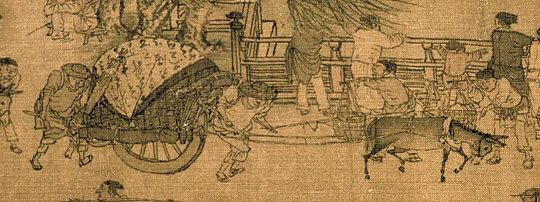
A detail of an early, one-wheeled wheelbarrow. Zhang Zeduan (1085 - 1145), Along the River During Qingming Festival, Northern Song Dynasty (960–1127), ink and colours on silk, 25.5 × 525 cm.
We must go back a bit.
We don’t know when for certain, but we do know that the wheelbarrow was first invented by the Chinese. Credit is often given to a shadowy figure called Ko Yu, who appears in records in the first century BC. To come up with a device that combines the benefits of the wheel and the lever was undoubtedly a work of genius. With a wheelbarrow’s load centred just behind the wheel, it does not require much effort to transport a significant load. So pleased were the Chinese with the invention, that they tried to keep it a secret – calling it, among other code names, the ‘Wooden Ox’.

Detail of a wheelbarrow in use during a brewing process. A tomb tile collected at Xinnong, Chengdu City, 25 - 220 AD, Eastern Han dynasty, Sichuan Provincial Museum.
We in the West were not quite so quick to cotton on to such a clever idea. The first known record of a wheelbarrow in Europe does not appear until the thirteenth century. Rather than being documented, it is to be found in a stained glass window at Chartres Cathedral, dated at around 1220.
Coming back to the present day, and to the garden at Fulham Palace, you will see wheelbarrows in constant use – transporting clippings to the compost bins, carrying a vast array of other tools for work on the remoter parts of the garden and so on. One of its most important roles is that of helping to move flowers and produce to the Barrow in the Walled Garden - where we all have the opportunity to buy home-grown, organic offerings grown right here.
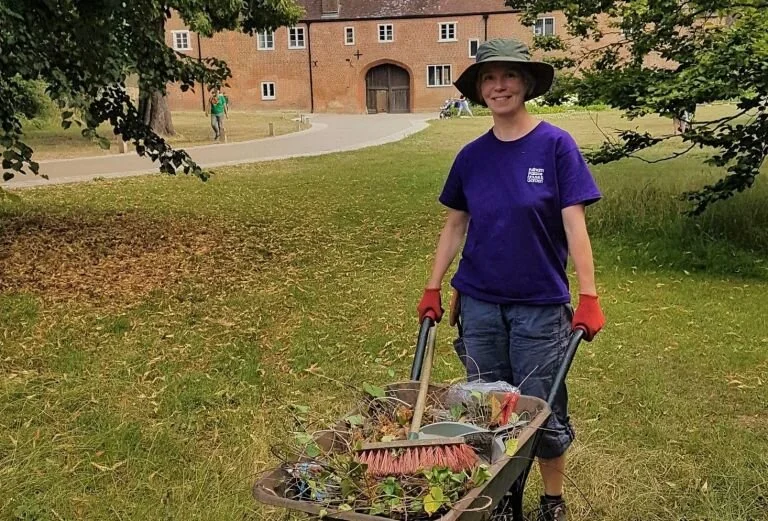
Garden apprentice Annette Förger and her wheelbarrow.
The Barrow is open for sales from 11 a.m. to 3 p.m. on Tuesdays – Saturdays inclusive. Sale proceeds are all ploughed back into the garden so it is a wonderful way of acquiring delicious vegetables and stunning plants, as well as supporting the Fulham Palace Trust charity and its magnificent garden during this difficult time.