
Every month we feature two blogs written by volunteers, one describes an object in the Palace and one a plant from the Garden. It is a great way to learn more about the Palace. If you would like to contribute there is no set format so please do send in your ideas.
This March we are grateful to Naomi Jennings - O’Toole for her take on the portrait of Bishop John King, c.1620 which is on display at Fulham Palace.
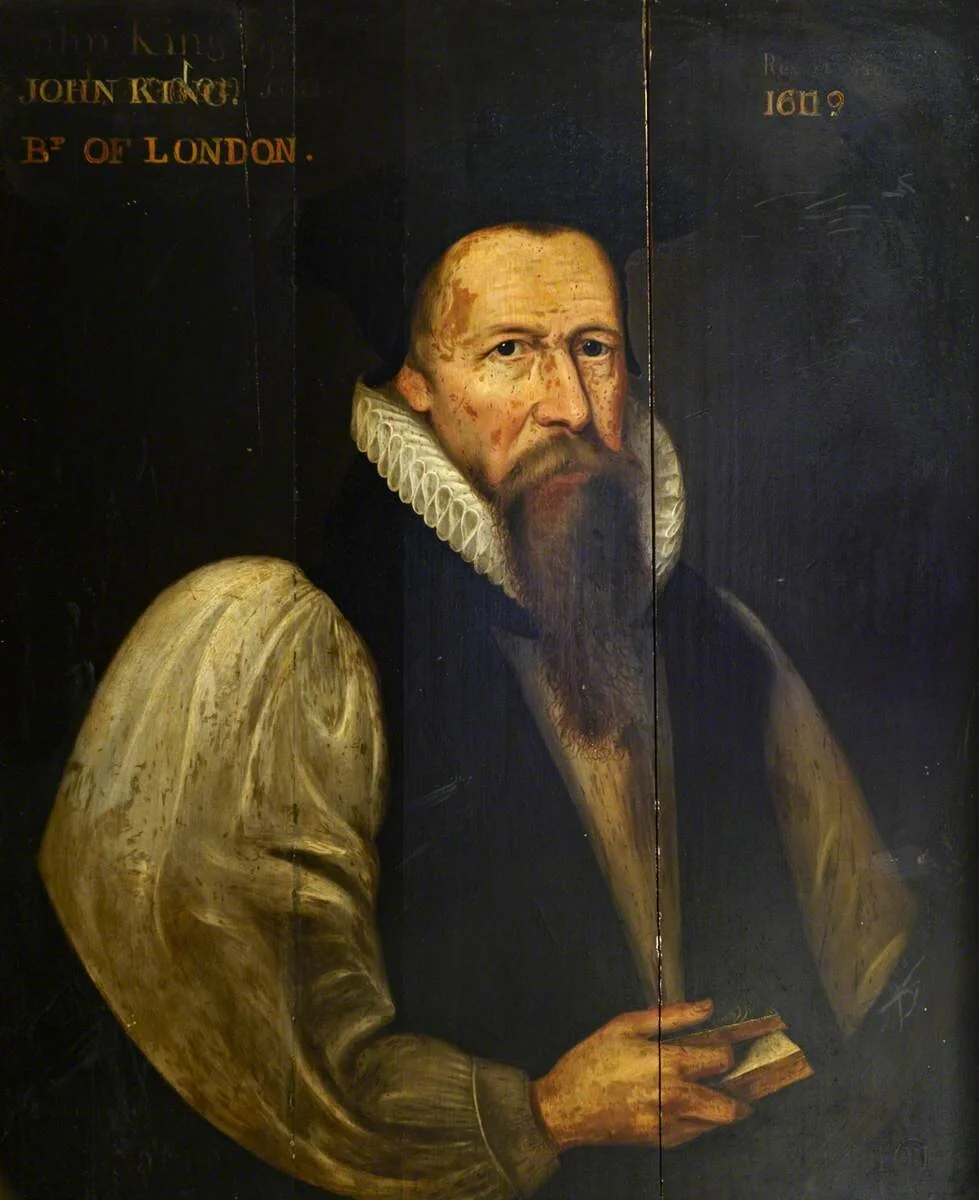
Bishop John King
Portrait of Bishop John King, oil on wood panel, after Nicholas Lockey, c. 1620, 55.9 x 43.8 cm, Fulham Palace.
The portrait was painted on three panels of wood. The vertical cracks between the panels are visible today.
John King was born in Worminghall, Buckinghamshire. He received a broad education, at Westminster School and Christ Church, Oxford, having graduated with his BA in 1580 and an MA three years later. He started his career as a preacher to the city of York, moving across various roles, including a domestic chaplain to Thomas Egerton in London, Rector of St. Andrews in Holborn and prebend of Sneating in St. Paul’s. After having been appointed chaplain in ordinary to James I, he was then appointed as dean of Christ Church in 1605, and later consecrated as Bishop of London on 8th September 1611.
King was a well-known Calvinist and anti-Catholic. Upon his death (on Good Friday) in 1621, Roman Catholic propagandists claimed that he converted to their church on his deathbed. The cause of death was actually gall or kidney stones – but his death was used in a marketing attempt to undo his Calvinist preaching!
His portrait is the first thing a visitor sees when entering the Palace’s exhibition. Framed in a knotted gold frame, and enveloped by darkness, the Bishop seems to emerge into the viewer’s space from his shadowy surroundings. This use of tenebrism was a convention that originally stemmed from Caravaggio’s dramatic Baroque paintings. Complete darkness, lit only by a singular source of light, tenebrism is a technique that casts the subject in a particularly theatrical manner. The portrait thus declares solemnity and infuses the Bishop with respect.
Interestingly, this piece in the Palace’s collection stems from an established ‘type’. The artist has reproduced a portrait that now hangs in the National Portrait Gallery. Painted by Nicholas Lockey in 1620, the piece became a prototype for later depictions of the Bishop, of which five are currently known.
Yet, there are a few differences in the Palace portrait that marks the hand of the artist. The tonal scheme is notably warmer than the prototype, which adds a sense of familiarity. As it stands, the National Portrait Gallery piece is tonally cool. In conjunction with the absence of eye contact with the viewer (the Bishop gazes above us as if in contemplation), this produces an effect of emotional distance. The Palace’s version seems to me to have a friendlier persona.
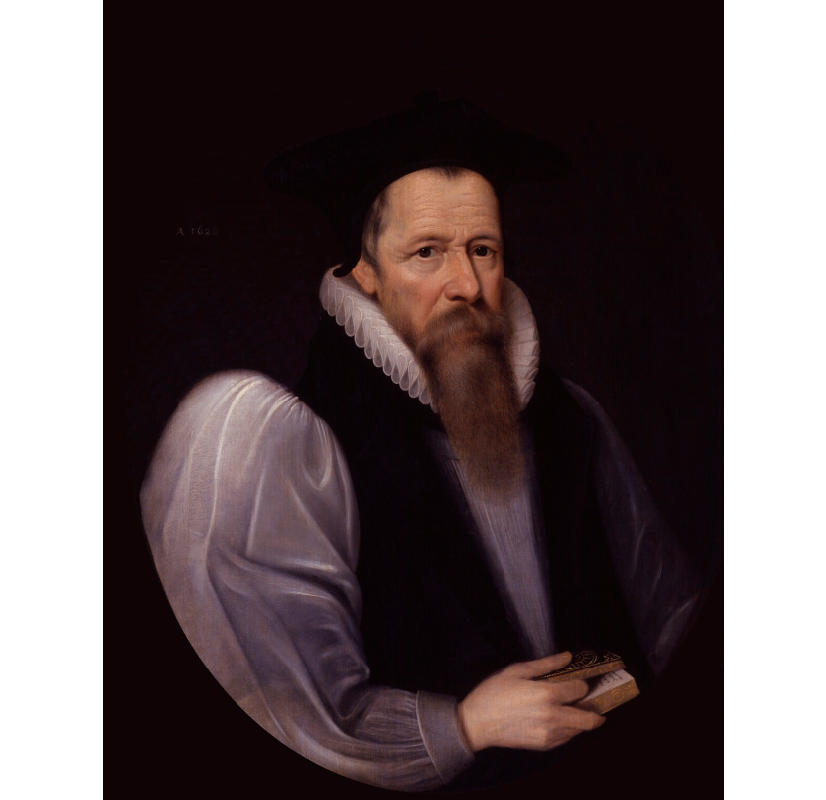
Portrait of Bishop John King, 1620, oil on panel, at the National Portrait Gallery.
King is depicted in all his Bishophood. He wears traditional clerical clothing that announces his Calvinism. The soft rendering of his cuff collar especially struck me - it is spectacularly rendered with highlights and twisting curls that really strike the eye. He grips a Bible in his proper right hand, partly open with his fingers, symbolising his active participation with the scriptures. The artist has added snippets of information around the subject; his name painted twice in the top left corner, the year of his consecration in 1611 and mysterious embossed lettering in the bottom left that has been painted over in black.
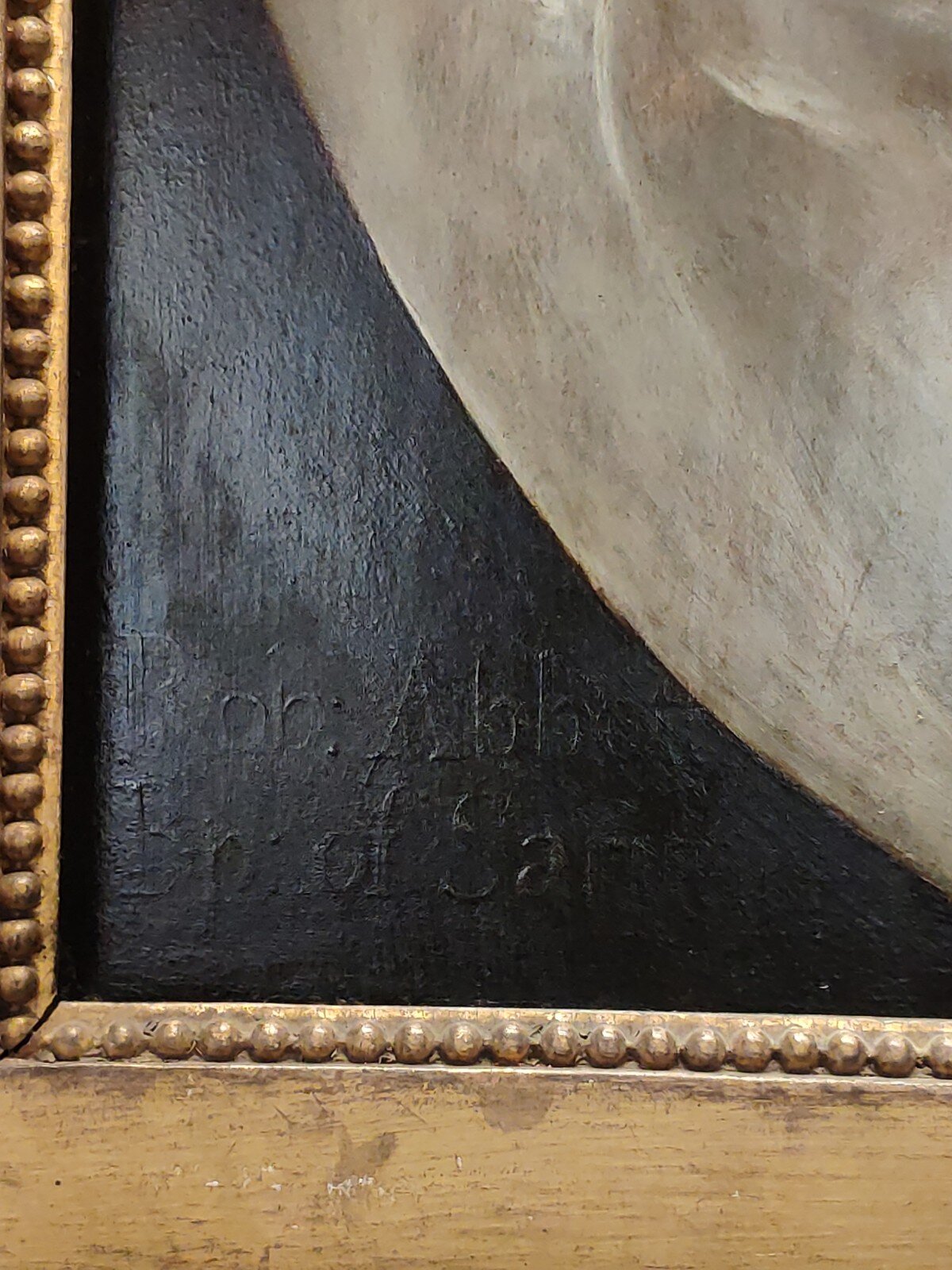
The embossed caption
This caption could refer to George Abbott, who was born in Surrey. He was installed as the Archbishop of Canterbury in the same year that Bishop John King was consecrated as Bishop of London (1611). Abbott was likewise known for being "[a] sincere but narrow-minded Calvinist” (Chambers Biographical Dictionary).
This painting is shown amongst a range of objects, from early photographs of the Palace, a tiny print of an old Tube map to archaeological discoveries. The curation reflects his position as an embedded and noteworthy part of the Palace’s history. The caption declares that the Bishop formed the Dr. Edwards and Bishop King’s Charity of Fulham, after having left £20 in his will to be given to the poor in bread, beef and money. This charity is still running today to relieve poverty in Fulham. The adjoining room holds a display of Bishop Compton’s botanical collections (who served as Bishop of London from 1675 - 1713). This room sensitively highlights the contribution that often overlooked people in history have made to the developments of the Gardens, such as those that collected and transported the botanical specimens back to London, often encountering danger and hardship. Between the two rooms is a display of a liturgical outfit, including a mitre, Bishop Winnington-Ingram’s cope and a pastoral staff that belonged to the first Bishop of Fulham. Visitors are invited to draw out connections between the roles of the Bishops, from being involved in charitable work for the local community to working with people on an international scale. The Bishops balanced responsibilities on a secular level to a religious level - and the curation of this exhibition juxtaposes these two natures of the life of a Bishop. The portrait of John King introduces us to the many objects held in the collection, that tell stories about the Bishops that have affected history from within the Palace walls.
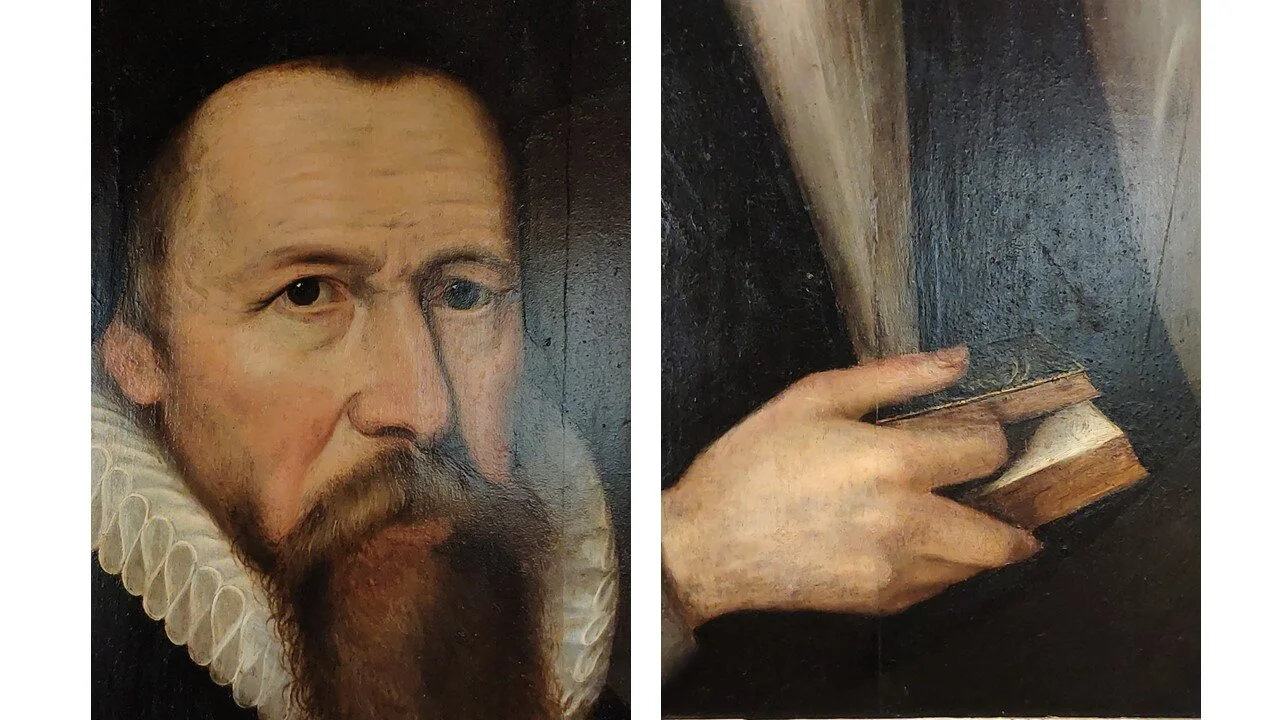
Details of the painting: the face of King is rendered with precision showing that accuracy of characterisation was a primary aim for the artist. The book that King holds in his hand is similar to the small Bible displayed in the cabinet opposite the portrait.
Thank you to Naomi for this fantastic blog about the portrait of Bishop John King. Please send your ideas for object or specimen of the month blogs to rachel.bagnall-bray@fulhampalace.org. If you would like some help, please let me know.