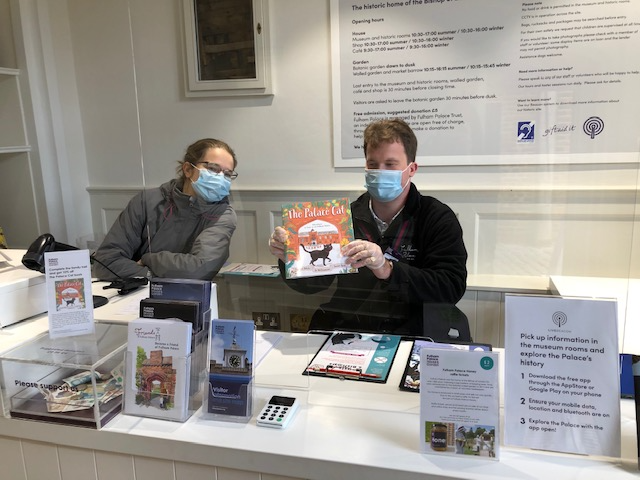
Every month we feature two blogs written by volunteers; one describes an object in the Palace and one a feature from the Garden. There is no set format so you are free to experiment with research, prose, poetry or anything new! It is a space for you to learn more about the Palace and share it with the volutneer community.
Many thanks to Alexander Ogilvie-Graham, front of house volunteer and library care team volunteer, for this month’s piece!
I am Alexander Ogilvie-Graham, a volunteer at Fulham Palace. I have Aspergers and an even keener interest than most sane people in Coat of Arms and Heraldry. I am hoping that this will be the first of many articles that I post on the portal. I have always been fascinated by Heraldry. This article will talk about the life of a specific coat of arms up to the present day and will explore how it ended up in the temporary exhibition room.
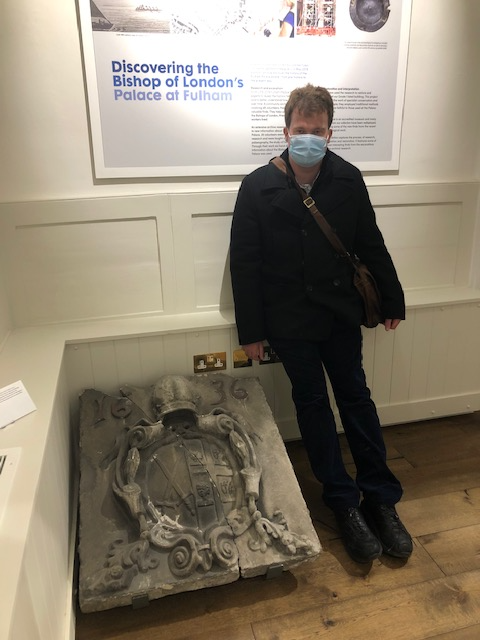
Standing with Bishop Juxon’s Coat of Arms in the exhibition room
I have chosen the Coat of Arms that is tucked away in the corner of the temporary exhibition room - the coat of arms of the mysterious Bishop Juxon. Juxon was Bishop of London from 1633-49 and served as the Archbishop of Canterbury from 1660 until his death in 1663. Bishop Juxon studied law in Oxford and was a clever Bishop. He had a rich and varied life. He was Lord High Treasurer from 1638 to 1641. He also held the same post as Sir Winston Churchill, which was the First Sea Lord of the Admiralty in the year of 1636 to 1638, which strikes me as a very odd role to place a Bishop as the head of the Navy - but this might have been because his family were from a military background? In the year of 1632, the Bishop held the position Clark of the Closet to King Charles the First. It must have meant that he had the kings ear and was close to him. He was the last person the King spoke to before he was executed.
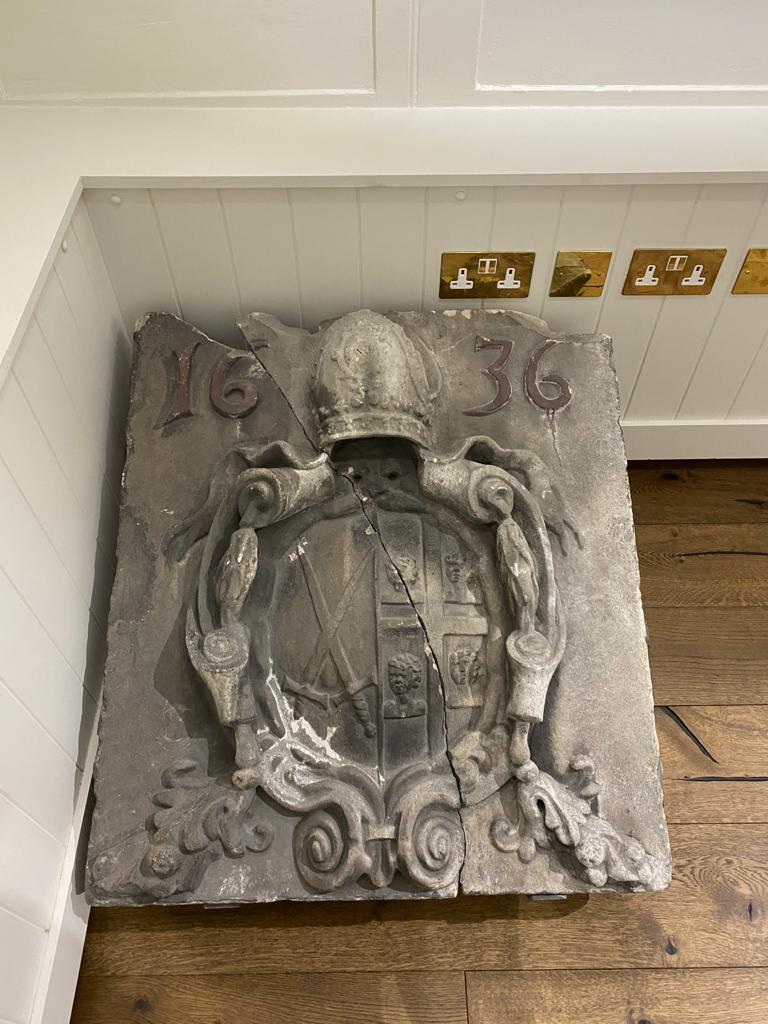
A closer look at the coat of arms
Today Juxon’s coat of arms is tucked away in the corner of the temporary exhibition room, almost unnoticed! It was commissioned in the 17th century and was made of the same decorative plasterwork that was used in the Great Hall. Its history got me thinking; What was the purpose of coats of arms? Why were they needed? Most people in medieval times did not read, so perhaps we might assume they are symbols of status?
Swords indicate that this is the coat of arms of a Bishop of London. And on the opposite side, depicting faces, are the insignia from his family’s crest. I wonder how the huge crack came to be in the middle? Will it always be in the temporary exhibition room? Where will it rest? These questions are what makes this coat of Arms so interesting to me!
Also featured in this coat of arms is the mitre - the hat at the top - a religious symbol. I think that the Bishop’s pointy hat represents the tongues of fire that appeared and rested on the apostles on the day of the Pentecost. This type of hat has been in use since the 4th century.
When I look at the coat of arms in the temporary exhibition room, I am reminded of my favourite painting by Edmund Munch - ‘The Scream’. It reminds me to look beyond what you physically see, to reflect on what is embedded within symbols and explore the history of the person behind them.