
Every month we feature two blogs written by volunteers, one describes an object in the Palace and one a plant from the Garden. It is a great way for us all to learn more about the Palace. If you would like to contribute there is no set format so, please do send us your ideas!
May’s object of the month is rather different. We’re going abstract and considering the wealth of stories and intriguing images on the Palace’s computer filing system the focus for this blog. For those who need it, let’s consider the computer our object this month. Katie Yeo, Masters student at the Central School of Speech and Drama, has just finished a learning placement at Fulham Palace. Her placement focused on storytelling, reading engaging stories to our Palace Explorers under 5s group and writing fascinating tales as part of our schools programme review.

Here’s Katie’s little list of intrigue:
I will keep my introduction short as it is relatively pointless to the purpose of this post. Fulham Palace was a place I had no idea existed when I first started. I had only been in London for 5 months and had rarely been near the Thames in that time. My first day here I bought some fresh chard and spinach from the Walled Garden greenhouse and was greeted warmly by the gardeners as I pestered them for directions. I was also met by Edmund the Cat who I think I disturbed from a nap which he didn’t seem too impressed with. This turned into a weekly occurrence of which I have zero regrets.
I was asked to work on finding interesting stories to write about from the Palace’s history and found myself getting lost in the company drive and external drive many many times, as I am sure many of us have like Alice down the rabbit hole. As well as being a great name for an album, the title ‘Little List of Intrigue’ relates to quite literally a list I created of interesting facts I accidentally came across.
So I thought when reflecting on my time here, I wanted to share with you a list of very interesting but stray and somewhat arbitrary facts that you may not know about Fulham Palace which you can add to your bank of ‘unnecessary but has potential to be in a pub quiz one day’ random facts! Without further ado and in no particular order other than the order in which I originally found these nuggets of mild intrigue:
- Bishop Laud had two tortoises at the Palace. One of them went with him to Lambeth Palace and the shell is preserved and on display at Lambeth. He also had a raccoon at Fulham (Feret, page 150) which must have been a great novelty.
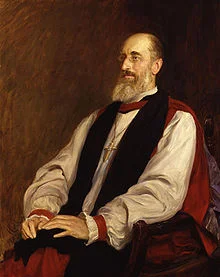
Bishop Mandell Creighton
- In 1869 the Palace inventory mentions 5 cows by name; Princess, Daisy, Rosey, Duchess and Lucy.
- The Bishop was also entitled to any “great fish” (whales) that swam up the Thames.
- There are over 100 rooms in Fulham Palace - of course, some of them are very small. Bishop Creighton (1897-1901) was continually getting lost.
- In 1617, according to Samuel Purchas, while Pocahontas was in London Bishop King entertained her "with festival state and pomp beyond what I have seen in his greate hospitalitie afforded to other ladies." Samuel Purchas, Hakluytus Posthumus, Vol. 19, p. 118. This would have been at his house by St Paul's, or elsewhere in the City, not at Fulham Palace.
- The manor house became known as Fulham Palace because bishops were considered “princes of the church”.
- The site was occupied by the Bishops from about 700 until Bishop Stopford retired in 1973.
- During the first fortnight of WWI the City of London Yeomanry and a Middlesex regiment were training in the grounds of the palace. Bishop Winnington-Ingram was chaplain to the London Rifle Brigade and he explains: “The only unfortunate incident that I remember was my promise to supply the forty officers with fresh fruit from Fulham Palace greenhouses, but, as they consumed eighty peaches at one breakfast, I was unable to live up to this promise”.
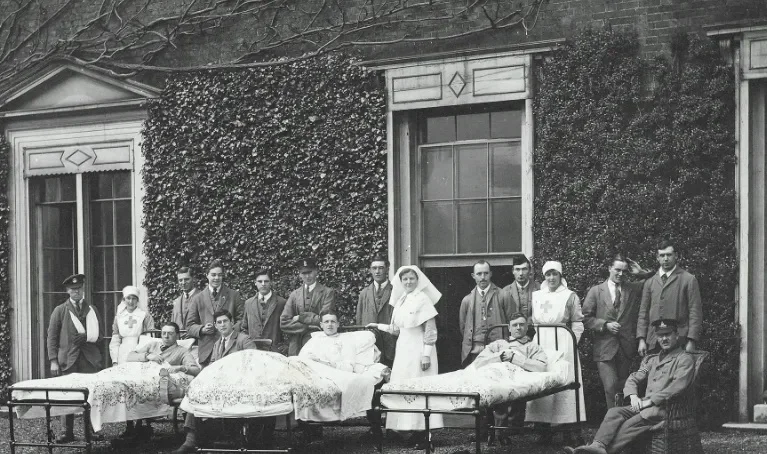
Fulham Palace as the Freemasons’ War Hospital, 1918-1919
- During WWII, the Palace was used to house people whose homes had been bombed - One of Bishop Fisher’s sons complained: “the prevailing effect of dirt and filth and smell with which we are still burdened and look as though we shall be forever unless we use gallons of Flit to create a diversion”
- Bishop Fisher had a miraculous escape from bombs that fell on Fulham Palace one afternoon: as lady Fisher recalls ‘As he ran the bomb exploded … his hat blew off and he thought if that’s all that happens, blast can’t be as bad as I thought! He didn’t realise straightaway that the staircase ceiling had fallen down 30 feet ahead of him, the door of the study on his right had blown off its jamb, and all the windows had come down just behind him! He was in the one place in the whole passage where he would not be hurt.’
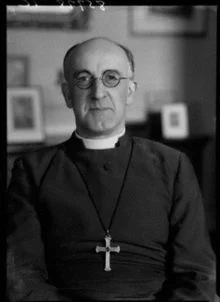
Bishop of London, Geoffrey Fisher (1939-1945)
- There was a great storm in November 1703 25-27th. 5 people drowned on the river near Fulham when a boat overturned.
- Bishop Howley spent £75 on providing bread and beef on Christmas Eve for around 2000 people in need in Fulham.
- In 1902 the coronation of Edward VII was delayed because on the day the King was being operated on for appendicitis. Bishop Winnington-Ingram recalled: “That very afternoon I was entertaining the 400 Indian troops who were quartered inside the grounds of Fulham Palace … there would be no coronation after all next day and that the King was very ill. They said at once, “Then we will go and pray for him,” and getting out their prayer carpets, they prayed for two hours for the King.’
And there you have it – a little list of information with little use but I hope it at least entertained you and made your eyes widen slightly.
I would like to thank absolutely everyone at Fulham Palace, particularly the learning centre for being so welcoming to me and such a wonderful support at my time here.
Katie Yeo,
Learning Placement
Please send your ideas for Object / Specimen of the Month blogs to rachel.bagnall-bray@fulhampalace.org. If you would like some help, please let us know.