
Every month we feature two blogs written by volunteers, one describes an object in the Palace and one a plant from the Garden. It is a great way for us all to learn more about the Palace. If you would like to contribute there is no set format so please do send us your ideas!
There’s a skeleton at my feet and the sky is turning yellow. The clouds have been gathering for some time now, even though the day started sunny. The light is fading although it is nowhere near dusk. The dense ochre clouds look eerie, unnatural, and a storm is presaged in the stillness of the air. People around me are trying to take photographs of the sky but can’t quite capture its strangeness in their images. Then someone says: “Is it because of something you’ve dug up?”
Not quite the end of the world, but an archaeological site at Fulham Palace last October, where I’m working as a volunteer. It’s just across the river from me so an easy daily walk. The skeleton is of a large dog- intact and perfectly laid out as it was buried by its owner over 200 years ago. We’ve already been asked if it’s a dinosaur by an excited small child. We’ve uncovered it about a metre from the surface, a level which is 18th century, but we have been digging further down among Tudors and Stuarts.
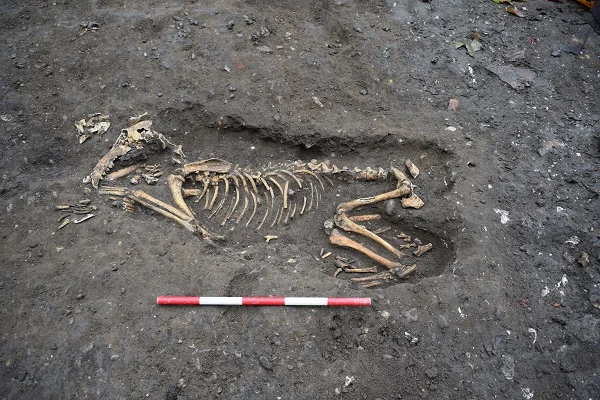
The skeleton of a large dog, found at the Fulham Palace Dovecote Dig 2017
The ghastly sky was much commented upon in the media at the time. A quotable quip came from someone who said that it was just like living in olden times, when everything was sepia. Winds from the south had carried sand from the Sahara and smoke from forest fires in Portugal into our skies, and it had been a day of violent localised storms. In the event we avoided rain on the site: the clouds dispersed and light returned.
Our October excavation had a specific aim in view: to locate the remains of a Tudor dovecote, visible on plans from the 1700s and known to have been demolished late in that century. We were also looking for traces of an earlier manor house on the site- perhaps even foundations. We were digging in the lawns at the front of the Palace, across one area 20 metres square and another somewhat smaller and rectangular. Almost every day we were visited by parties of schoolchildren and there were advertised tours and talks for the public every afternoon. A lot of effort went into posting accounts of progress onto social media too.
A mechanical digger had taken off the topsoil down to about a metre, where it hit a layer of demolition rubble about nine inches thick: red brick; red roof tiles, some with holes in them to accommodate nails; and plaster. This layer covered about half the main site and part of the adjacent subsidiary one. It showed up very clearly as a red and white stratum in the trench wall. The discarded topsoil was searched with a metal detector at intervals and we turned up a number of coins stretching back a century or so. Most interesting among these was a Belgian coin whose design was used from the 1850s until 1917. Since the Palace was used as a training ground and convalescent hospital during World War I, the coin probably arrived with a wounded soldier from Flanders.
A large area of the rubble was systematically cleared. We found no intact bricks: they had presumably been removed for recycling. But we found a great deal of decorated plasterwork whose recovery was literally hit-and-miss since we were having to use pickaxes and mattocks to loosen the tightly compacted layer. We managed to lift intact a fair amount of layered and beaded ceiling cornicing, half of an armorial shield and two enchanting “green man” faces, of the kind one sees carved onto stone bosses in medieval churches. These were about six inches across. Sometimes we found bricks with plaster fragments still attached. Less common were pieces of shaped, cream-coloured stone- perhaps the remains of window and door surrounds. Numerous corroded iron nails kept the metal detector beeping, so much so that we stopped being excited when it went off.
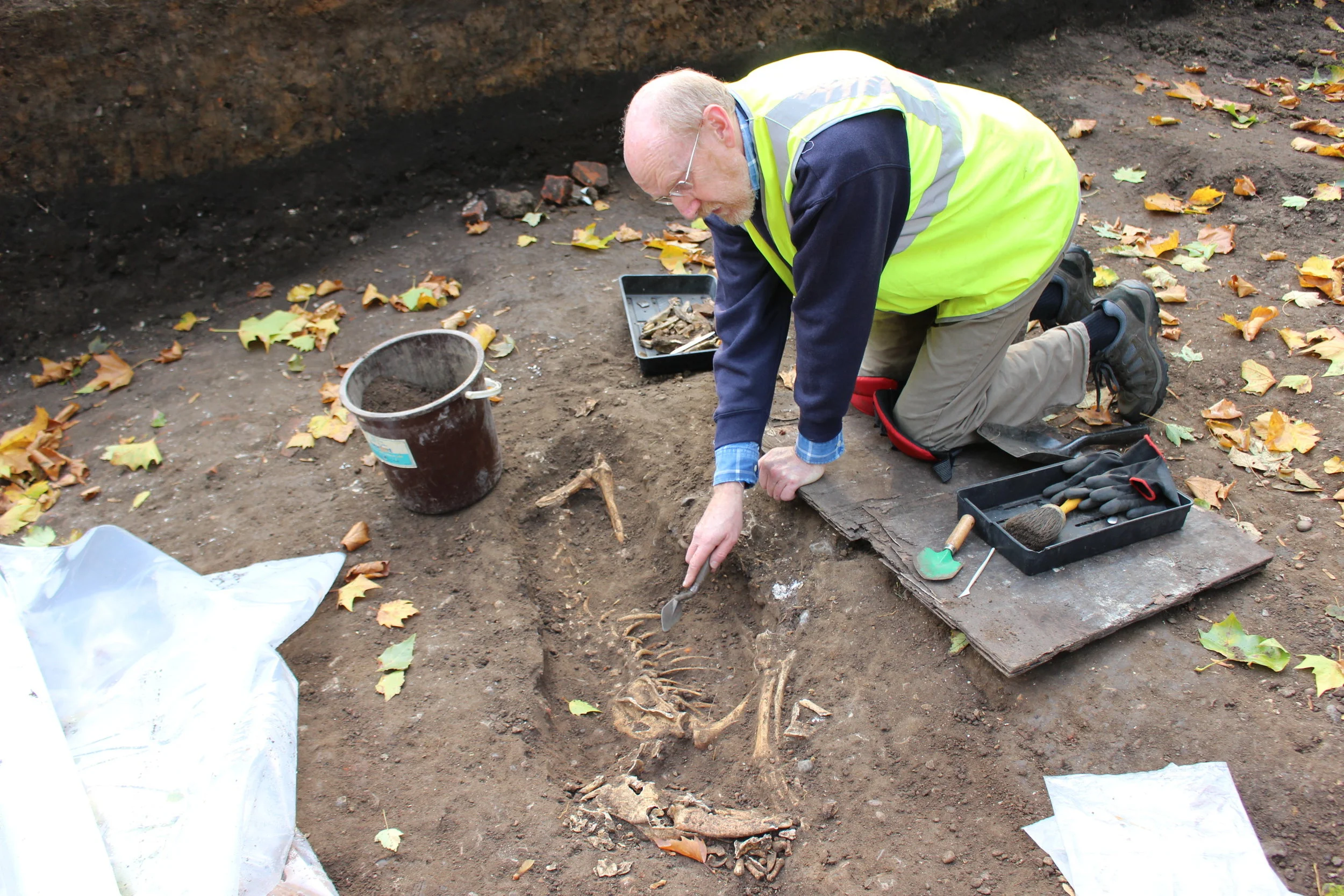
I wonder about that dog. One of our more experienced volunteers devoted much time to painstaking exposure of the bones, removing all the surface dirt so that they stood out against the dark soil like an X-ray in reverse. It was placed to rest with care, laid out as if sleeping, not wantonly flung into the ground to land any old how and be roughly covered up. It meant something to someone. A big dog, with a large rib cage. Something like a greyhound? A hunting dog? Or just a companion? Perhaps a bit of both, loping along beside its owner on horseback, and accelerating away on glimpsing a rabbit or a squirrel. Maybe a guard dog into the bargain, sleeping outside or in the hall and barking as strangers approached.
There are stories to be spun from all our finds.
Simon Butt, Archaeology Volunteer
Please send your ideas for Object / Specimen of the Month blogs to rachel.bagnall-bray@fulhampalace.org. If you would like some help, let us know.