
Every month we are going to feature two blogs written by volunteers, one will describe an object in the Palace and one a plant from the Garden. It is great way for us all to learn more about the Palace, if you would like to contribute there is no set format so send us your ideas!
My favourite historic object (or, at least, one that provoked research and a question)
I have no picture of the beautifully-carved wooden panel on the chimneypiece in what was the Porter’s Room to the left of the main entrance gate to the Tudor Quadrangle. When a number of us explored “The Fireplaces of Fulham Palace” with Curator, Miranda Poliakoff, in January 2015 we were given privileged access to this room, currently occupied by one of the commercial tenants. The next phase of restoration will open to the public, and re-imagine, this and other historic rooms around the north side of the Tudor Quadrangle.
The decorative chimneypiece I saw, displayed the coat of arms of Bishop John Robinson (1650-1723) Bishop of London from 1713 to 1723. Museum Volunteers know that he was the successor of our ‘Gardening Bishop’, Henry Compton. On his arrival at Fulham, Bishop Robinson had found the Palace “old and ruinous ... and too large”. He was not interested in botany, and, sadly, allowed much of Compton’s renowned collection to be broken up. But what is Bishop Robinson’s claim to fame?
Before he was appointed Bishop of London, he was a Diplomat for nearly 30 years, and Chaplain to the British Embassy in Stockholm. He negotiated, and signed, the 1713 Treaty of Utrecht, which ended the War of Spanish Succession.
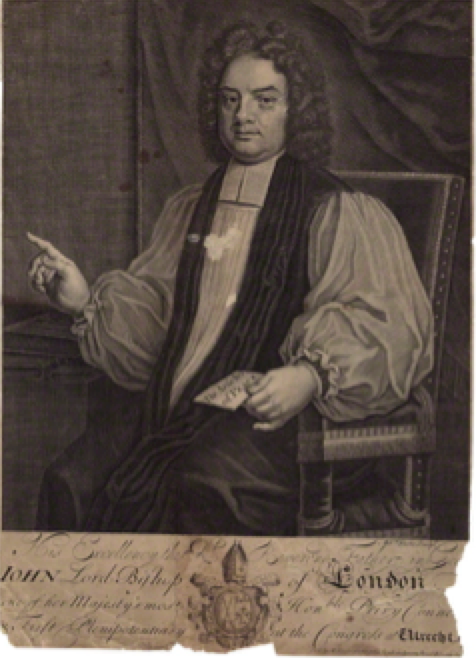
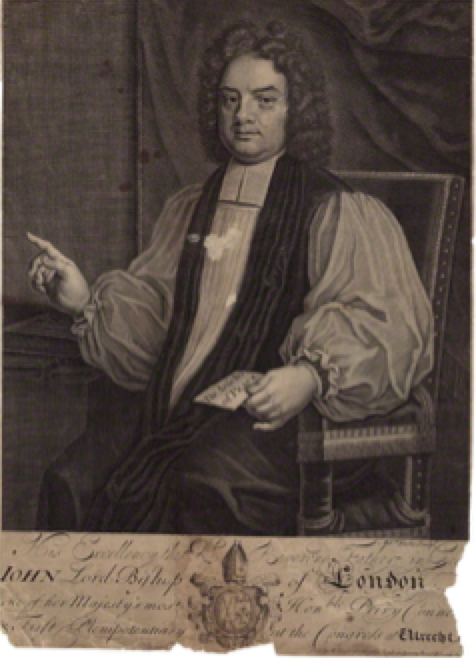
In this engraving, he is portrayed holding the Articles of the Peace. Under the Treaty, Britain secured the monopoly (asciento) to transport slaves to the Spanish West Indies, beside which the concurrent acquisitions of Gibraltar (in the news again now) and Menorca seemed modest.
Thinking about the Treaty of Utrecht, perceived as a victory for British diplomacy, reminds me that during the previous century, a near neighbour of the Bishop of London in Fulham - Sir Nicholas Crisp (c. 1599-1666) – made his fortune by trading slaves from Guinea in West Africa. Crisp built a fine house near the River Thames at Hammersmith, and rare glass beads have been found at his Hammersmith Embankment site. They would have been manufactured there to be used in the slave trade, and are now on display in the ‘London, Sugar & Slavery’ Gallery of the Museum of London Docklands.
Early in the following century, Bishop Beilby Porteus (1737-1809), Bishop of London from 1787 until his death in 1809 at Fulham Palace, was a staunch campaigner in the House of Lords for the abolition of the transatlantic slave trade, achieved in 1807 two years before his death. However, Bishop Porteus was quick to dissociate himself from proposals to abolish the institution of slavery altogether.
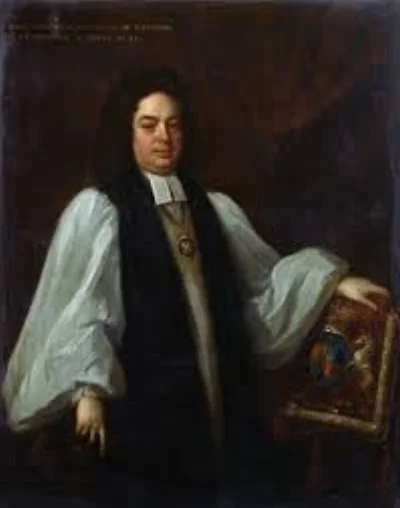
Reverting to Bishop Robinson, I saw this portrait by Michael Dahl (1659-1743) when visiting Charterhouse with the Friends of Fulham Palace. From 1713, Bishop Robinson had been a Charterhouse Governor.
Finally, there is, or was – according to an early edition of the Dictionary of National Biography – “an anonymous portrait of Bishop Robinson, painted while he was in Sweden, preserved at Fulham Palace”. It was included in the Catalogue of National Portraits exhibited at South Kensington in 1867, and I think that this may be am image of it:
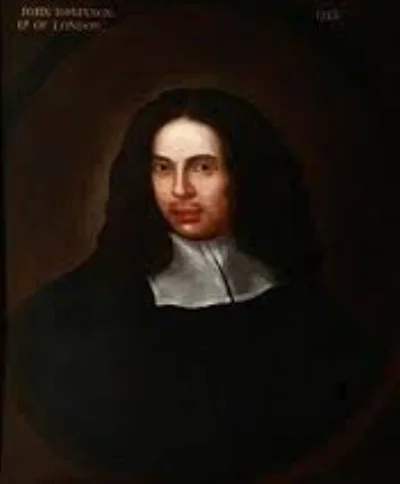
Does anyone know the current whereabouts of this rather fine, though anonymous, portrait?
Jane Bowden-Dan
Volunteer Museum Steward and Historical Tour Guide
Please send your ideas for blogs to commsvolunteer@fulhampalace.org If you would like some help, let us know.