
Today is the centenary of the Battle of the Somme. On 1st July 1916 the British army suffered its greatest loss in a single day, taking nearly 60,000 casualties.
Before the battle closed on the 18th November 1916 more than a million soldiers had been killed, making it probably the bloodiest battle in human history. There was hardly a family in Britain or the Commonwealth that escaped losing someone. Many families connected with the Palace lost loved ones. Casualties included William Burley, the son of the incumbent Bishop’s chauffeur. His name can be found inscribed on a war memorial in Fulham Library.
As we commemorate this sad day in British and World history, I thought it fitting to consider Fulham and the Bishop of London's Palace's role in the war effort.
During the First World War, then Bishop Winnington-Ingram became a chaplain to the London Rifle Brigade. He was called “the most successful recruiting officer in the country.” He spent two weeks at the Western Front in 1915, staying with Field Marshal French, addressing troops at Ypres, and visiting the London Rifle Brigade. He went out with his car, which the troops nicknamed ‘Fulham Palace’.
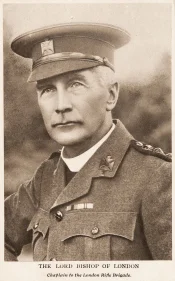
Bishop Winnington-Ingram
Several clergymen who were to become Bishops of London served in the war as army chaplains, including Henry Montgomery-Campbell, who was awarded the Military Cross for bravery at Gallipoli.
On the home front, the Bishop’s Meadow became an army training ground. These then became allotments in 1916, to feed the people of Fulham. This reduced the Palace gardens from 36 acres to 13. Part of the allotments remain today.
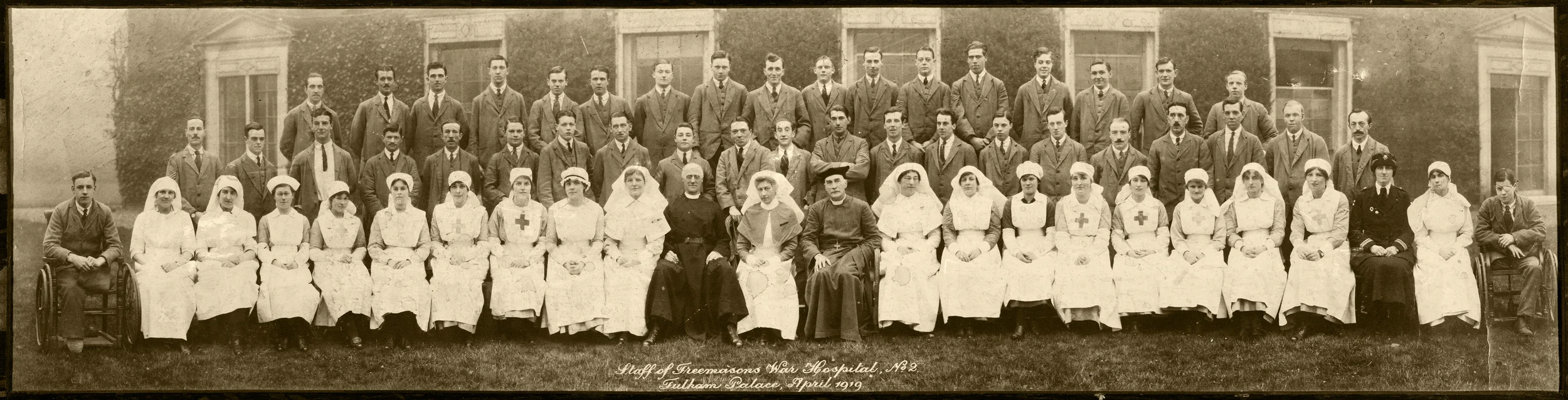
The Palace itself became a hospital in 1917, run by the Red Cross.

From an autograph album, which belonged to Sister Mary Latchmore, one of the nurses at the hospital. It includes photographs of the patients, the nurses and some of the Palace rooms when in use as a hospital.
It became a refuge for over a hundred shell shocked soldiers.

From an autograph album, which belonged to Sister Mary Latchmore, one of the nurses at the hospital. It includes photographs of the patients, the nurses and some of the Palace rooms when in use as a hospital.
The Porteus Library and Drawing Room became wards and the more mobile patients assisted in the garden. It closed in 1919.
The Borough of Fulham also played its role in the war effort. The Fulham Potteries made rum jars that were sent to the front. These would have been a common site in the trenches. Men were given a tot of rum after 'stand-to' and often before 'going over the top'. 3,000 Belgian refugees made the Empress Hall, Earls Court their home for the duration. Nearby Shepherd's Bush Market was set up by returning soldiers.
Fulham Workhouse became a military hospital and treated over a thousand men seriously injured during the Battle of the Somme.
One of the greatest civilian tragedies of the war occurred at Blake's Munitions factory, Wood Lane, when an explosion led to the deaths of thirteen men and women. A memorial cross bearing their names can be found at Margravine Cemetery.
Let us take a moment today to consider their sacrifice.