
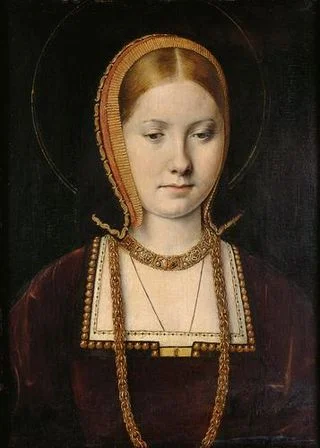
Walking into Fulham Palace through its front entry-way, its connection to England’s Tudor history is unmistakable. Construction began on the buildings around the courtyard, now ornamented by a gently burbling fountain, during the reign of Henry VII, father of England’s most (in)famous king, Henry VIII. There is an important historical link to the House of Tudor itself; before becoming the first of Henry VIII’s six wives, Katherine of Aragon resided briefly at Fulham Palace.
Unfortunately, Katherine’s time at Fulham Palace was characterized by ill-health and unhappiness. The daughter of Spanish monarchs Queen Isabella I of Castile and King Ferdinand II of Aragon, the teenaged Infanta had journeyed to England to wed Henry VII’s eldest son and heir Arthur, Prince of Wales. However, just months after the nuptials, both contracted a mysterious illness; Katherine recovered, and Arthur died. Though she’d ultimately marry Arthur’s brother Henry, 7 years elapsed before the former sister and brother in-laws wed. It was during these years of uncertainty and transition that Katherine was housed at Fulham Palace.
In 1504, Katherine was again suffering poor health. Fearing she might succumb to her sickness, she was granted total access to the Palace as a place of convalescence. Following Katherine’s recuperation, she resided either at Fulham or Henry VII’s court until, a year later, she established her household at Durham House. Katherine’s last sojourn to Fulham Palace was probably in late 1506. Henry VII’s policy towards the marriage between Arthur’s widow and his surviving son was inconsistent; initially keen, he later considered other alliances for Henry and, was also actively seeking a bride for himself. Consequently, he was troubled when the couple started to become increasingly close. To subdue the burgeoning romance, he sent Katherine back to her Fulham in 1506. Despite these fears, the separation was brief, and she quickly returned to court. Katherine and the newly crowned Henry VIII finally married on 11 June 1509, less than two months after his father’s death.